

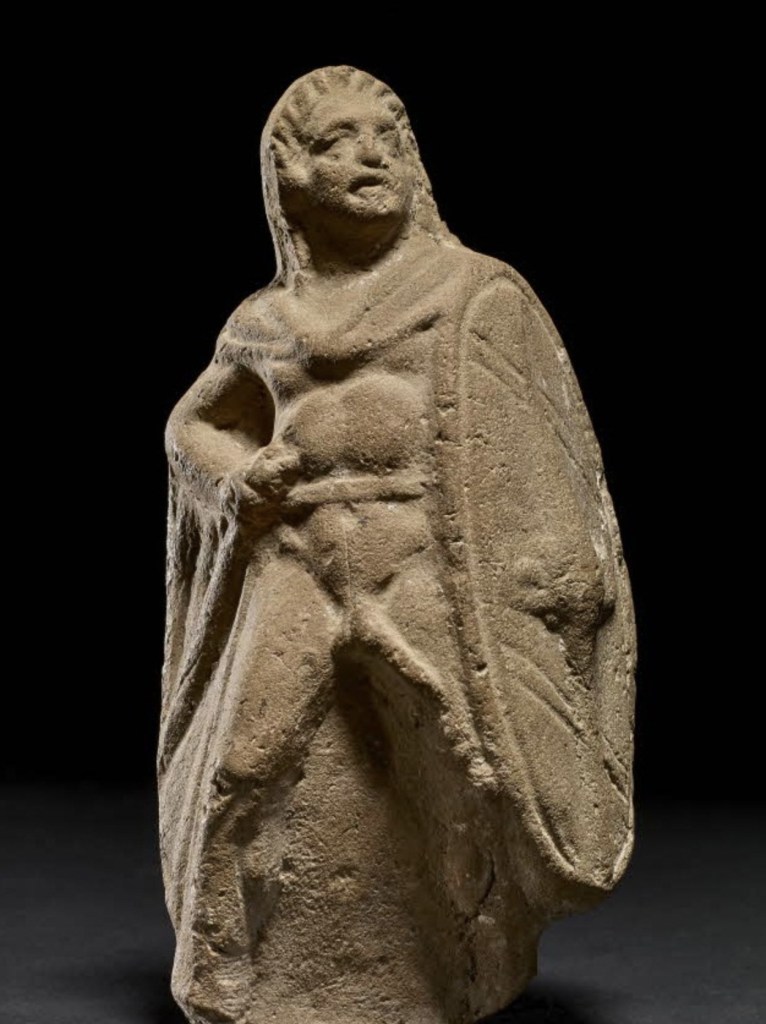
After the Galatians settled in Asia Minor, Northern Phrygia became a popular recruitment area for various competing Hellenistic monarchs. These Celts were known and respected for their military prowess. At the same time, the various kings of the ancient world occasionally waged war against them. These victories were then used in the royal propaganda to portray the monarch as a defender of civilization and liberty against these “barbarians.” This perceived liberating role was often celebrated with the title “Soter” (“Savior”). The ambiguous love-hate relationship with the Galatians is clearly demonstrated in Ptolemaic Egypt, particularly during the reign of Ptolemy II.
Ptolemy II Philadelphos recruited some 4,000 Celtic warriors sometime during the 270s BCE. At the time, Ptolemy II was engaged in a conflict with his rebellious stepbrother, Magas, in Cyrenaica to the west. Magas, who became part of the Ptolemaic dynasty through his mother’s marriage to Ptolemy I, had established a kingdom centered around the wealthy Greek colony of Cyrene in modern-day Libya. While Ptolemy headed west to address this threat, the Celtic mercenaries rebelled around 274 BCE.
According to Pausanias (1.7.2), the Celts sought to seize control of Egypt while Ptolemy II was preoccupied in the west. However, Ellis Berresford rightly notes that this claim is likely a gross exaggeration; a force of just 4,000 warriors would hardly have entertained such an ambitious plan. Instead, the Celts probably aimed to exploit the king’s absence by plundering Egypt’s numerous wealthy temples and towns before fleeing the country.
Ptolemy II, however, reacted swiftly and drove the rebels to an island near Sebennytos, where, according to Pausanias, they were starved into submission.
This victory was a minor event but quickly became a key element in Ptolemaic propaganda. The members of the Ptolemaic court, as well as the king himself, likely recognized the propaganda value of this triumph. As rival kings legitimized their rule through victories over Celtic tribes, Ptolemy seized the opportunity to join the ranks of these esteemed “liberator” kings.
Coins were issued featuring Galatian shields to commemorate this victory. Additionally, Ptolemy II was famously celebrated as a second Apollo in Kallimachos’ Hymn to Delos. In this work, the Hellenistic court poet recalls Ptolemy II’s victory over the Celts in the following manner:
“Yes, and some day afterward a general conflict will come upon us, when the later-born Titans, raising up against the Greeks a barbarian sword and Celtic war, from the farthest west rushing like snow or equal in number to the heavenly bodies when they flock most thickly in the sky.” (transl. Dee Clayman)
Interestingly, Kallimachos describes the Celts as new Titans. The Titans were the older generation of gods who ruled the universe until they were overthrown by the Olympian gods under Zeus’ command. If the Celts are the Titans, then the Ptolemaic king and his army are likened to the Olympian gods. This comparison between the Celts and villains from mythical history is not unique to Kallimachos’ poem. Similarly, in Attalid propaganda, parallels are drawn between their war against the Celts and the legendary Gigantomachy, the mythical victory of the Olympian gods over the Giants.
What is the purpose of this victory? It elevates the conflict with the Celts to an entirely new level. Just as the Titanomachy and Gigantomachy were remembered as triumphs of order, justice, and liberty, the subjugation of the Celts is meant to be celebrated as a victory over barbarism and chaos.
This reimagining of the wars against the Celts proved to be a powerful tool for legitimizing the Hellenistic monarchies in the eyes of the Greeks. The Greeks were naturally inclined to view kingship as an illegitimate and un-Greek form of government. Consequently, the kings employed these powerful mythological narratives to portray themselves as essential to the world order and worthy of rule, despite the autocratic nature of their governance. Moreover, if Zeus, a king, was accepted by the Greeks as the ruler of the cosmos, then why should the Hellenistic monarchs not be accepted as legitimate rulers?
In short, Ptolemy’s victory over the Celts, despite its limited scale, provided him with a triumph he could frame as a victory of order over chaos. This sent a powerful message throughout the Hellenic world: he was a god performing godlike deeds. Furthermore, as the Olympian gods were accepted by the Greeks as kings, why shouldn’t the Ptolemaic monarchy be afforded the same respect?
It is hard not to detect the hubris in this Ptolemaic mindset. They were mortals striving to be gods—or so it might seem. To the Ptolemies, there was no such contradiction: they were not merely mortals aspiring to divinity; they were gods. Through the dynastic cult and other forms of propaganda, they blurred the line between the divine realm and the Egyptian monarchy. Narratives emphasizing the kings’ similarities to the gods were widespread throughout the kingdom. For instance, the Ptolemies’ practice of sibling marriage mirrored the relationship between Zeus and Hera, who were also siblings. The story of the Celts aligns seamlessly with this broader propaganda effort, making its use entirely logical.
Olivier Goossens
 alongthesilkroad.com
Leave a comment