

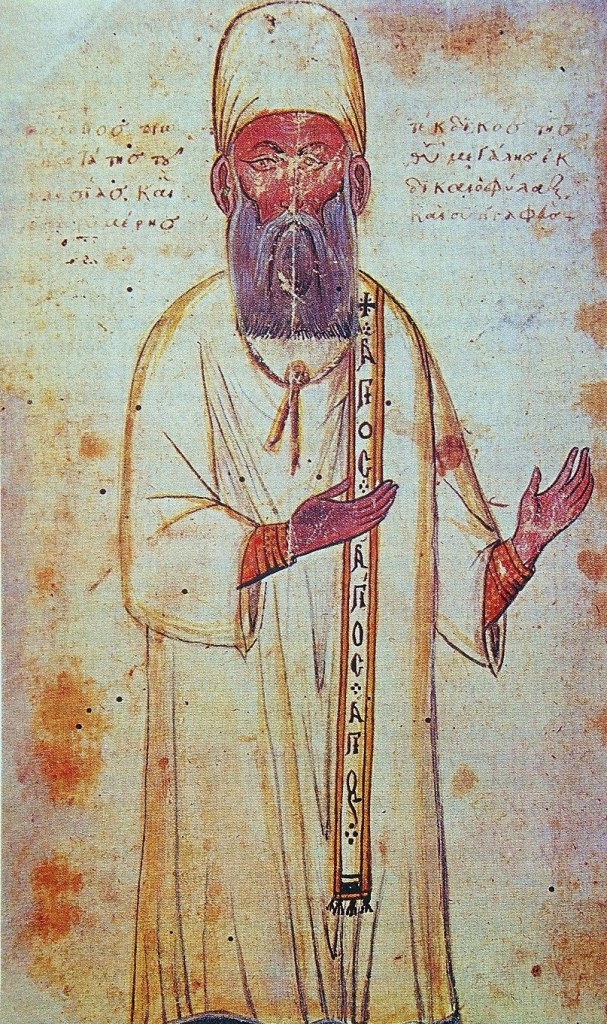
Georgios Pachymeres’ father was part of the large group of Byzantines who fled the capital of the Eastern Roman Empire, Constantinople, after the Latin conquest of 1204 during the Fourth Crusade. He sought refuge with the Laskarid dynasty in Nicaea, one of the Byzantine successor states, where Georgios is believed to have been born around 1242. Here, the Laskarid dynasty prospered, ensuring a pleasant childhood for Georgios. In his historiographical work, nostalgia for this period often resonates in the form of criticism directed at emperor Michael VIII (r. 1261-1282), who neglected the situation in Asia Minor.
Georgios had a wealthy father who could afford to provide his son with a solid and broad education. When Michael VIII recaptured Constantinople in 1261, Pachymeres followed the new emperor to the ancient capital of Byzantium. There, he continued his higher studies, although the details remain unclear. It is generally assumed that his teachers were Georgios of Cyprus and Georgios Akropolites (1217–1282). Akropolites was a gifted writer and diplomat who became a central figure in the revival of higher education in Constantinople. Pachymeres undoubtedly had much to learn from him. Akropolites was a specialist in rhetoric, the quadrivium, and philosophy—fields in which Pachymeres would later excel.
Pachymeres demonstrated an exceptionally strong knowledge of both religious and secular law, which increased his chances of securing a lucrative position within the patriarchate or the court. Indeed, he quickly found his way into imperial circles and joined the ranks of the Constantinopolitan clergy.
His ecclesiastical career began in 1265 when he was ordained as a deacon of the Hagia Sophia, the center of Orthodox faith. His intellectual abilities were clearly appreciated, as evidenced by his appointment in 1277 as didaskalos tou apostolou, a position in which he was responsible for providing commentaries on the letters of the Bible and the Acts of the Apostles. In 1285, he was appointed hieromnemon, a role that made him responsible for various ecclesiastical matters, including priestly ordinations. One of the highlights of his career was his appointment as protekdikos in the same year, an influential role within the ecclesiastical court. Additionally, he utilized his knowledge of secular law to attain the position of dikaiophylax, an imperial judge. These high-ranking positions brought him into contact with several prominent figures, including members of the imperial family, Ioannes Bekkos, Athanasios II of Alexandria, and Theodosios Prinkips.
In addition to these responsibilities, Georgios also demonstrated a remarkable talent for the liberal arts. During this time, higher education and the academic world experienced a flourishing period in the newly reconquered capital, thanks in part to the efforts of the aforementioned Akropolites. The “dark” 13th century gave way to the so-called Palaiologan Renaissance, a revival of the Greek intellectual world and the arts. A significant milestone was the reopening of the Patriarchal Academy which was closed after the Latin conquest.
In other words, Constantinople offered ample opportunities for intellectuals with pedagogical talent. That Pachymeres excelled in teaching challenging subjects is evident from his literary work, which will be discussed in part 2. He earned his living as an instructor at the renowned Patriarchal Academy. More specifically, he held the position of oikonomikos didaskalos until 1275. In this role, he earned the respect of his colleagues and students. His significant contribution to the Palaiologan Renaissance cannot be overstated.
As a professor, he taught philosophy and the quadrivium. It is possible that he also taught rhetoric, although this is not certain. The quadrivium comprised the second and final series of the septem artes liberales: geometry, music, astronomy, and arithmetic. It is often assumed that his work, the Quadrivium (see part 2), served as support for his lessons. In any case, he had a significant influence on the later study of these subjects.
During his philosophy lessons, he covered the two major traditions of antiquity: Plato and the (Neo-)Platonic tradition on one hand, and Aristotle on the other. His autograph manuscripts reveal a particular interest in relatively rare commentaries on Plato and Neo-Platonic scholars. For his courses on Aristotle, he wrote an extensive summary of Aristotle’s works in 12 books, the Philosophia (see part 2). He held immense admiration for Aristotle.
According to Pachymeres, Aristotle’s genius lay in his apparent anticipation of many Christian doctrines. Specialist Pantelis Golitsis situates this idea within the context of the polemic over the question of how best to reach God.
The monastic movement, which gathered around Patriarch Athanasios (r. 1289-1293; 1303-1309), believed that a monastic lifestyle was the only correct way to draw closer to God. These fundamentalists sought to impose this idea on the rest of the clergy. This movement, better known as Hesychasm, partly originated in the theology of the famous Gregorios Palamas. They stubbornly opposed any philosophical rationalism in the approach to God.
Pachymeres, on the other hand, believed in an alternative path to a divine experience: through philosophy. Understanding God’s creation was also a legitimate form of devotion. In this way, he sought to give the ancient philosophy, which he cherished, a more accepted place within Byzantine society.
According to Arnakis, this attitude of Pachymeres is more understandable in the context of the new proto-nationalist trend among the Byzantines, where they no longer considered themselves solely as Romans, but also as Hellēnes, without the term necessarily carrying a pejorative or pagan connotation. The intellectual elite of Constantinople was well aware of the significant contributions of their fellow speakers to world history and was proud of this. Pachymeres’ love for and teaching of Aristotle and Platonism, therefore, according to Arnakis, can be seen as part of this development.
Judging from what has been said, it might be tempting for the sensationalist to unmask Pachymeres, like Plethon, as a pagan in Christian garb. However, this is unlikely. Nowhere in his works do we detect anti-Christian ideas. One of his poems (at the end of his commentary on Aristotle’s Fysika) attests to his unwavering devotion to Christ and God. Likewise, in his Quadrivium, he claims that the salvation of mankind depends on God’s grace. In his work, we also find other traditional Christian beliefs, such as the salvation found in the sacraments and the inherent weakness of humanity. Interestingly, he often supports the latter claim with references to ancient, pagan authors. This leads us to the next issue: to what extent are these professions of faith sincere? This question may give rise to endless discussions, but a final judgment is beyond the realm of possibility. In any case, Pachymeres sought to present himself as a traditional, orthodox Greek.
Yet, there is something innovative about Pachymeres. His attitude is reminiscent of that of the Italian humanists. By encouraging philosophy, he assigns a greater responsibility to humanity in creation. The idea that the Byzantines were the forerunners of the European Renaissance is a stance defended by many Byzantinists. Indeed, a certain Christian anthropocentrism characterizes Pachymeres, which, although it ends with God, begins with humanity.
We know a lot about his public life thanks to the various autobiographical elements in his works. However, he remains silent about his personal life. It is generally believed that Pachymeres died in the year 1310 at the age of 65. The cause of death remains a mystery. His friend Manuel Philès wrote an epitaph for him, although the date of this remains uncertain. A portrait of Pachymeres has been preserved, but the reliability of its depiction is also questionable.
Olivier Goossens
 alongthesilkroad.com
Leave a comment