


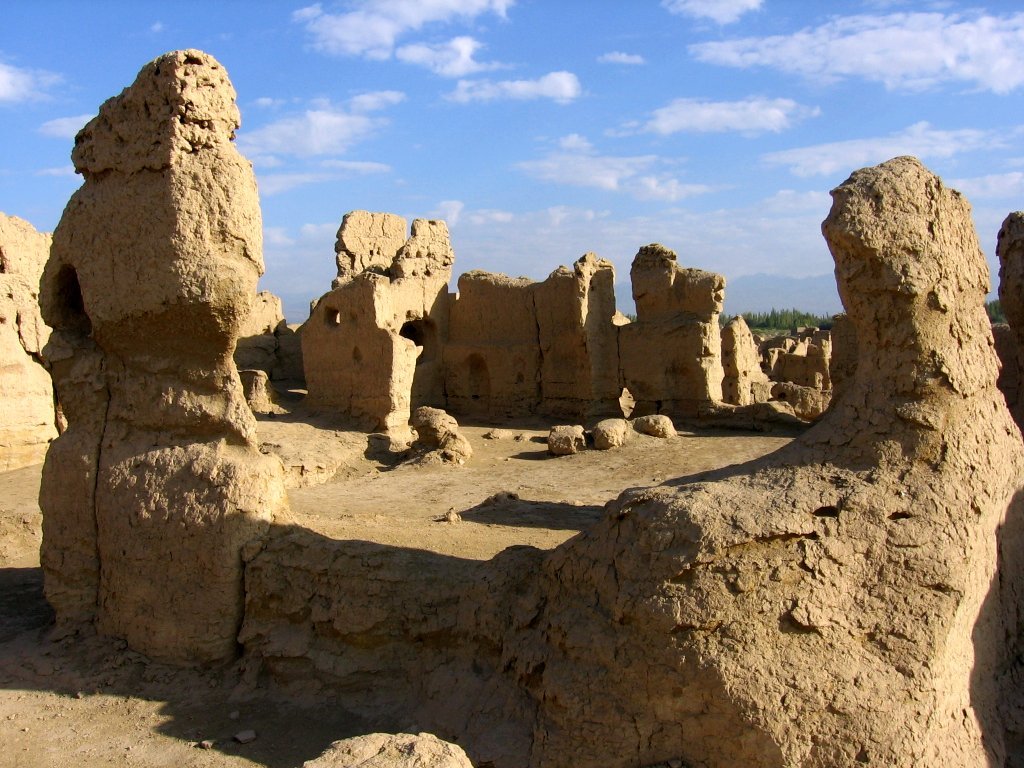
Across the vast territories through which the Silk Road ran lies the great Taklamakan Desert, in the west of China, in the Xinjiang Uyghur Autonomous Region. According to folk etymology, the name Taklamakan means “the place one enters but cannot leave” in Turkish. Indeed, the Silk Road did not pass through the heart of this desolate region but split into two branches that circumvented it to the north and south. Along the southern route, oases flourished into prosperous cities and even city-states, enriched by the commerce of merchants from distant lands. Many of these states became multicultural and multilingual centres, engaging in cultural and economic exchange with empires to the east (Tang China), west (the Persian world), and south (India).
After reaching their zenith in the (early) Middle Ages, these city-states eventually declined under the pressure of nomadic invasions and imperial ambitions. The desert sands swallowed almost all trace of their once-great cultural achievements. In 1903, an expedition of Prussian scholars (the first of four such expeditions) investigated the ruins of the important caravan city of Turfan. The results of this expedition were nothing short of spectacular: the explorers unearthed a trove of manuscripts (most of them fragmentary) in more than 20 languages including Sogdian, Sanskrit, Old Turkish, and Syriac. Among the finds were also thousands of fragments written in an unknown language using a variant of the Indic Brahmi script.
A few years later, on 1908, the two German philologists Emil Sieg and Wilhelm Siegling had deciphered the language and proposed that this was in fact an Indo-European idiom distantly related to Sanskrit, Latin, Greek, and English. They referred to this language as Tocharian, based on a colophon to the Old Uyghur translation of the Tocharian Maitreyasamitinataka, in which the original language was referred to as the speech of the “twγry.” The name also recalled the “Tocharians” (Τόχαροι) mentioned in ancient Greek sources. However, these classical Tocharians should actually be identified with the Bactrians of modern-day Afghanistan, who spoke an Iranian language also well represented in the Turfan manuscript corpus. The name “Tocharian,” therefore, is something of a misnomer, but it stuck.
Texts have been found in two distinct varieties of the language, which scholars have labelled Tocharian A and Tocharian B. Tocharian A was likely spoken in the city of Agni (hence also called Agnean or East Tocharian in older scholarly literature). Its highly formalized appearance suggests it was already a dead, purely literary language by the time it was written. By contrast, most surviving texts are in Tocharian B (or Kuchean, from the city of Kucha; in older scholarly literature also known as West Tocharian), which was a living language when the documents were composed. Tocharian B texts show a significant degree of internal variation and encompass a wide range of genres, from literature and religious texts to recipes and administrative records.
This discovery stunned the linguistic world. No one had anticipated the existence of an Indo-European language so far east. Moreover, Tocharian’s grammatical structures defied expectations, diverging markedly from the reconstructed Proto-Indo-European verbal system. Because of its unique features, the Tocharian branch is thought to have split from the Indo-European family tree at a very early stage, possibly soon after the archaic Anatolian branch. Centuries of contact with neighbouring civilizations drastically altered the appearance of the Tocharian languages, to the point where their Indo-European origin is evident mainly in their core vocabulary. For example, Tocharian A pācar means “father,” mācar“mother,” and pracar “brother.” Both dialects absorbed many loanwords, especially from Iranian languages, Sanskrit and Middle Indic dialects (often in a Buddhist context), as well as from Old Uyghur and Middle Chinese. Intriguingly, Tocharian B even influenced Mandarin Chinese lexically: the Tocharian B word mit (“honey”, from Proto-Indo-European medhu, whence also English mead) was borrowed into Chinese and survives in modern Mandarin as mì (蜜), more precisely fēngmì (蜂蜜), “bee honey.”
A significant portion of the Tocharian corpus consists of translations from Sanskrit Buddhist literature. Buddhism spread in the region during the first centuries CE, and the Tocharians seem to have embraced the new religion enthusiastically (we only have scant traces of their previous religion). A popular genre among these Buddhist texts is the Jataka, or “birth tale,” which recount the past lives of the Buddha. One such tale is the Punyavantajataka, also known as “The Tale of the Five Princes.” The Tocharian version is a paraphrase of the Sanskrit original, but it diverges significantly and introduces unique features.
An especially intriguing episode is that of “The Tale of the Mechanical Girl” (Tocharian A: yantärṣi śomiṃ), a blend of prose and verse containing reflections that may strike today’s readers as surprisingly modern. This episode is not found in the Sanskrit version but survives in Tibetan and Chinese translations. The Tocharian A edition stands as an original composition that also reflects the multicultural setting in which it was written.
The story begins with an anonymous painter visiting a friend who is a skilled mechanic. The mechanic graciously hosts his guest and sends in one of his inventions, a female automaton crafted from wood and cloth, to serve him. The painter falls in love with the artificial maiden, but just as he moves to kiss her, the device malfunctions and collapses into a pile of lifeless wood and rags. Humiliated and disillusioned by mere appearance, the painter begins to question the nature of reality. As a form of revenge, he starts painting an image of himself hanging dead from a hook on the wall of his room, then quietly leaves. The next morning, the mechanic finds the painting and, mistaking it for reality, calls the townspeople. Everyone believes the image to be real. Just as the mechanic reaches to cut the “body” down, the real painter appears and reveals the trick to the astonished crowd.
This tale resonates with themes well known from classical literature, e.g. the myth of Pygmalion as told by the Roman poet Ovid. Although the tale appears in Buddhist literature across various traditions, its origins may predate its inclusion in the canon. As opposed to the Tibetan and Chinese versions, the Tocharian edition notably omits any comparison between the two protagonists and the Buddha’s disciples Sariputta and Mogallana.
As such, this timeless piece of literature, preserved in the sands of the Taklamakan and composed in a language whose roots stretch thousands of miles to the west, offers an almost post-modern reflection on the nature of reality.
Dr. Maxime Maleux
Bibliography:
- Adams, D., Dictionary of Tocharian B: Revised and Greatly Enlarged, 2013, Rodopi.
- Beguš, N., “A Tocharian tale from the Silk Road: A philological account of The Painter and the Mechanical Maiden and its resonances with the Western canon”, Journal of the Royal Asiatic Society, Vol. 30, 2020, pp. 681-706.
- Carling, G., Pinault, G. & Winter, W., Dictionary and thesaurus of Tocharian A, 2023, Leipzig.
- Krause, W. & Thomas, W., Tocharisches Elementarbuch, 1960, Heidelberg.
- Lane, G., “The Tocharian Puṇyavantajātaka: Text and Translation”, Journal of the American Oriental Society, Vol. 67, 1947, pp. 33-53.
- Weiss, M., Kuśiññe kantwo: elementary lessons in Tocharian B: with exercises, vocabulary, and notes on historical grammar, 2022, Ann Arbor.
 alongthesilkroad.com
Leave a comment