
*In this article, I decided to put the word ‘dialect’ in inverted commas because there is no consensus among linguists on the distinction between language and dialect.
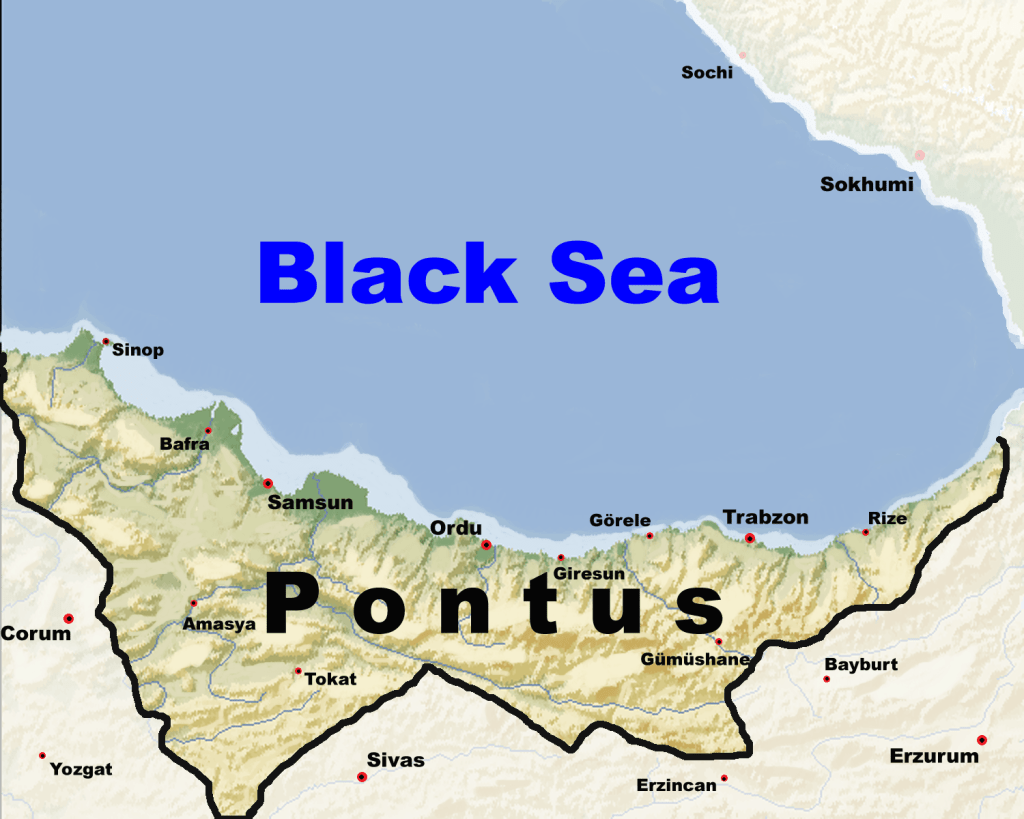
In north-eastern Turkey, in the coastal region known to the Greeks as Pontos (literally ‘sea’, cf. the adjacent Black Sea), the inhabitants of several villages, of mainly Turkish and Muslim identity, communicate by means of a Greek ‘dialect’: Romeyka (or Romayka). This article explores the sociolinguistic history of this Greek ‘dialect’ and how it differs from the rest of the Greek language.
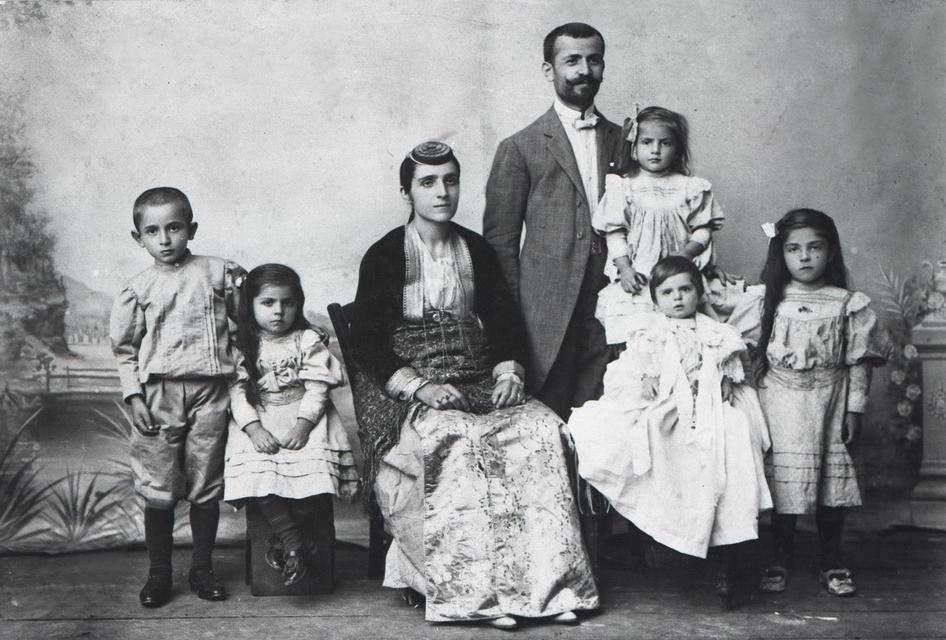
Before 1923 – when the infamous ‘Exchange of Populations’ between Greece and Turkey took place (after the Greco-Turkish War of 1919–1922) – a larger, high-profile Greek community used to live in the area, known as Pontic Greeks (or simply Pontians), speaking Pontic Greek dialects. However, the locals of a few rather isolated villages near Of, in the Trabzon region (eastern Pontus), still speak a form of Greek similar to the Pontic Greek dialects once spoken there. The speakers of this intriguing ‘dialect’ partially descend from Greeks who converted to Islam over 300 years ago. As a result, they developed a Turkish, non-Greek identity, and were thus safeguarded from a forced displacement to Greece.
Christian Orthodox (thus, Greek-identified) Pontians always felt culturally connected with Greece. They even had Greek schools, from kindergarten to secondary level, where Standard (Modern) Greek was taught prescriptively. The Pontian Greek children learned the same literary and linguistic models – nationalistic, with a strong focus on classical studies, Ancient Greek grammar and Orthodox texts – as the children on the Greek mainland. Since they learnt at school a language (Standard Greek) far removed from the vernacular (Pontic dialect), Pontian Greeks arriving in Greece “found it completely bizarre, indeed abnormal, that a language that people knew already, could be taught at school” (Drettas 1998: 82 in Bortone 2009: 68).
Muslim Pontians, on the other hand, have never identified themselves as Greeks. Isolated in the eastern corner of Pontus, they have never seen (Modern or classical) Greek literature, have never heard Biblical Greek and have never learnt any Standard Greek. In other words, they have never been in contact with any form of the Greek language other than their own. Moreover, their ‘dialect’ has never been written, printed or broadcast. In contrast to the strict Greek policies of language standardization, archaization and purism, Romeyka has no recorded local tradition and is therefore not formally taught anywhere; it has no standard variety and, consequently, no prescriptive rules (Bortone 2009: 69). Remarkably, many Muslim Pontic Greek speakers do not even realise their language has anything to do with Greek. On top of that, it isn’t evident for Muslim Pontians – who are basically Turks – to accept the fact that their mother tongue is Greek, the language of an enemy of the former Ottoman Empire (Bilici 2011: 8; see also Sitaridou 2023: 138).

While linguistic correctness and purity has never been a concern for the Muslim Pontic speech community, the Christian Pontians – Greek-identified and Greek-educated – did show interest in the Greek ‘dialect’ of their Muslim neighbours. In several unpublished, handwritten interviews with Pontian Greek refugees, who moved from the Of area to Greece in the 1920s, many stated that Muslim Pontic Greek (Romeyka) was ‘better’ than their Greek ‘dialect’, saying that there were “Turkish villages that spoke Greek better than we did” (τουρκικὰ χωριὰ ποὺ μιλούσανε ἑλληνικὰ καλύτερα ἀπό μας) (Archives of the Centre for Asia Minor Studies, Athens: interview catalogued as PO129, 29 in Bortone 2009: 70).
Furthermore, Greek-educated Pontians not only regarded Muslim Pontic as the ‘best Greek’, but they also compared it to Ancient Greek:
“They used to speak Greek like the ancient Greeks. We would barely understand them … they preserved our local language better because they were not coming into contact much with Greeks from other areas of Pontus” (Αὐτοὶ μιλούσανε τὰ ἑλληνικὰ ὅπως οἱ ἀρχαίοι Ἕλληνες. Ἐμεῖς καλὰ καλὰ δέν τοὺς καταλαβαίναμε … ἐπειδὴ αὐτοὶ δὲν ἐρχόταν τόσο σὲ ἐπαφὴ μὲ Ἕλληνες ἄλλων περιφερειῶν τοῦ Πόντου, κράτησαν τὴν τοπική μας γλῶσσα καλύτερα.) (PO129, 30, 33 in Bortone 2009: 83).
Indeed, Romeyka has remained, to some extent, more archaic than ‘Christian’ Pontic, and far more archaic than Modern Greek. By remaining isolated from other Greek ‘dialects’ – and thus, the centuries-long Greek tradition of making the Greek language more archaic – Romeyka has ironically maintained its authenticity and archaic nature. Georges Drettas, a scholar of Pontic Greek, even calls Muslim Pontic a “model of archaic purity” that Greece has lost (Drettas 1998: 87 in Bortone 2009: 83). Romeyka in fact has some archaic features lost in any other ‘dialect’ of Greek.
Among the archaic features present in Romeyka, some are indeed reminiscent of Ancient Greek. I have listed below the – in my opinion – most remarkable ones (Bortone 2009: 83-85):
- Pronunciation
- Where Greek spelling has an η, the according Romeyka (but also Christian Pontic) pronunciation is the Ancient Greek è, instead of Modern Greek i.
- The pronunciation of the third-person personal pronoun αυτός is quite remarkable in Pontic Greek (both Muslim and Christian). Whereas in Modern Greek it is pronounced aftos, in Pontic it is pronounced autos, which virtually corresponds to the Ancient pronunciation. Because of their different pronunciation, Pontian refugees in Greece got the sneering nickname aoutides (αούτηδες).
- Morphology
- Just as in Ancient Greek, Romeyka has an imperative in –(s)on : akouson (‘listen!’), corresponding to Ancient imperative aorist ἄκουσον, for Modern akouse (άκουσε).
- The (vocalic) temporal augment, typical of Ancient Greek, is still used in Romeyka: ekousa (cf. Ancient Greek ἤκουσα), instead of Modern Greek akousa (άκουσα, ‘I have listened’). In Ancient Greek, an augment is an initial addition (ἐ-) to the root of a verb, indicating the past tense. When the verb starts with a vowel or diphthong, it basically contracts with the augment, resulting in a lengthening of the initial vowel/diphthong. This particular variant of the augment is called ‘temporal’.
- Instead of the Modern Greek mas (μας, ‘our’), Romeyka possesses the Ancient possessive form ἡμῶν, pronounced emon.
- Syntax
- Some varieties of Romeyka have retained the Medieval Greek future tense with νά: na tro (‘I will eat’), for Modern tha fao (θα φάω). The Modern Greek and Christian Pontic future tense particle θα is known to only a few Romeyka speakers.
- In some cases, Romeyka still uses the infinitive, whereas this verbal form has vanished in Modern Greek and any other Greek ‘dialect’. For more detailed, linguistic information about the survival of the infinitive in Romeyka, I would like to recommend Sitaridou (2014).
- Semantics
- In Romeyka, fevgo (φεύγω) still means ‘to flee’, just like in Ancient Greek, unlike Modern Greek ‘to leave’.
- Vocabulary
- Whereas Modern Greek has den (δεν) for the negation article ‘not’, some Romeyka-varieties have ou(tch), like Ancient Greek οὐ(κ).
Furthermore, Romeyka has yielded some intriguing spontaneous compounds such as (Bortone 2009: 86):
(The meaning of the asterisk * is ‘non-existent in that language’)
- pertchepago (‘to accompany’): < παίρνω + πάγω ‘take and go’
- ajinetchigos (‘unmarried [male]’): *α-γυναίκ-ιγος ‘without a wife’ (whereas the Modern Greek variant is, somewhat confusingly, αν-ύπ-ανδρος ‘not dependent on a husband’)
Nonetheless, Muslim Pontic Greek contains various Turkish elements. Living in Turkey, where Turkish is the only official language, Muslim Pontians have evidently come into contact with the Turkish language. In 1964, the Turkish Ministry of the Interior even Turkified some Pontic place names – Αληθινός (Alithinos) became Uzuntarla, Σαράχος (Sarachos) became Uzungöl, Κατωχώριν (Katochorin) became Çaykara, and Ζησινό (Zisino) became Bölümlü (Bortone 2009: 74). By 1973, 431 out of 562 (77%) Pontic towns still caried their original Greek names (Bilici 2011: 12). Family names have also been Turkified: a 1934 Turkish law imposed Turkish names and prohibited the use of ‘foreign’ names. Although a whole range of Pontic family names have officially disappeared, they are still used in everyday life (Bilici 2011: 12-13). Taught in all schools in Pontus, Turkish is the only standard language Romeyka speakers know, whereas Romeyka has no linguistic norm at all. The two languages are constantly converging and borrowings from Turkish seem to occur in all possible forms. Not only Turkish words are adopted, but also syntactic constructions and morphological patterns from both languages are blended in Romeyka. The reason why Muslim Pontians adopt Turkish so easily is not only the standard status of the language, but also their identitarian attachment to the Turks, combined with the Turkish devaluation of regional cultures, which has resulted in the gradual replacement of Romeyka by Turkish. Although they are aware of what is and isn’t considered ‘correct’ Turkish, Romeyka speakers have no concerns about linguistic registers or notions of correctness when speaking Romeyka. Pietro Bortone, a scholar of Modern Greek, claims that whenever he asked them “how one decides which Romeyka form is, in their view, right or better, they answered ‘serbest’, the Turkish for free(ly) ” (Bortone 2009: 82). As a linguist, it is important to note that Romeyka does have structure. Having fewer linguistic norms does not mean a language has fewer linguistic rules. In Romeyka, the creativity and the room to make up words, and even morphological and syntactic patterns, manifests itself, for example, in the different ways how one and the same Romeyka speaker refers to the Greeks (of Greece), according to Bortone (2009: 82):
- eladoti (based on Greek morphology *Ελλαδ+ώτ+οι)
- eleni (based on Greek morphology *Ελλήν+οι)
- junani (based on Turkish yunan ‘Greek’ + Greek -οι)
- junanistanlides (based on Turkish yunanistan ‘Greece’ + Turkish –li or Hellenized Turkish -λή + Greek -δες)
Interestingly, Romeyka also contains some native Greek terms, which ironically have been replaced by Turkish loanwords in Modern Greek. One of the most striking examples of this paradox of Romeyka as a Greek ‘dialect’ in Turkey, is the word for ‘yoghurt’. While the Greeks in Greece make use of γιαούρτι, from Turkish yoğurt, Romeyka speakers – who live in Turkey and encounter the Turkish language on a daily basis – have a Greek word for it: ksinogala (literally ‘sour milk’).
Rik Verachtert
Sources:
- Bilici, F., “Que reste-t-il de la langue et de la culture grecques sur les côtes turques de la mer Noire ?”, Cahiers balkaniques [online], Vol. 38-39, 2011, pp. 1-16. DOI: https://doi.org/10.4000/ceb.834
- Bortone, P., “Greek With No Models, History or Standard: Muslim Pontic Greek”, Standard Languages and Language Standards: Greek, Past and Present, eds. A. Georgakopoulou & M. Silk, 2009, Farnham, pp. 67-89.
- Drettas, G., “La langue pontique comme objet identitaire: questions de représentations”, Les Grecs pontiques – diaspora, identité, territoires, ed. M. Bruneau, 1998, Paris, pp. 71-88.
- Sitaridou, I., “The Romeyka infinitive: continuity, contact and change in the Hellenic varieties of Pontus”, Diachronica, Vol. 31 (1), 2014, pp. 23–73.
- Sitaridou, I., “Romeyka”, Endangered Languages In Turkey-2023, eds. M. Bağrıaçık, Ö. Demirok & B. Öztürk, 2023, Istanbul, pp. 117-146.
 alongthesilkroad.com
Leave a comment