


The Silk Road was more than a trade route; it was a network of interlinked pathways that shaped the economic, cultural, and artistic legacy of the Eurasian continents for centuries. One of the most vital and treacherous segments of this transcontinental route extended from the western rim of the Taklamakan Desert to the eastern capital of Chang’an (modern-day Xi’an). Crossing harsh deserts, fertile oases, and military outposts, this route encapsulated the complexity and endurance of Silk Road exchanges. The movement of goods such as silk, wool, indigo, paper, and porcelain between empires was accompanied by the transmission of religious philosophies, artistic motifs, and technical know-how—much of which survives today in the archaeological record. Among the most significant sites contributing to our understanding of this route is the Astana Graveyard, near Turfan, where materials unearthed illuminate the vibrant interactions that characterized life along the Silk Road corridor.
“The Taklamakan Desert, whose name is often translated as “the place from which no one returns,” posed a formidable challenge to ancient travelers”
The Taklamakan Desert, whose name is often translated as “the place from which no one returns,” posed a formidable challenge to ancient travelers. Instead of attempting to cross the desert’s interior, merchants and pilgrims made use of its circumferential oasis towns, forming two principal routes around its northern and southern edges. The northern route, which passed through Hami, Turfan, and Dunhuang, emerged as one of the most important arteries of trade during the early first millennium CE. The southern route, connecting Khotan, Miran, and Yarkand, rejoined the northern corridor at Dunhuang. Both routes converged at strategic points before advancing through the Hexi Corridor toward the Chinese interior.

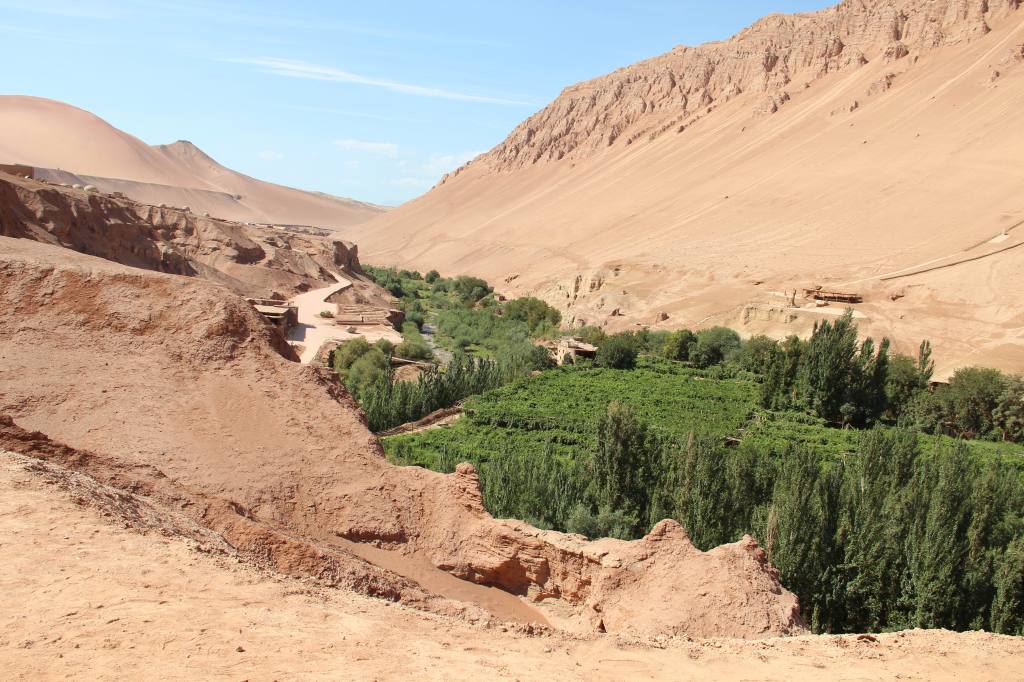
Turfan, located at the foot of the Flaming Mountains on the northern edge of the Taklamakan, served as a critical stopover for caravans. Its irrigated landscape supported farming communities, while its geographical position connected Central Asia to China. From Turfan, travelers would journey eastward along the Gansu Corridor—a narrow strip of habitable land bordered by the Gobi Desert and the Qilian Mountains. This stretch led to Dunhuang, a city famed not only for its Buddhist cave temples but also as a frontier garrison of the Tang empire. From there, the road continued to Chang’an, the Tang capital and one of the largest cities in the world during its peak, bustling with international merchants, artists, and monks.
“It is through the archaeological record of Turfan—especially the Astana Graveyard—that scholars have reconstructed the vibrancy of this route.”
It is through the archaeological record of Turfan—especially the Astana Graveyard—that scholars have reconstructed the vibrancy of this route. Dating from the 3rd to 8th centuries CE, the Astana Cemetery served as the necropolis for Gaochang’s elite. Its dry desert climate preserved an extraordinary array of materials: silk and wool textiles, wooden slips, paper documents, burial paintings, and everyday tools. These findings offer a rare glimpse into the material culture and social map of Silk Road societies. The graves not only tell the story of individual lives but also map the larger narrative of intercultural exchange between Chinese, Sogdian, and Central Asian communities.
The textiles recovered from Astana reflect the movement of both raw materials and weaving knowledge along the Silk Road. Silk production remained a closely guarded Chinese secret until around the 6th century, when sericulture began to spread westward. However, Chinese artisans retained mastery over silk weaving techniques, producing refined warp-faced polychrome weaves, known as jin. These silks, often used as currency and diplomatic gifts, were in high demand from Persia to the Mediterranean. In contrast, Sogdian weavers from Central Asia—present in Turfan in large numbers during the 5th to 8th centuries—brought with them wool weaving traditions and indigo-dyeing practices, producing weft-faced tapestries with bold, abstract motifs.
“The textiles recovered from Astana reflect the movement of both raw materials and weaving knowledge along the Silk Road.”
The textile remains at Astana reflect a period of artistic and technical hybridity. Sogdian and Chinese weavers worked side by side in state-run workshops, exchanging knowledge and integrating techniques. Wool was woven into patterned fabrics using tapestry methods, while Chinese weavers adopted these same techniques using silk, eventually developing the kesi or “carved silk” style during the Song dynasty. These innovations in textile production—sparked by the co-presence of diverse craftspeople—highlight how the route from the Taklamakan to Chang’an was not just a path of movement, but also a site of sustained cultural collaboration.
Documents found at Astana further underscore the interconnectedness of this trade corridor. Written in Chinese, Sogdian, and other scripts, they record commercial contracts, tax inventories, and household transactions. These texts document the goods in circulation—silk bolts, wool garments, dyes, and medicinal plants—and confirm that the communities along the northern Taklamakan were deeply enmeshed in imperial and transregional economies. Interestingly, though the Sogdians were known as elite traders, few of the Astana documents suggest direct involvement in the silk trade. Instead, they may have specialized in intermediary services, logistics, or alternative commodities.
As caravans travelled eastward, they entered the heavily policed Hexi Corridor, where fortresses ensured the protection of valuable cargoes. Towns like Jiuquan, Zhangye, and Wuwei hosted staging posts, inns, and artisan communities. These towns not only supported logistical movement but also reflected growing integration with the Tang administrative system. The final approach to Chang’an—located in the Wei River Valley—marked the completion of a journey that could take months, or even years, depending on the season and political climate.
Chang’an itself was a beacon of Silk Road exchange. A city with a grid-patterned layout, it housed foreign embassies, Buddhist temples, and bustling markets where goods from Rome, Persia, and India were bought and sold. The textiles, documents, and cultural practices that had moved through the oasis towns along the Taklamakan now entered the urban life of the Chinese capital. The discoveries at Astana provide the material proof of how deeply these connections ran—from the weaving sheds of Turfan to the courtly wardrobes of Chang’an elites.

In conclusion, the route from the Taklamakan Desert to Chang’an offers a vivid lens into the mechanics of the Silk Road. More than a geographic corridor, it was a social and cultural landscape shaped by exchange, collaboration, and innovation. The Astana Graveyard, with its extraordinary preservation of textiles and texts, allows us to visualize the lives of those who lived along this route—the artisans who wove silk and wool, the merchants who carried indigo-dyed goods, and the scribes who recorded the movement of empire and economy. Their stories, etched into fiber and script, continue to illuminate the enduring legacy of the Silk Road.
Bakhtawar Jamil
 alongthesilkroad.com
Leave a comment