“Your town is only a perfect town when there is a hammām in it”. – early Islamic historian Abū Sirr-
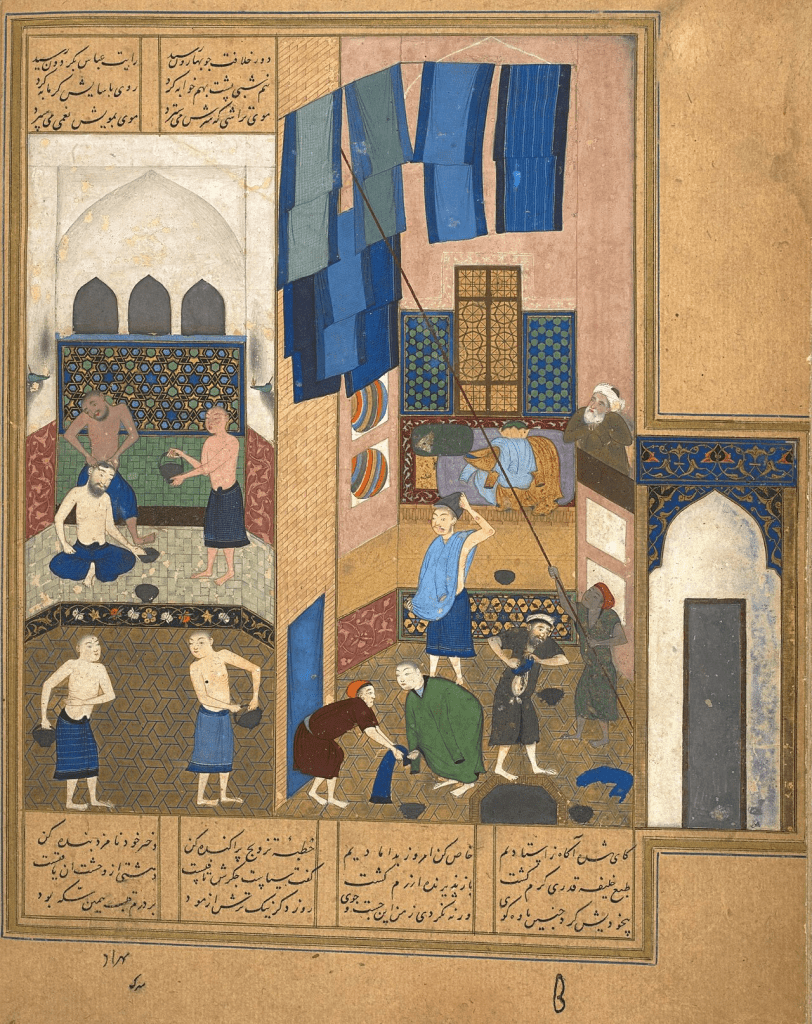
Bathhouse scene by Kamāl ud-Dīn Behzād, 1495.
It is well known that the tradition of the modern spa and its industry is not a new phenomenon. With some minor differences, this tradition has a long history, flourishing in various civilizations—particularly within Islamic civilization, where it was known as the hammām.
The following two terms of thermae (ancient Greeko-Roman) and hammām (Arabic and Muslim vocabulary) both refer to the meaning of “steam bath” or “spreader of warmth”. According to some sources, the term “spa” owes its roots to the municipality of Spa located in the Belgian province of Liège, where the area is famed for its hot springs which was frequented as a watering place as early as the 14th century CE. Some other sources speculate that the term may be an acronym derived from the Latin phrase Sanitas Per Aquas (“health by or through water”). In its generic use, ‘spa’ refers to a place with water—usually a mineral or hot spring—believed to have special health-giving properties.
The Roman Thermae
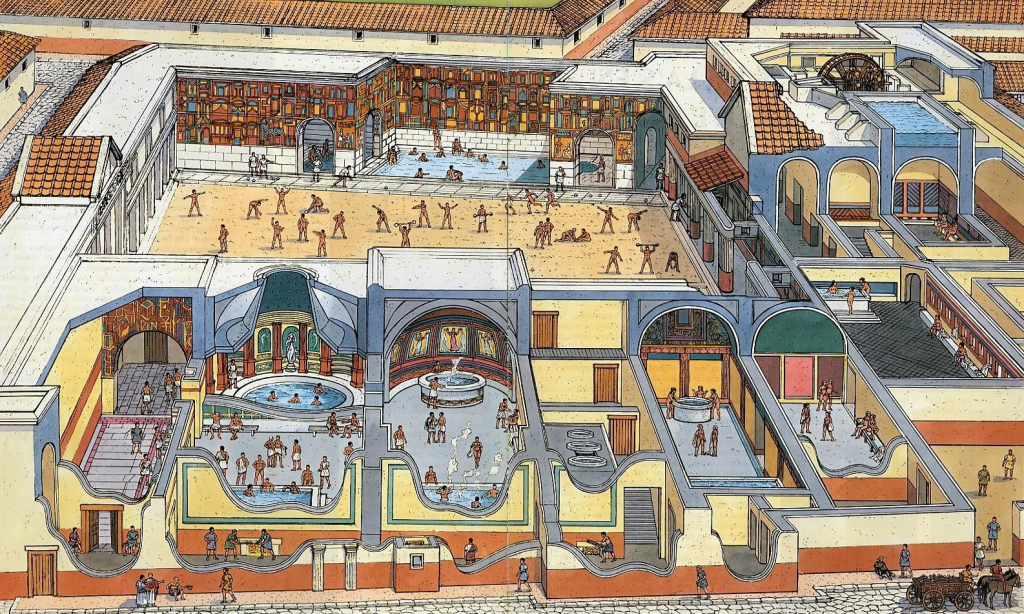
With reference to the ancient Graeco-Roman thermae, the complex places enclosed by the walls of the thermae included sports centers, swimming pools, parks, libraries, little theatres for poetry readings and music, and great halls for parties—a city within a city, where each thermae offered a particular attraction. Many of thermae were considered “free zones,” outside the jurisdiction of authorities. Perhaps this explains why, at times, the thermae were teeming with misuses and abuses in spite of municipal ordinances eliminating them. At the center of thermae, the main attraction was always the baths themselves–hot water baths, cold water baths, hot-air baths, virtually every type of bath that ingenuity and lust for bathing could devise. The thermae were open daily and rarely closed for any reason. Sometimes men and women bathed together, but this custom varied from one period to another and depended upon local attitudes. Patrons of thermae brought their own bathing implements: brushes, an oil flask, a flat dish for scooping water and the strigil, a curved metal tool, for scraping off oils and sweat.
Reconstruction of the Roman baths at Pompeii by Marc Henniquiau
“The tradition of hammām is close to thermae and spa in terms of its meaning but it is different in terms of practice. “
The hammām
The tradition of hammām is close to thermae and spa in terms of its meaning but it is different in terms of practice. A millennium-and-half old tradition, hammām played a great role in Muslim History and Civilization.
When discussing hammām or “spa”, the “water” is always considered to be the fundamental element of this tradition. In their quest to identify the essential element of life, early Greek scholars concluded that it must be either air, fire, earth, or water. However, later on, the Religion of Islam solved this problem of confusion, identifying and clearly pointing out that the essential element is “water”. In many occasions, the Holy Qur’an stresses on the importance of water and in a particular verse, Allah explicitly emphasized water to be the essential element of life where, in Sūrah al-Anbiyā’(21): 30, He says: “We have made from water every living thing. Will they not then believe?”.
Indeed, about 72 per cent of the surface of our globe is covered with water, showing the predominance of this element. That all life began in water is also a conclusion to which today’s knowledge in biological science points. Apart from the fact that protoplasm, the original basis of living matter, is liquid or semi-liquid and in a state of constant flux and instability, there is also the fact that land animals, like the higher vertebrates, including man, show, in their embryological history, organs like those of fishes, indicating the aquatic origin of their original habitat. The constitution of protoplasm is about 80 to 85 per cent water.
The resting room at the Kilic Ali Pasa Hamam in Istanbul, Turkey.Source: kilicalipasahamami.com
Large numbers of purification rites are performed universally in different religions and beliefs on widely varying occasions, both in private life, from conception to death, and in religious ceremonies. Such rites employ various materials like water, dust, dry sand, etc. Like most ritual acts, ablution may carry a wide range of meanings to those who perform it. The stain of ritual uncleanness may be felt to be as real as contamination with unseen germs is for the medically minded; the act of cleansing may be only a gesture, symbolic of desired purity of soul.
In the Religion of Islam, the “major ablution” that entails washing the entire body in ritually pure water, is required in specific cases for both the living and the dead. The ghusl (“major ablution”) must be performed whenever a state of major ritual impurity has been incurred: following sexual intercourse, seminal emission, menstruation, or childbirth. It is believed that one who is impure cannot perform the daily ritual prayer, touch the Qur’an or recite its verses, etc.
“Historically speaking, this “mini-self-spa” had a great impact on Muslim societies, where it gradually shifted to public areas and eventually resulted in the establishment of the tradition of the so-called hammām.”
It is widely known that these followings are the essentials of ablution in Islam: (1) to bathe the whole face in water, and (2) both hands and arms to the elbows, with (3) a little rubbing of the head with water, and (4) the bathing of the feet to the ankles. In addition, following the practice of the Prophet, it is common to first wash the mouth and the nose before proceeding with the rest of the face and body. Since it is performed on a daily basis by Muslims, or in most cases few times a day, emphasizing the above-mentioned body parts, I call this act a “mini-self-spa”. Historically speaking, this “mini-self-spa” had a great impact on Muslim societies, where it gradually shifted to public areas and eventually resulted in the establishment of the tradition of the so-called hammām.
Archaeological remains today witness the existence of the tradition of the hammām as early as the Umayyad period (661-750 CE) in the cities of Fustat (Egypt) and Basra (Iraq), where it has continued to occupy a position of primary importance until the present day.
The ritual use of the hammām in the performance of the major ablution explains why this tradition has gained religious significance, and why it has always been considered one of the essential amenities of the Muslim city—gradually assimilated as “a sort of annex of the mosque”—while at the same time, the life of a whole quarter revolved around it. Significantly, the tradition of the hammām facilitated people in achieving physical and intellectual development.
People of the past were going to the hammām for relaxation as well as to fulfill the laws of hygiene or a religious regulation, and the hammāms, which were numerous in every town/city, formed considerable sources of revenue for the private individuals and/or the authorities who established them. The popularity of the use of the hammām had also led to the installation of hammāms in the precincts of palaces or within larger town houses.
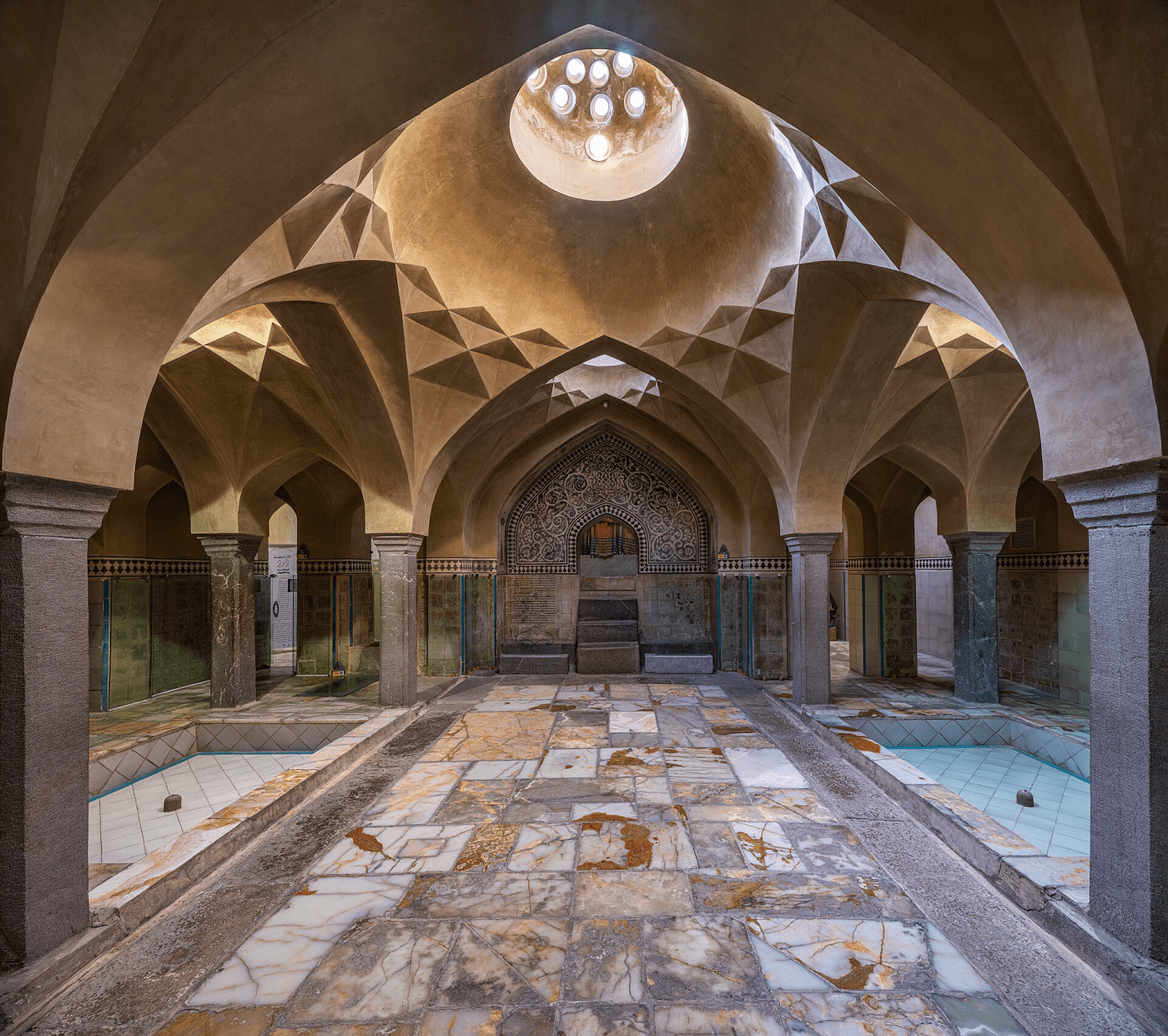
Ali Gholi Agha hammam, Isfahan, Iran.Wikipedia (user: Amirpashaei)
“As the Religion of Islam spread, so did the use of the hammām“
As the Religion of Islam spread, so did the use of the hammām, which accounts for many still standing from the lands of Bilād al-Shām, Iran, Anatolia, the Balkans, all the way to North Africa, from Egypt to Morocco. Before the Muslims were repelled by rebellious subjects, there were hammāms in Moorish Spain and high up the Danube River. According to the data found in the early sources with reference to the Umayyad, the Abbasid and the Ottoman periods, large number of hammāms existed in the chief Muslim cities.
The order in which the operations in the hammām were performed has remained practically the same everywhere throughout the Muslim world. The clients of the hammām first enter the changing room, where they put on a simple loin-cloth composed of towels knotted together. The clients gradually accustom themselves to an atmosphere which becomes increasingly hot and humid as they proceed towards the center of the building, where their spell in the sweating-room produced intense perspiration. Then the clients pass into the hands of specially-trained staff, male for men and female for women, who were wash them clean with soapy lather, rub them vigorously, massage them, remove their body-hair and shave them. The clients then proceed either to wash themselves with warm water or to immerse themselves completely in baths of warm or hot water. Finally a brief period of relaxation in a rest room is intended to restore the bodies exhausted by this vigorous treatment.
“entrance fees were kept low so everyone could enjoy them”
The hammām became also a place to socialize. As the early Arab historian Abū Sirr said: “Your town is only a perfect town when there is a hammām in it”. To promote the local hammāms, entrance fees were kept low so everyone could enjoy them. “I leave it to the bather,” said a caliph in A Thousand and One Nights, “to pay according to his rank.” In an effort to keep the hammām owners and staffs honest, sometimes they were given the privilege of being tax exempt.
The warm room of the Arab baths (Baños Arabes) of Ronda, Spain, late 13th century. Wikipedia (user: Julia Kostecka)
Throughout Muslim history, the hammāms were one of the few places open to everyone from the early morning until late at night, and sometimes even longer. One of the attractions of the hammāms was the barber. He shaved faces, cut hair, massaged and washed bodies. Because the barbers were in such close contact with the clients of the hammām, they were not allowed to eat garlic or anything else that causes bad breath. An important task of the barber was scrubbing the soles of hammām users’ feet to remove calluses. It was believed that de-calloused feet not only allowed bad vapors to escape but also drove away migraine headaches. When the bather stood up, fatigue and other undesirables supposedly flowed down and out through the feet. Barbers, privy to town and travel talk, were the hub of news and gossip.
“Barbers, privy to town and travel talk, were the hub of news and gossip.”
The hammāms were also the beauty parlors at the time. They offered facial, hair and body care and treatment with plants and oils, with which the spirit and body rested and became rejuvenated. Rough mitts made from cotton, silk and goat hair, were used to rub sweating bodies, scouring down the skin, and detoxifying it with soaps. Special banquets were also prepared with the best food and great care.
Eating fruit, drinking juices and mineral water were traditions at the hammām. There would be parties with singers, and women would be dancing to the music. These traditions formed around hammām, as the integral part of social life, has been the subject of many movies, anonymous songs, novels, riddles and proverbs in some parts of the Muslim world.
Vaulted chambers of the Umayyad bathhouse at Qusayr ‘Amra, covered in Late Roman or Byzantine-style frescoes, 7th or 8th century. Wikipedia (user: flowcomm)
There were different tools used by men and women, which have been preserved with the utmost care, displaying the rich tradition of hammām. The special bowl used in these hammāms were made in different sizes for men and women. They were made from copper, silver or brass, decorated with relieves and inlays, used to pour the water from marble basins.
This tradition was so much a part of town’s social life that even the wealthy, who usually owned private hammāms, frequented them. People went to hammāms to publicly show the town they were clean. Although the hammāms were usually built under the auspices of a mosque or the government, they were often constructed by wealthy individuals as well. To build a hammām was a venture that pleased Allah as well as the people; so the wealthy were inclined to heed the advise of Yusuf bin ‘Abdulhādī, an early Arab writer, who said, “Whoever has committed many sins should build a hammām (as penance).”
Ottoman hammām bowl, Abdulhamid II period, 1876-1909. Michael Backman Ltd.
“Whoever has committed many sins should build a hammām (as penance).”
The hammāms were available to the whole society and special, solemn occasions were often celebrated here. The following examples are illustrative: “Bride’s Bath Ceremony”, for instance, performed the day before the wedding; “40th Day Bath” performed when the baby is 40 days old; “Mourner’s Bath” performed 20 days after the death of a relative; “Vower’s Bath” performed when a wish comes true; “Hospitality Bath” performed when a host introduces his or her guests to their relatives; and “Feast Bath” performed the day before the religious festivals, etc.
Order and cleanliness were essential to the hammāms. The office of Muhtasib, who was the chief of police, patroller of bazaars and guardian of public morals throughout Muslim history, controlled the order and cleanliness of the hammām buildings as well as the seemly behavior of the users and of the bath attendants. The Muhtasib was given the task of ensuring that the hammāms were washed frequently, which entailed scrubbing the stone surfaces with a hard instrument to remove dirt and slippery traces of soap. The Muhtasib also checked the quality of the water. Aside from cleaning the place, the attendants burned incense twice a day for purification.
In the hammām, massage attendants rubbed their hands with pomegranate peel to harden them and give them a pleasant scent. Attendants also made sure that no beans or peas were eaten in the hammām, no lepers were allowed inside, and anyone revealing his/her private parts was ejected. Not only was the hammām pleasurable, but, as was believed by common people, it also brought luck, as the following old proverb claims: “Whoever goes to the hammām on forty consecutive Wednesdays will succeed at anything they do.”
Mesut Idriz
Prof. Dr. Mesut Idriz currently works as professor at the Department of History and Islamic Civilization and director of SIFHAMS at the University of Sharjah, Sharjah Emirate, United Arab Emirates.
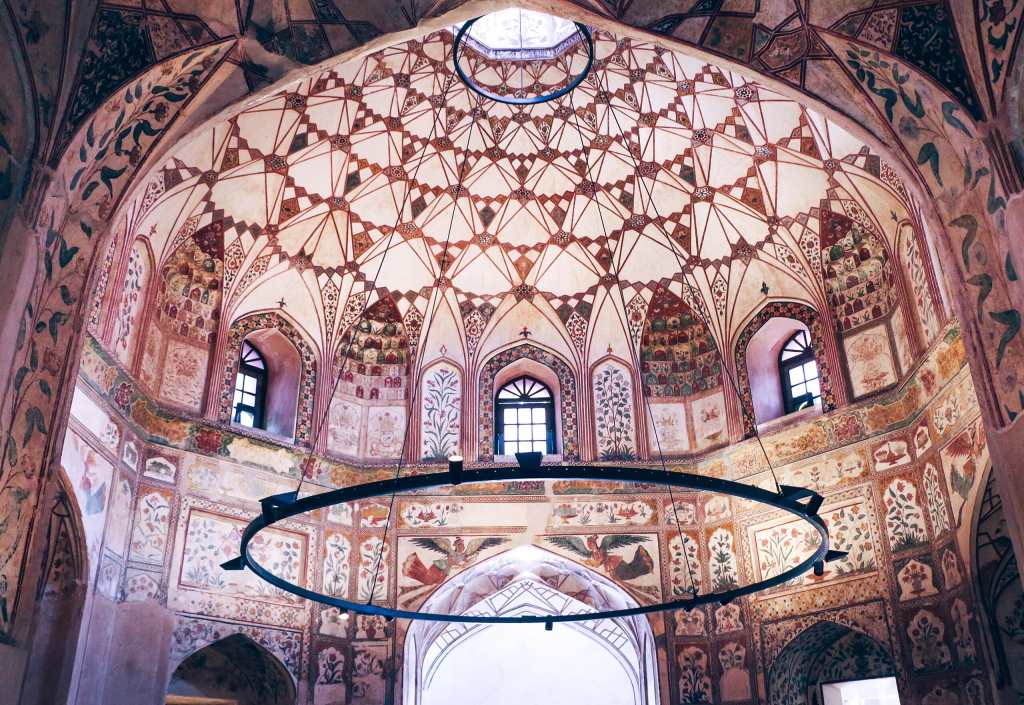
The 17th-century Shahi Hammam in Lahore, Pakistan, elaborately decorated with Mughal-era frescoes. Wikipedia (user: Kumail Hasan)



 alongthesilkroad.com