
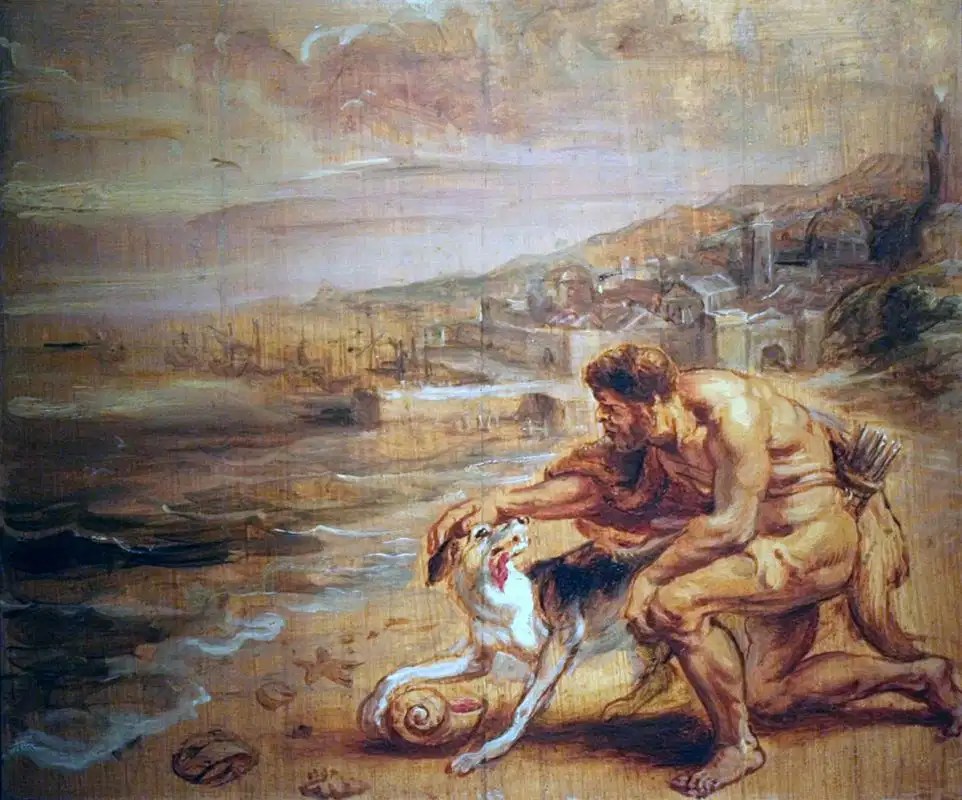
Within what we might call the “Phoenician world” (i.e. the overall set of communities that spoke Phoenician), dogs were required to perform a range of auxiliary tasks in everyday life and the economy, just as they did in the Greco-Roman world. But precisely because their functions were similar, Greek and Roman sources, which were more interested in what characterised the Phoenician and Carthaginian worlds as otherness, have left us with little useful information on this subject. For classical writers, sheepdogs, hunting dogs, and watchdogs were probably just too common a feature to deserve mentioning.
The Consumption of Dog Meat
“Persian king Darius sent an embassy to the Carthaginians which, among other things, urged them to stop eating dog meat.”
We do, however, have a curious piece of information, reported to us by a rather late source (Just. Epit. 19.1.10–13), according to which the Persian king Darius sent an embassy to the Carthaginians which, among other things, urged them to stop eating dog meat (edictum, quo Poeni humanas hostias immolare et canina vesci prohibebantur). This piece of news, of dubious historical reliability, is corroborated by the discovery, in dog remains found in some Phoenician settlements in North Africa, Sardinia and Spain, of cut marks that seem to imply actual consumption, at least occasional, of dog meat (cf. D’Andrea 2018: 191–193). The fact that, at present, there is no evidence of dog meat consumption in the Phoenician homeland has suggested the hypothesis that it was a practice adopted in Phoenician settlements due to the cultural influence of local native populations. It has also been suggested that dog meat was consumed mainly by members of the poorer sections of the population, who hardly had alternative access to meat. However, could the consumption of dog meat also have been part of ritual activities? The sacrifice of dogs is not mentioned in the so-called “sacrificial tariffs”, but these inscriptions refer to the rules governing the offering in specific sanctuaries, and this absence is therefore not necessarily significant for all sanctuaries, not even in Carthage alone. In fact, there are remains that seem to indicate a consumption of dog meat in ritual contexts (e.g. Carenti and Wilkens 2006: 176), among other ritual employs of dogs and dog images (cf. Minunno 2023: 395-400).

Dog Depositions
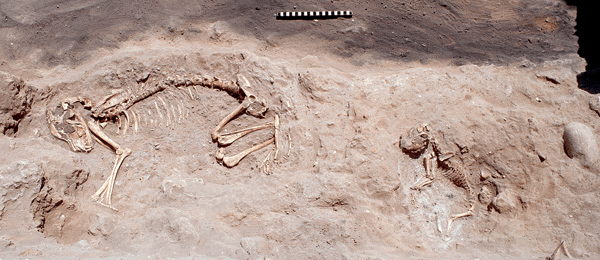
Dog bones, or even complete skeletons, are sometimes found in funerary contexts, as well as images of dogs. In the Cadiz necropolis, dogs were presumably involved in ritual activities centred on their killing and burial. (Niveau de Villedary y Mariñas 2008). In the Phoenician homeland, however, numerous dog depositions have been found, not associated with human burials (in Beirut, at Khalde, Tell Burak). These are complete remains of dogs, apparently “buried” in individual pits, sometimes partially covered with fragments of amphorae or stones. These burials are not unique to the Phoenician world. Although complete dog skeletons are also known from later as well as earlier contexts, it is in the Persian period that most of the dog burials occur in the Levant. While the number of specimens found in these contexts is always small, only exceptionally exceeding twenty individuals, more than 1,250 dog burials have been excavated in Ashkelon (cf. Wapnish and Hesse 1993). A unified interpretation of this evidence should therefore take these quantitative differences into account. According to some, the dogs were buried as animals sacred to a deity in whose sanctuary they had lived or to which they had access (Stager 1991; Heltzer 1998; Halpern 2000). However, no archaeological remains attributable to any sanctuary associated with these deposits have been found in Ashkelon, Beirut, Khalde or Tell Burak. It has therefore been suggested that the dogs were deposited in specific areas after having been killed, possibly during some healing/purifying ritual and in a manner which left no traces in the archaeological record (Edrey 2008). In support of this hypothesis, there is a passage in the Old Testament (Isaiah 66:3) that could allude to a ritual practice involving breaking a dog’s neck. Another hypothesis that has been put forward is of an economic nature: Ashkelon may have served as a hub for the trade in dogs. The remains found would therefore be those of dogs that died before being shipped (Smith 2015). The single burial of dogs, rather than a landfill, seems to imply some emotional attachment (Miller 2008: 493), or even that dogs could have acquired the role of “persons” and were therefore buried according to the funeral customs adopted for members of society with the lowest social status (Dixon 2018).
“The single burial of dogs, rather than a landfill, seems to imply some emotional attachment.”
Human ‘Dogs’
Phoenician onomastics, on the other hand, attests that men and women could have proper names constructed using the element “dog”, klb (Benz 1972: 131–132, 331; Dixon 2018: 35 Table 4). These names are probably to be interpreted as a reference to the positive attributes of faithfulness and devotion to his master that are universally recognised in dogs. The master, in this case, is mostly identifiable as a deity whose name is not expressed explicitly, or is expressed in a generic way (some individuals bore the name klb’lm, “dog of the gods”), essentially meaning “obedient worshipper” (Krahmalkov 2000: 227). A similar value is perhaps also linked to the presence of “dogs” in a Phoenician inscription from Kition (CIS I 86), in Cyprus. Here, klbm and grm are mentioned in a list of recipients of payments in connection with the temple of the goddess Astarte. According to one possible interpretation, the two terms literally mean “dogs” and “whelps” (cf. Watson 1997: 93). Admitting this translation, or at least the less contested one of klbm as “dogs”, the problem remains of understanding the latter’s nature and function. In fact, according to some scholars, they were real dogs, present in the sanctuary. However, it is perplexing that payments were provided for them as for other (human) workers mentioned in the list. It has therefore been assumed that the klbm were human beings. Perhaps, according to the traditional interpretation of klbm in some passages of the Old Testament (Deut. 23:18, 1 Kgs 15:12, 2 Kings 23:7; cf. Rev. 22:15 and Phil. 3:2), they were cultic (male) prostitutes (cf. Day 2004), although someone believes that they were actually real dogs (Goodfriend 1995). Perhaps even the story in the Gospels (Mark 7: 24–30; Matthew 15: 21–28) of the encounter between Jesus and a woman described as Syrophoenician or Canaanite could allude to a particular closeness between the Phoenicians and their dogs, at least in comparison to the Jewish environment at the time of the writing of the Synoptic Gospels. The woman and her daughter are compared to dogs, to whom it would not have been right to give the bread intended for the children (the Jews). The woman, accepting the comparison, obtains the grace she desired by replying that it is the right of dogs to eat the scraps from their lord’s table.
Conclusion
The role of dogs in the economy of Phoenician communities must have been no less important than that which they played in the Greek and Roman worlds. While in certain contexts dog meat could be consumed in secular or religious contexts, appreciation for dogs’ qualities, probably above all their loyalty to their masters, was taken as a model for the relationship between humans and deities. Perhaps, at least in certain areas and periods of Phoenician culture, dogs were even granted a personal status close to that of a human being.
Prof. Dr. Giuseppe Minunno
Giuseppe Minunno is an Italian archaeologist and field expert in History of Religions, who received his PhD from the University of Rome in 2009 and has participated in numerous archaeological excavations and published many papers on religions of the ancient Near East. He currently works as Adjunct Professor of Hebrew and Ancient Near Eastern History at the University of Genoa, as well as Adjunct Professor of Phoenician-Punic Archaeology at the School of Specialisation in Archaeological Heritage, University of Florence.
Bibliography
- Benz, F.L., Personal Names in the Phoenician and Punic Inscriptions, Rome 1972.
- Carenti, G. and Wilkens, B., “La colonizzazione fenicia e punica e il suo influsso sulla fauna sarda”, Sardinia, Corsica et Baleares antiquae 4 (2006), pp. 173–186.
- D’Andrea, B., “Le chien dans la religion et dans la vie quotidienne des communautés phéniciennes et puniques de la Méditerranée occidentale”, Mélanges de l’École Française de Rome 130 (2018), pp. 185–217.
- Day, J., “Does the Old Testament Refer to Sacred Prostitution and Did it Actually Exist in Ancient Israel?”, in C. McCarthy and J.F. Healey (eds) Biblical and Near Eastern Essays. Studies in honour of Kevin J. Cathcart (Journal for the Study of the Old Testament Supplement Series 375), London/New York 2004, pp. 2–21.
- Dixon, H., “Late 1st-Millennium B.C.E. Levantine Dog Burials as an Extension of Human Mortuary Behavior”, Bulletin of the American Schools of Oriental Research 379 (2018), pp. 19–41.
- Edrey, M., “The Dog Burials at Achaemenid Ashkelon Revisited”, Tel Aviv 35 (2008), pp. 267–282.
- Goodfriend, E.A., “Could keleb in Deuteronomy 23:19 Actually Refer to a Canine?”, in D.P. Wright, D.N. Freedman and A. Hurvitz (eds) Pomegranates and Golden Bells. Studies in Biblical, Jewish, and Near Eastern Ritual, Law, and Literature in Honor of Jacob Milgrom, Winona Lake 1995, pp. 381–397.
- Halpern, B., “The Canine Conundrum of Ashkelon: A Classical Connection?”, in L.E. Stager, J.A. Greene and M.D. Cogan (eds) The Archaeology of Jordan and Beyond. Essays in Honor of James A Sauer, Winona Lake 2000, pp. 133–144.
- Heltzer, M., “On the Vth Century B.C.E. Dogs from Ashkelon”, Transeuphratène 15 (1998), pp. 149–152.
- Krahmalkov, C.R., Phoenician-Punic Dictionary (Studia Phoenicia XV. Orientalia Lovaniensia Analecta 90), Leuven 2000.
- Miller, G.D., “Attitudes toward Dogs in Ancient Israel: A Reassessment”, Journal for the Study of the Old Testament 32 (2008), pp. 487–500.
- Minunno, G., “Dogs in Phoenician Culture”, in I. Fiore and F. Lugli (eds), Dogs, Past and Present. An Interdisciplinary Perspective, Oxford 2023, pp. 394-406.
- Niveau de Villedary y Mariñas, A.M., “¿Compañero en la muerte o guía hacia el más allá? El perro en la liturgia funeraria púnica”, in E. Ferrer Albelda, J. Mazuelos Pére and J.L. Escacena Carrasco Sevila (eds) De dioses y bestias. Animales y religión en el Mundo Antiguo, Sevilla 2008, pp. 97–141.
- Smith, A.M., “The Ashkelon Dog Cemetery Conundrum”, Journal for Semitics 24 (2015), pp. 93–108.
- Stager, L.E., “Why Were Hundreds of Dogs Buried at Ashkelon?”, Biblical Archaeology Review 17/3 (1991), pp. 26–42.
- Wapnish, P. and B. Hesse, “Pampered Pooches or Plain Pariahs? The Ashkelon Dog Burials”, The Biblical Archaeologist 56 (1993), pp. 55–80.
- Watson, W.G.E., “Comments on the Phoenician Tariff Inscriptions from Kition”, Die Welt des Orients 28 (1997), pp. 89–95.
 alongthesilkroad.com
Leave a comment