
In his magisterial Social and Economic History of the Hellenistic World, volume 1, published in 1941, Mikhail Rostovtzeff characterized the Ionian poleis as “fragments of the western world on the fringe of the eastern, serving as connecting links between the two.” For all of his contributions to the field of ancient history, however, in this case Rostovtzeff delivers only a good quote; he was neither the first nor the last writer to imagine the Ionian Greek cities this way. Indeed, from an etic (external) perspective, the Greek cultural identity that gets classified as European and the physical location in Asia creates a fundamental tension that requires resolution to understand this region. As early as the second century CE, commentators used this tension to explore what they regarded as a simple binary between Greek and barbarian, such as when Plutarch characterized Ephesus as “in danger of becoming barbarized” on account of such contact at the end of the fifth century (Lysander 3.2).
“Put another way, these might have been Greek speaking people with close cultural and social ties to the Greek speaking people in Europe, but they were not simply western, European outposts awash on an Asian shore.”
It is easy to see where this idea comes from. Setting aside Chios and Samos, the two Ionian poleis whose core island territories now belong to the modern Hellenic Republic, the ten remaining members of the Ionian dodecapolis (Miletus, Myus, Priene, Teos, Ephesus, Colophon, Lebedus, Erythrae, Clazomenae, and Phocaea) all sit inside modern Türkiye. The inhabitants of this region spoke Greek dialects, and some versions of their origin stories described a migration of people who sailed across the Aegean, conquered the indigenous communities, and founded new Greek cities. The origin of the cities was more complicated than these migration stories allow, and Naoise Mac Sweeney has shown that they vied for supremacy with stories that linked the cities to Minoan Crete and indigenous foundations. Put another way, these might have been Greek speaking people with close cultural and social ties to the Greek speaking people in Europe, but they were not simply western, European outposts awash on an Asian shore. They were “connecting links” after a fashion, but this characterization also reduces the people to their culture. The Ionians were of their environment, both Greek and Asian.
I use the terms “Asian” and “eastern” in these opening paragraphs both deliberately and with reservation. As a simple geographic fact, Ionia lay on the Aegean’s eastern littoral—that is, in Asia. The word Asia may even have its etymological roots in the Hittite word Assuwa used for the region to the west of the Halys (modern Kızılırmak) River. Although this etymology is speculative, it would be fitting if the same region bore one name, Asia, from a people looking westward, and another, Anatolia, connected to the rising sun, from a people, the Greeks, looking eastward. As in the Rostovtzeff line that opens this essay, these terms come loaded with additional meaning. Outside of its four-hundred-year Roman province era, Asia did not refer to a static space. Its geographical referent shifted to accommodate the rhetorical demands of authors who associated it with opulence, decadence, and effeminacy. Ionia could be caught by the same characterization, or not, depending on context. As early as the fifth century BCE, Herodotus associated Asia with Persia and Ionia with (European) Greeks, despite Ionians and other Anatolian Greeks contributing large numbers of ships and men to the Persian invasions of 490 and 480 BCE.
The cultural position of Ionia is no clearer than its location in the geographical imaginary. Identity through alterity—that is, forming positive identity in distinction to real or imagined differences in others—is a common way of explaining Greek identity formation. According to this explanation, first pioneered by Edith Hall in a study of fifth-century BCE Athenian drama and revised recently by Hyun Jin Kim and Jan Paul Crieelard to late sixth century Ionia, the arrival of the Persians provided a catalyst that allowed Greeks to define “barbarians” as people different from themselves, which, by extension, defined Greeks as not barbarians. The bones of a common culture predated this turn in the form of shared language, religious spaces, and mythology, but those only began to take shape as something that transcended polis and ethnic identities as a result of these later processes. And yet, these explanations for the development of Greek identity as a whole do not adequately explain the lived experience in Ionia, which had always involved multiple types of cultural fusion.
Geography created the first condition for cultural fusion. The Ionian cities were not European outposts clinging to hostile shores and thus shaped by the commercial and social interests of a mother country. Rather, these ten poleis were political communities clustered around three river valleys that enmeshed them in complex commercial networks that extended into the interior of Anatolia as well as across the Aegean and rippling outward to dozens of colonies and commercial entrôpots around the Mediterranean and Black Seas. Indeed, Ephesus might be regarded as the natural port of Sardis, the capital of the Lydian kingdom and, subsequently, a major Persian satrapal center. It shouldn’t come as a surprise, therefore, to find reports that a potential consumer could find all manner of Persian and Lydian luxuries for sale there.
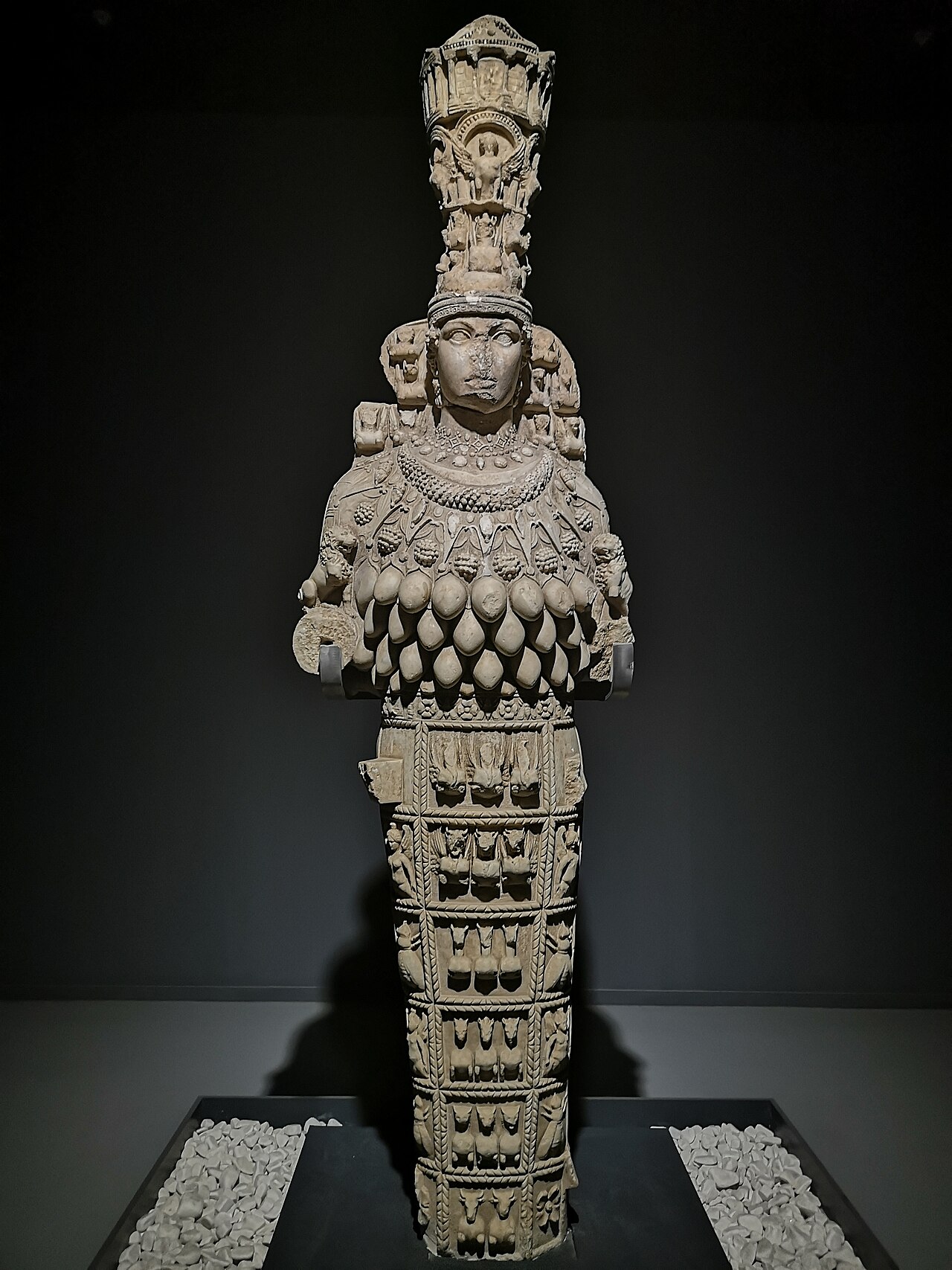
This anecdotal evidence for commercial activity is also borne out by reliefs with a person in Persian garb walking in a procession at the Temple of Ephesian Artemis. This figure is usually identified as the Megabyxus, a castrated priest of Artemis. The origin of the title is unknown, but it is attested multiple times starting in the fifth century BCE and its similarity to Persian names gives clear evidence for Persian influence in the region, though the position need not have been held by a Persian. While the Megabyxus is an extreme example of Asian influences in Ionian cults, other Anatolian influences also exist. The iconography of Ephesian Artemis, including her rows of bulbs and the panel scenes around the bottom of the statue are often found on statues for other Anatolian gods and goddess and the priestly family that oversaw the Oracle of Didyma (at Miletus) in the Archaic Period were the Carian Branchidae. Moreover, local myths explained that Artemis and Apollo were born nearby, not on Delos as the canonical myth found in the Homeric Hymn to Apollo would have it. Indeed, the worship of both deities plausibly emerged first in Bronze Age Anatolia and only subsequently made their way into the Greek mythological pantheon.
“Nor were Anatolian trappings superficial. The stories about the Ionian migration are filled with evidence for intermarriage.”
Nor were Anatolian trappings superficial. The stories about the Ionian migration are filled with evidence for intermarriage. Some of these stories indicate forcible couplings, as with an anecdote in Herodotus’s History about a tradition at Miletus where the women refuse to dine with their husbands or call them by their names in the memory of their foremothers who were abducted and forced to marry the invaders (1.146.2–3; cf. Pausanias 7.2.6). Others, though, provide evidence for more peaceful interaction, as with Pausanias’s account of Teos, where Carians mixed together with Greeks and the Ionians plotted no evils (7.3.6). Lydian kings waged war against the Ionians, but they also donated lavishly to Ionian temples and patronized Ionian artists. Alyattes, the father of Croesus, even married an Ionian woman, which demonstrates an intercourse taking place at least at the highest levels. This exchange is also on display at Miletus where an extraordinary inscription listing the names of principal magistrates (stephanephoroi) year by year includes the name Sadyattes three times in three different patronymic pairs, often with fathers or sons bearing names with clearer Greek origins (I.Milet. 3.122). Herodotus records that a Lydian king by the name Sadyattes waged war against Miletus in the sixth century BCE (1.17–18), but this inscription nonetheless suggests that it circulated among multiple elite Milesian families of the fifth and fourth centuries.
Put simply, the status of Ionia as formulated by Rostovtzeff is untenable. These communities were epicenters of Greek literature and intellectual culture in the Archaic period, but that hardly made them European offshoots. Ionia sprang from an Aegean ferment of cultural exchange that owed as much to their Anatolian neighbors and Asian commercial partners as it did to their European cousins.
Joshua P. Nudell
Joshua P. Nudell is Assistant Professor of History at Truman State University, known for his work on Ionia, having published in 2023 the book Accustomed to Obedience? Classical Ionia and the Aegean World, 480–294 BCE.
Further reading
- Bremmer, Jan. “Priestly Personnel of the Ephesian Artemision: Anatolian, Persian, Greek, and Roman Aspects.” in Practitioners of the Divine: Greek Priests and Religious Figures from Homer to Heliodorus, Hellenic Studies Series 30, edd. Beate Dignas and Kai Trapedach. Center for Hellenic Studies, 2008, online. http://nrs.harvard.edu/urn-3:hul.ebook:CHS_DignasB_and_TrampedachK_eds.Practitioners_of_the_Divine.2008
- Brown, Edwin L. “In Search of Anatolian Apollo.” In ΧΑΡΙΣ: Essays in Honor of Sara A. Immerwahr, Hesperia Supp. 33, edited by Anne P. Chapin, 243–57. Athens: American School of Classical Studies, 2004.
- Crielaard, Jan Paul. ‘The Ionians in the Archaic Period: Shifting identities in a changing world.” In Ethnic Constructs in Antiquity: The Role of Power and Tradition, edited by T. Derks and N. Roymans, 37–84. Amsterdam University Press, 2009.
- Greaves, Alan M., The Land of Ionia: Society and Economy in the Archaic Period. Blackwell: 2010.
- Hall, Edith, Inventing the Barbarian: Greek Self Definition Through Tragedy. Oxford University Press, 1989.
- Kim, Hyun Jin, “The Invention of the ‘Barbarian’ in Late Sixth-Century BC Ionia.” In Ancient Ethnography, edited by Eran Almagor and Joseph Skinner, 25–48. Bloomsbury, 2013.
- Mac Sweeney, Naoíse. Foundation Myths and Politics in Ancient Ionia. Cambridge University Press, 2013.
- Mac Sweeney, Naoíse. “Separating Fact from Fiction in the Ionian Migration.” Hesperia 86, no. 3 (2017): 379–421.
- Miller, Margaret C. “Clothes and Identity: The Case of Greeks in Ionia c.400 BC.” In Culture, Identity and Politics in the Ancient Mediterranean World, edited by P.J. Burton 18–38. Canberra: The Australasian Society for Classical Studies, 2013.
- Morris, Sarah P. “Artemis Ephesia: A new solution to the enigma of her ‘breasts’?.” In Das Kosmos der Artemis von Ephesus, edited by Ulrike Muss, 135–51. Vienna: Österreiches Archäologisches Institut, 2001.
- Morris, Sarah P. “The View from East Greece: Miletus, Samos and Ephesus.” In Debating Orientalization, edited by Corinna Riva and Nicholas C. Vella, 66–84. Sheffield: Equinox, 2006.
- Nudell, Joshua P. Accustomed to Obedience? Classical Ionia and the Aegean World, 480–294 BCE. University of Michigan Press, 2023.
- Rostovtzeff, Mikhail, Social and Economic History of the Hellenistic World, volume 1. Oxford University Press: 1941.
- Thonemann, Peter. The Maeander Valley: A Historical Geography. Cambridge University Press, 2011.
 alongthesilkroad.com
Leave a comment