
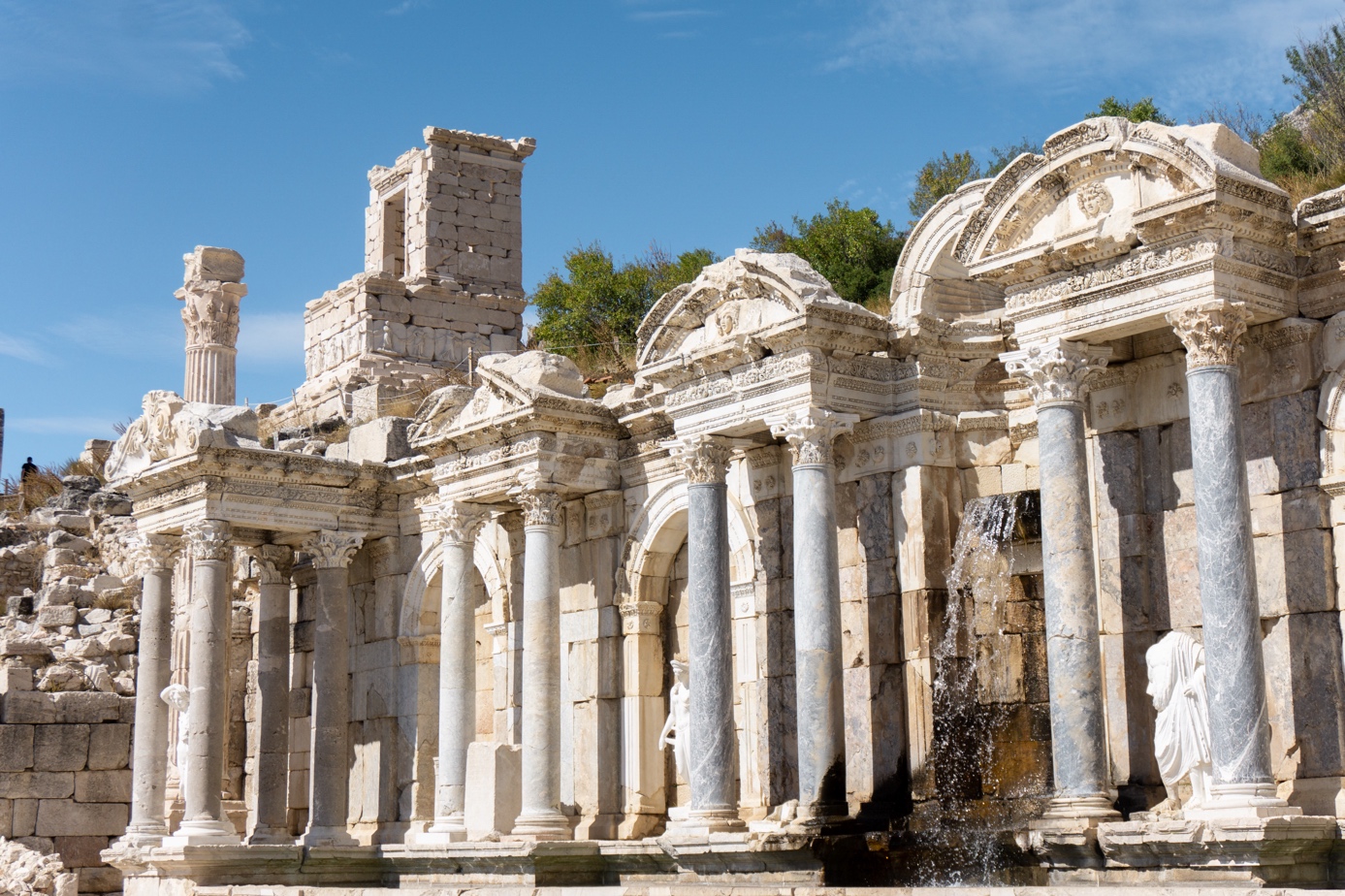
Sagalassos is an ancient archeological site in the historical region of Pisidia located in the South-West of modern-day Türkiye. Its top-notch state of preservation provides an absolute goldmine of archaeological information. The original architecture can easily be reconstructed with the material still present, with especially the Roman Imperial period incredibly well preserved. The site of Sagalassos has been studied and excavated for three decades. Marc Waelkens, who sadly passed away in 2021, has supervised the archaeological site for more than 20 years, until he passed on the torch to Jeroen Poblome, professor of classical archaeology at KULeuven, in 2014. Today, KU Leuven still works on the site in collaboration with VUB, Bilkent üniversitesi in Ankara and Koç üniversitesi in Istanbul.1 This article will provide a succinct synopsis of Sagalassos’ history and its significance for the knowledge of Classical Antiquity.
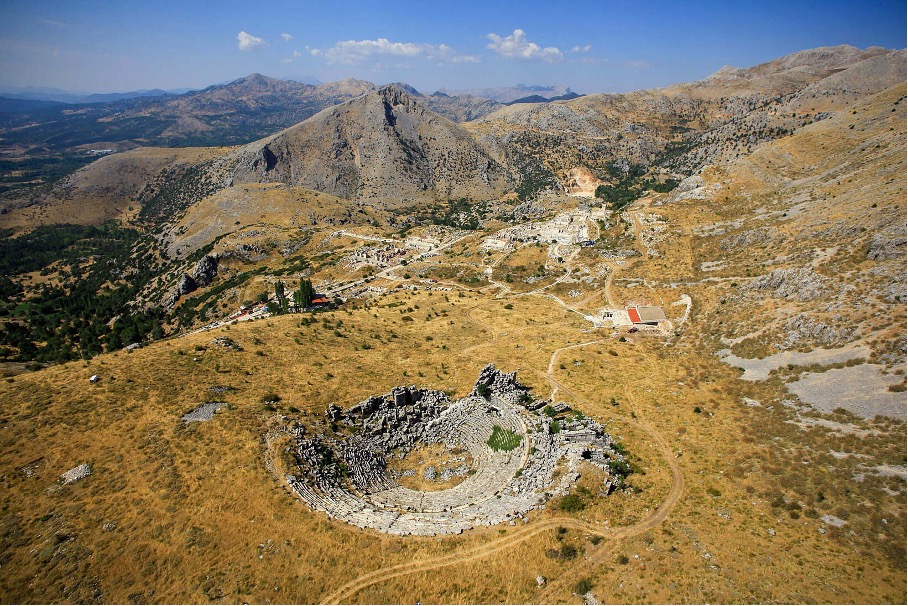
Prehistory2
Although erosion has permanently destroyed most artefacts dating before 20.000 BP (18.000 BCE) indications of human activity dating back to Middle Paleolithic (150,000-45,000 BP) have been found. Hunter-gatherer activity is detectable, albeit scarcely, from 12.000 BP (10.000 BCE) onwards. At the beginning of the Holocene, around 10.000 BP (8000 BCE), the change in climate was accompanied by the decrease of water levels of surrounding lakes, resulting in an increase of rich, cultivable land. A millennium later Aceramic (i.e. not producing pottery) Neolithic settlements found their abode in the area, using the rich earth for cultivation and hunting grounds. During the following millennia, these settlements would expand and multiply until the end of the 3rd millennium BCE. The transition from the 3rd to the 2nd millennium was accompanied by raids, the reason for which remains unclear.
Hittite documents dating to the 14th century BCE mention a mountain settlement called Salawassa, which could be identified with a predecessor of Sagalassos.3 During the next centuries, the region of later Pisidia would be subject to many regime changes. In 1200 BCE, after the fall of the Hittite empire, the so-called “the dark ages” ensued, a period with a marked lack of archeological and epigraphic information, which persisted until the 8th century BCE due. During the subsequent five centuries, Sagalassos was ruled by different empires, one falling after the other. In 546 BCE the Lydian Empire succumbed to the Achaemenid Persian.4 The latter would continue to rule over the vast territory of Anatolia, including Sagalassos, until the late 4th century BCE.
Alexander the Great
In 334 BCE, it was Alexander the Great who came knocking on Sagalassos’ door. As recorded in Arrian’s Anabasis, it took a lot of huffing and puffing before Alexander successfully blew down Sagalassos’ metaphorical door. According to Arrian, Sagalassos was one of the main concerns for Alexander in his objective to subdue Pisidia. Even though Sagalassos did not stand a chance against the behemoth that was Alexander’s army, Arrian emphasizes the city’s bravery:
“τὴν Τελμισσὸν δὲ ἀπέγνω ἑλεῖν ἂν ἐν ὀλίγῳ χρόνῳ, ἀλλ᾿ ἐπὶ Σαγαλασσοῦ ἐστέλλετο. ἦν δὲ καὶ αὕτη οὐ μικρὰ πόλις· Πισίδαι καὶ ταύτην ᾤκουν, καὶ ἐδόκουν πάντων Πισιδῶν μαχίμων ὄντων αὐτοὶ εἶναι [οἱ] μαχιμώτατοι·“
“He concluded that the2 capture of Telmissus would be a long business, and moved on to Sagalassus, also a large city, inhabited by Pisidians who were thought to be the most warlike of this warlike people;” 5

As a Belgian, I cannot help but be reminded by Caesar’s description of the Belgians as the strongest of all Celts in his Commentarii de Bello Gallico (horum omnium Belgae fortissimi sunt). Caesar’s praising of the enemies he encountered on his path as a way of emphasizing his bravery and the magnitude of his conquests shows a keen resemblance with Arrian’s description of Sagalassos as ‘not a small city’ (ἦν δὲ καὶ αὕτη οὐ μικρὰ πόλις), and its people as ‘the most warlike of this warlike people’ (πάντων Πισιδῶν μαχίμων ὄντων αὐτοὶ εἶναι [οἱ] μαχιμώτατοι) . The archeological record on the other hand shows that the Sagalassos that Alexander conquered, was actually no more than a modest town.6
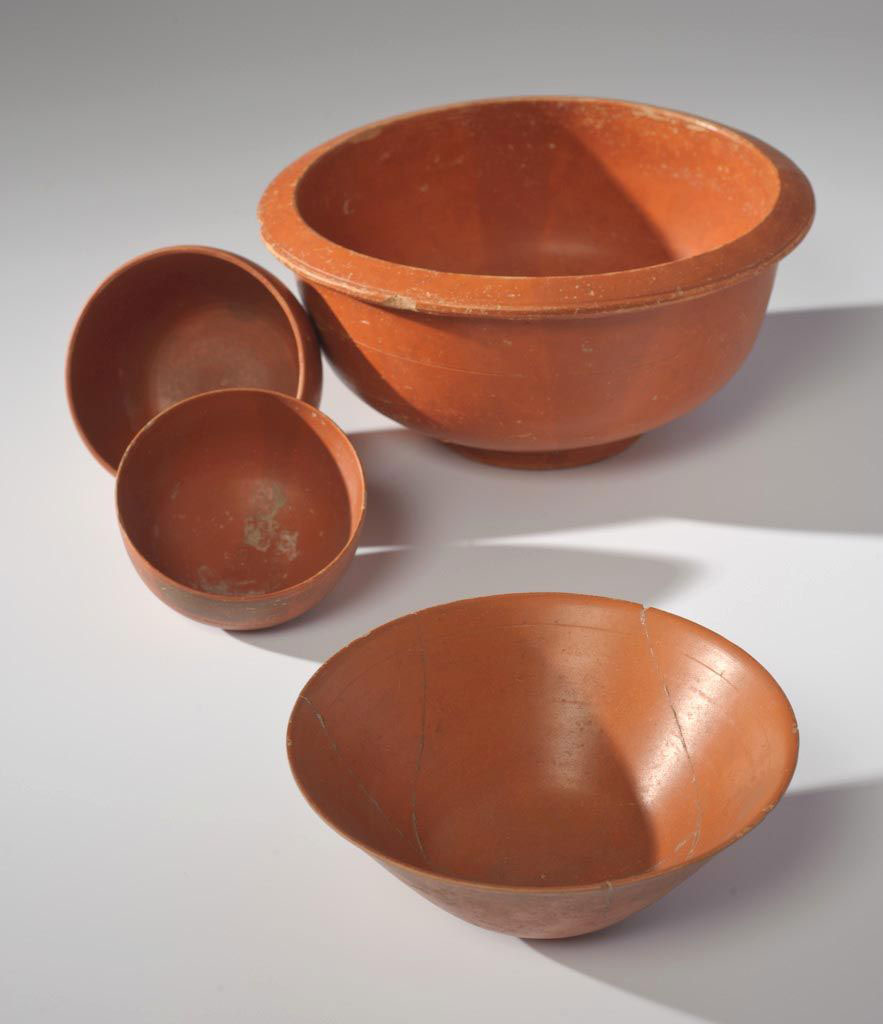
“Although many a pottery series like these exist, Sagalassos has proven to be the longest in recorded history, making it a truly exceptional archeological site.”
It was this incorporation into the Macedonian empire that would pave the way for the development of this mere village into a Hellenized Polis. From Alexander’s death onwards, Sagalassos would play a key role in Classical pottery production. This pottery production is one of many things which sets Sagalassos apart from other archeological sites, for the production would last for over a millenium, until finally disappearing around the 7th century CE. This continuous production line has enabled archeologists to create a timeline by associating every period with a certain type of dominating pottery. Although many a pottery series like these exist, Sagalassos has proven to be the longest in recorded history, making it a truly exceptional archeological site.
Hellenistic and Roman Period
In the 3rd and 2nd centuries BCE, Pisidia became part of the Attalid kingdom, also known as the kingdom of Pergamon, which was created by Philetaerus, lieutenant of Lysimachus, one of Alexanders former generals. In 133 BCE, after the last Attalid king, Attalus III, deceased, the kingdom was given by testament to the Roman Republic and transformed into the Roman provincia Asia.7 At this point, Pisidia was entrusted to the kingdom of Cappadocia, although this did not prove to be fruitful.
In 25 BCE, under the rule of emperor August, Pisidia became part of the newly created province of Galatia. From this point on, Sagalassos underwent major architectural changes, which defined its later archeological appearance. Sagalassos would continue to thrive for the following five centuries. Sophisticated water systems, public baths, etc, emerged. In the 6th century CE Sagalassos underwent once again major changes which catered to the needs of the upcoming byzantine period.8
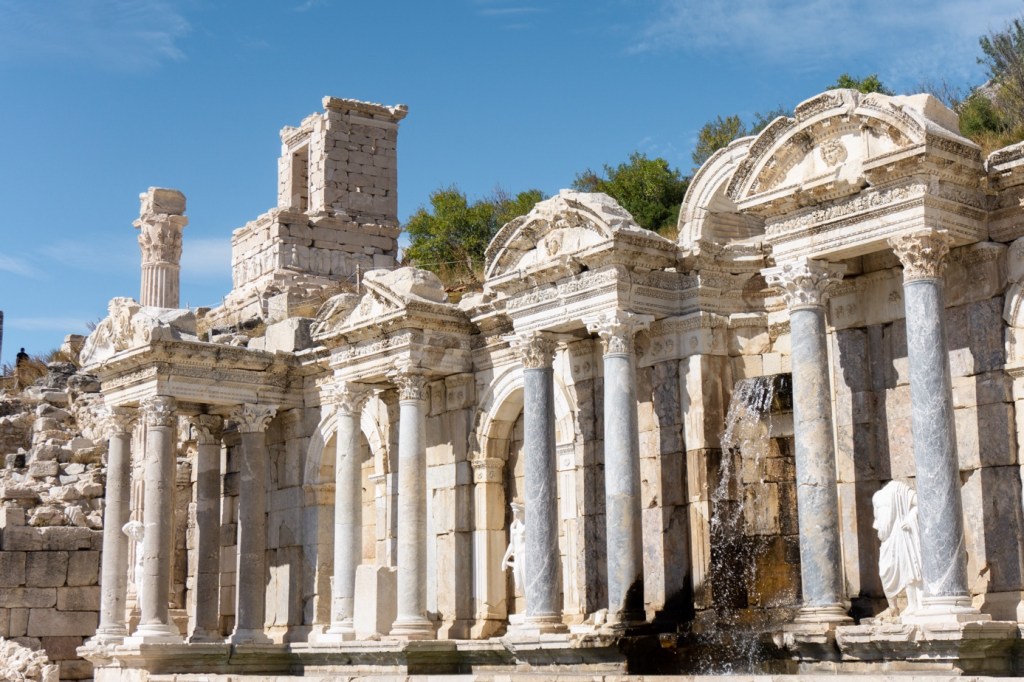
It won’t be until the end of 6th century CE that the population started to shrink. Although Sagalassos had dealt with other threats in the past, the epidemics, Arab raids and earthquakes in the 6th century CE proved to be too much to handle. As a result of these misfortunes, large parts of the town were left abandoned, and Sagalassos opted for a more rural way of living. Although the city had passed its prime, the site wasn’t abandoned until the 13th century. 9
Sagalassos’ exemplary state of preservation is truly remarkable. Needless to say, the site of sagalassos has been the KULeuven’s pride ever since excavations started three decades ago.
Benjamin Van Noordenne

Bibliography
- KU Leuven. (n.d.). Historie – Sagalassos. Faculteit Letteren – KLeuven. https://www.arts.kuleuven.be/sagalassos/historie.
- UNESCO World Heritage Centre. (2007). Sagalassos [Tentative list entry]. https://whc.unesco.org/en/tentativelists/5409/.
- KU Leuven. (2023, October 12). Sagalassos: Tot elke steen is omgedraaid. https://stories.kuleuven.be/nl/verhalen/sagalassos-tot-elke-steen-is-omgedraaid.
- Waelkens, M., & Peetermans, D. (2002). Ontdekking van het verloren Sagalassos. Davidsfonds.
- Arrian. (2015). Anabasis of Alexander (P. A. Brunt, Trans.). Harvard University Press. (Original work written ca. 2nd century CE)
- Kosmetatou, E. (2003). The Attalids of Pergamon. In A. Erskine (Ed.), A companion to the Hellenistic world (pp. 159–174). Blackwell Publishing.
- KU Leuven, Sagalassos: Tot elke steen is omgedraaid. ↩︎
- Unesco, Sagalassos; KU Leuven, Sagalassos; Waelkens, Ontdekking van het verloren Sagalassos ↩︎
- Waelkens, Ontdekking van het verloren Sagalassos ↩︎
- Waelkens, Ontdekking van het verloren Sagalassos ↩︎
- Arrian, Anabasis of Alexander. ↩︎
- KU Leuven, Sagalassos. ↩︎
- Kosmetatou, The Attalids of Pergamon. ↩︎
- KU Leuven, Sagalassos: Tot elke steen is omgedraaid. ↩︎
- Unesco, Sagalassos. ↩︎
 alongthesilkroad.com
Leave a comment