
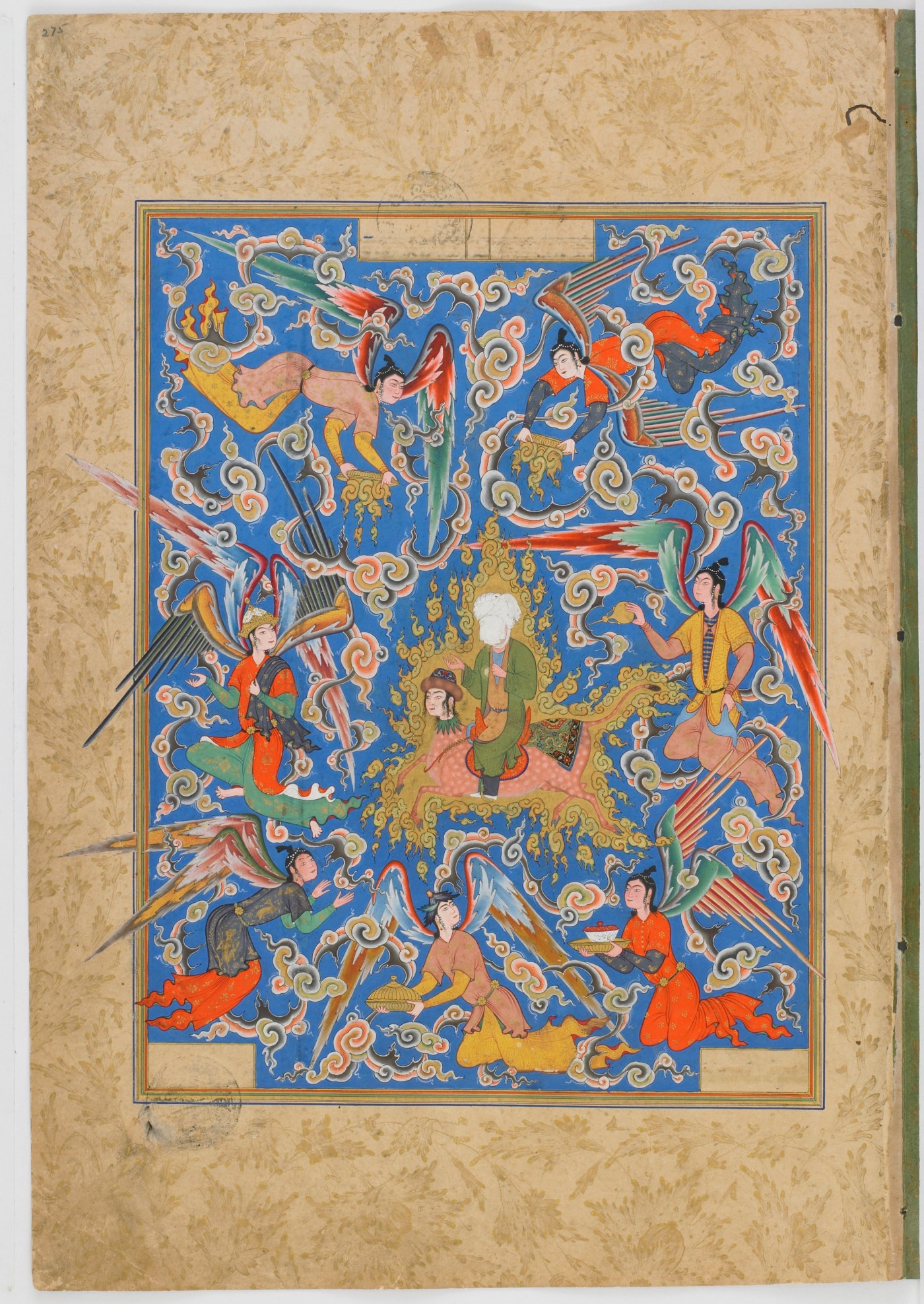
The circulation of illustrated manuscripts and the mobility of artists and visual models across the Ottoman, Safavid, and Central Asian worlds formed one of the most dynamic artistic networks of the early modern Islamic world. Far from being isolated artistic traditions, these regions were linked through political conquest, diplomatic exchange, royal patronage, and interregional trade. Illustrated manuscripts, luxurious objects combining calligraphy, painting, and book arts, played a particularly important role within this network. Their movement between courts, often accompanied by the migration of artists and the transfer of visual motifs, created a shared visual culture across Iran, Anatolia, and Central Asia while simultaneously shaping the distinctive artistic traditions of each region.
Circulation of Illustrated Manuscripts between the Ottoman and Safavid Worlds
The movement of manuscripts between the Safavid and Ottoman empires occurred primarily through two mechanisms: diplomatic gifts and spoils of war. Both channels demonstrate the political and symbolic importance of illustrated manuscripts in the early modern Islamic world.
Diplomatic exchanges frequently involved highly prized manuscripts intended to establish prestige, legitimacy, and goodwill between rival courts. One of the most celebrated examples is the Shahnama of Shah Tahmasp, also known as the Shahnama-yi Shahi. Widely considered the most luxurious and artistically significant illustrated copy of Firdausi’s epic ever produced, this monumental manuscript was created in the Safavid royal atelier in Tabriz over a period of approximately twenty years. Containing 258 extraordinary paintings, it represents a brilliant synthesis of the balanced Timurid Herat style and the vibrant Turkmen painting traditions of Tabriz and Shiraz. In 1568, Shah Tahmasp presented this masterpiece to the Ottoman Sultan Selim II as an accession gift, along with a Qur’an believed to have been written by Imam Ali. The manuscript remained preserved in excellent condition in the Topkapı Palace library for more than three centuries.
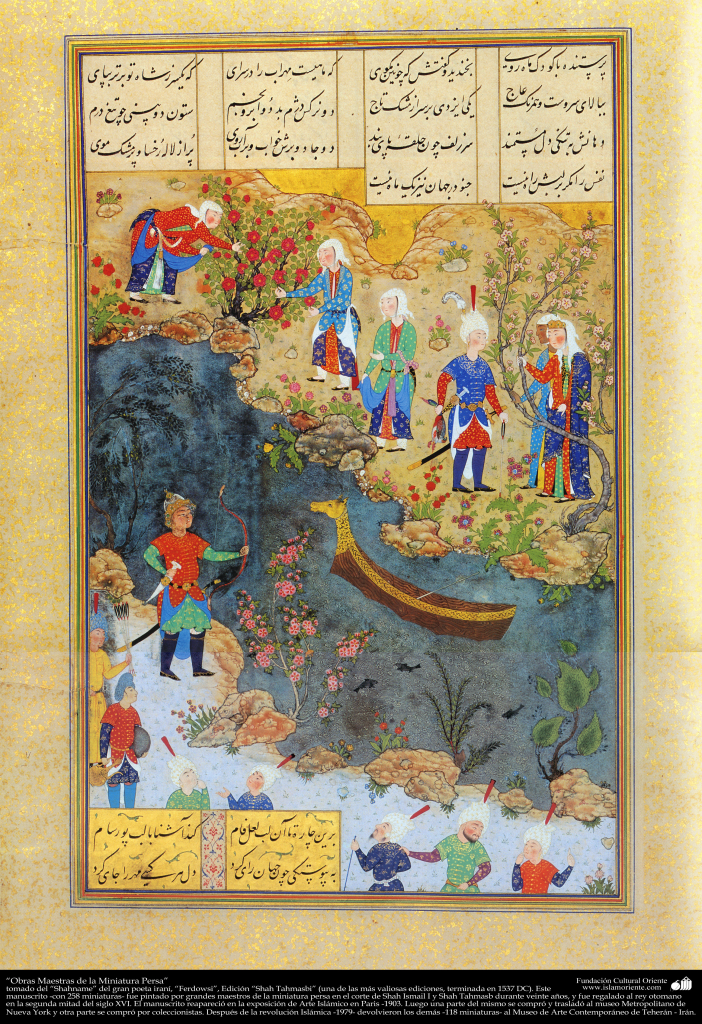
Source: https://fotografia.islamoriente.com/en/content/masterpieces-persian-miniature-taken-shahname-great-iranian-poet-ferdowsi-shah-tahmasbi-2?ovr=1
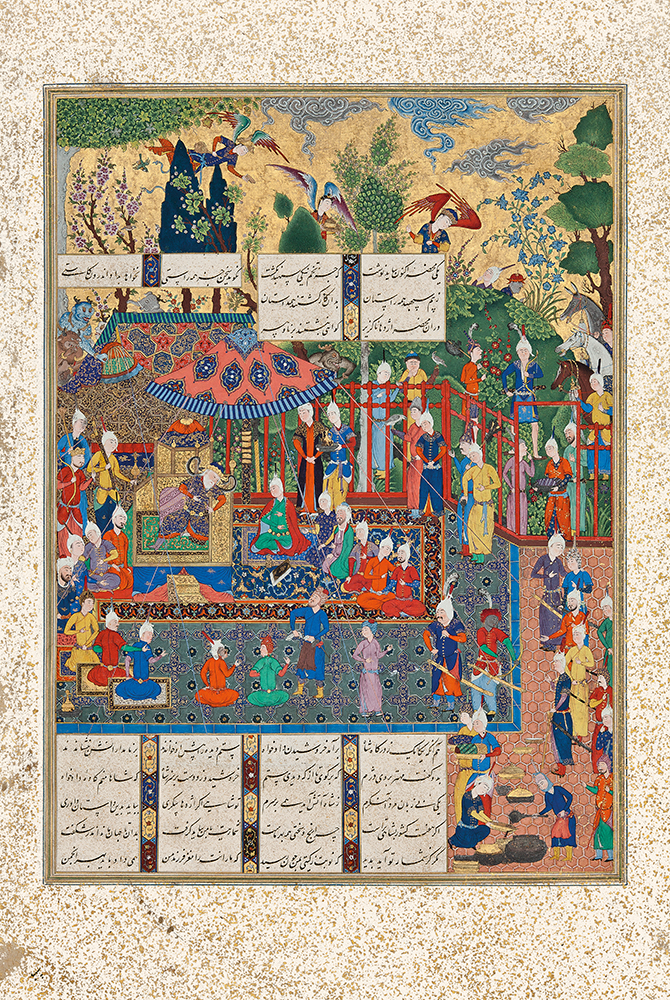
Source:https://commons.wikimedia.org/wiki/File:Folio_31v_from_the_Shahnama_of_Shah_Tahmasp_TMoCA.jpg)
“Following military victories, conquering rulers frequently confiscated royal libraries as symbols of triumph and imperial authority”
Military conflict also played a major role in the transfer of manuscripts. Following military victories, conquering rulers frequently confiscated royal libraries as symbols of triumph and imperial authority. A defining example occurred after the Battle of Chaldiran in 1514, when the Ottoman Sultan Selim I defeated Shah Ismail and captured the Safavid capital of Tabriz. During this campaign, Selim I seized numerous valuable illustrated manuscripts from the Safavid royal collections and transported them to Istanbul, where they entered the Ottoman imperial library at Topkapi Palace. Through these mechanisms, gift exchange and wartime confiscation, illustrated manuscripts circulated widely between the two empires, contributing to the formation of closely related artistic traditions.
Artist Migration and the Mobility of Workshops
The circulation of manuscripts was closely connected to the mobility of artists themselves. Throughout the medieval and early modern Islamic world, rulers recognized artistic production as a symbol of imperial prestige and often actively relocated skilled artists to their courts. One of the earliest examples occurred during the late fourteenth century, when Timur (Tamerlane) conquered major cultural centers such as Baghdad, Shiraz, and Tabriz. Timur forcibly relocated leading artists and craftsmen from these cities to his capital in Samarkand. This concentration of talent contributed to the formation of the highly influential Timurid artistic tradition that later flourished in Herat.
“rulers recognized artistic production as a symbol of imperial prestige and often actively relocated skilled artists to their courts”
A similar process occurred in the early sixteenth century. When Shah Ismail, founder of the Safavid dynasty, conquered Herat in 1510, he transferred the city’s artists, including the legendary master Kamal al-Din Behzad, to his capital in Tabriz. Behzad, widely regarded as the greatest painter of the Herat school and often called the father of Persian miniature painting, was appointed director of the Safavid royal library and atelier (kitabkhanah). In Tabriz, the refined compositional balance of the Herat school merged with the dynamic color and ornament of the Turkmen painting traditions of Tabriz and Shiraz. This synthesis produced what would become the classical Safavid miniature style.
The mobility of artists intensified further following the Ottoman victory at Chaldiran. After capturing Tabriz in 1514, Sultan Selim I relocated approximately one hundred Safavid artists, calligraphers, illuminators, and bookbinders to Istanbul. These masters worked alongside Ottoman artisans in the imperial nakkaşhane (royal workshop), playing a crucial role in shaping the emerging classical Ottoman miniature tradition. Artist migration was not always forced.
At times, it resulted from shifting patterns of patronage. When Shah Tahmasp gradually withdrew from artistic patronage due to increasing religious devotion, many Safavid artists sought new opportunities abroad. Some migrated to the Mughal court in India, particularly under Emperor Humayun, while others moved to Ottoman territories. Meanwhile, when the Shaybanid Uzbeks captured Herat in the 1530s, artists of the Herat school relocated to Bukhara, establishing a new artistic center that continued the traditions associated with Behzad. Through these movements, artists transmitted techniques, compositions, and aesthetic ideas across vast regions.
“Artist migration was not always forced. At times, it resulted from shifting patterns of patronage.”
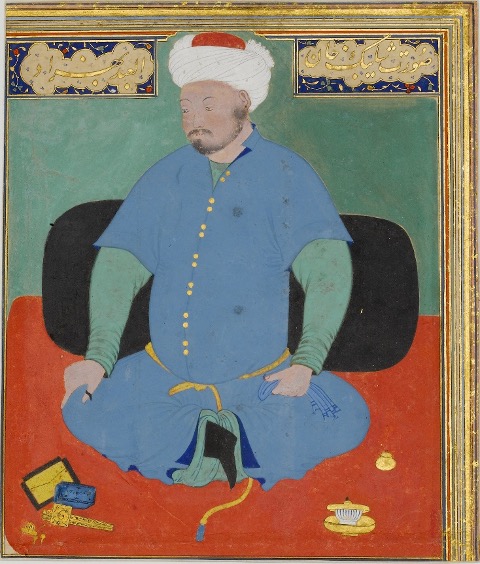
Source: https://tr.wikipedia.org/wiki/Dosya:Muhammad_Shaybani.jpg
Circulation of Visual Models and Motifs
“European painters worked in the Safavid court, while Iranian artists were sent to Rome for training. This encounter introduced new artistic concepts”
Alongside manuscripts and artists, visual models themselves circulated widely, creating a complex cross-cultural artistic vocabulary. Following the Mongol conquests of the thirteenth and fourteenth centuries, the Ilkhanid capital of Tabriz emerged as a key node in trade networks connecting the Islamic world with China. Through these exchanges, Chinese artistic elements, including dragons, phoenixes (simurgh), lotus blossoms, peonies, stylized cloud formations, and refined landscape techniques, entered Iranian painting. Persian artists adapted and stylized these motifs, integrating them into Islamic decorative traditions known as Hatayi motifs, which subsequently spread across Central Asia, Anatolia, and the Indian subcontinent.
A second wave of stylistic exchange occurred during the seventeenth century under Shah Abbas I, who relocated the Safavid capital to Isfahan and actively promoted European trade and diplomacy. The establishment of the Armenian merchant community of New Julfa in Isfahan facilitated sustained cultural contact with Europe. European painters worked in the Safavid court, while Iranian artists were sent to Rome for training. This encounter introduced new artistic concepts, such as naturalistic representation, linear perspective, and portraiture, into Persian painting. These influences culminated in a hybrid style known as Farangi Sazi, or “Europeanized painting.”
Masterpieces and Master Artists
Several manuscripts stand as monumental achievements produced within this interconnected artistic world. Alongside the Shahnama of Shah Tahmasp, another major Safavid work is the Khamsa of Nizami (1539–1543), painted by leading artists such as Sultan Muhammad and Mir Musavvir. The manuscript is celebrated for its elaborate margins, refined nasta‘liq calligraphy, and sophisticated narrative compositions. Equally notable is the Haft Awrang (Seven Thrones) of Jami (1556–1565), produced in Mashhad for the Safavid prince Ibrahim Mirza, a nephew of Shah Tahmasp and an important patron of the arts. This manuscript brought together many of the finest artists who had previously worked in the Safavid royal atelier.
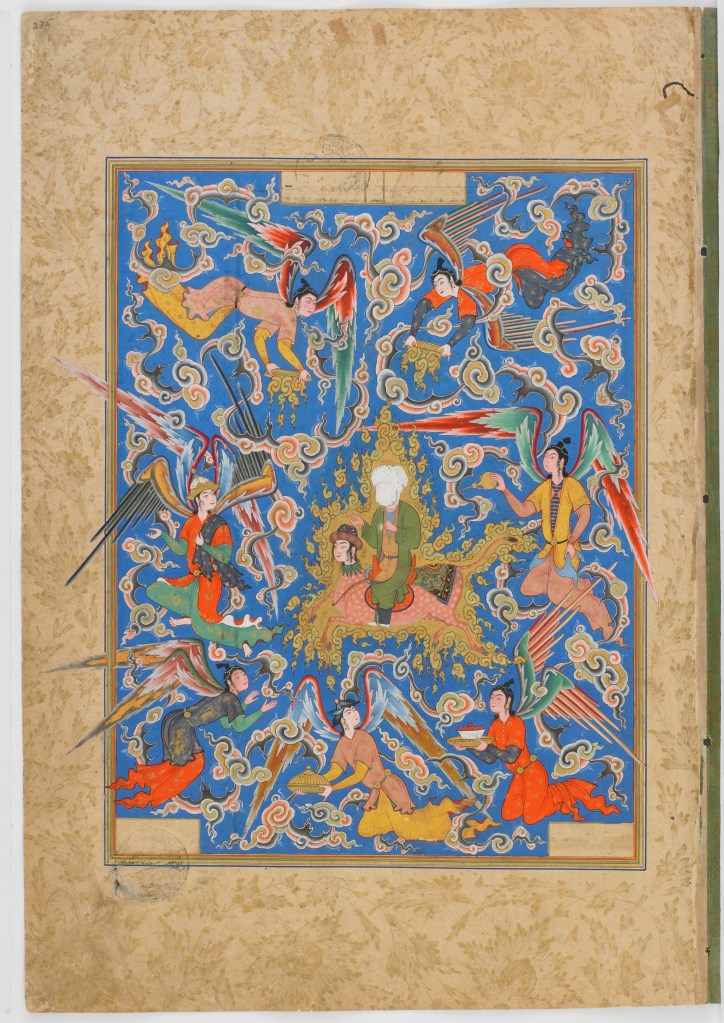
Source: https://asia-archive.si.edu/object/F1946.12.275/
In the Ottoman context, the monumental Siyer-i Nebi, a richly illustrated narrative of the life of the Prophet Muhammad, reflects strong Iranian artistic influence. Iranian artists participated extensively in its production, and the work retains Persian conventions such as representing the Prophet with a veiled face and a radiant halo.
Behind these masterpieces stood a remarkable group of artists. Among them were Sultan Muhammad, Mir Musavvir, and Aqa Mirak, who served successively as directors of the Safavid royal atelier responsible for the Shahnama of Shah Tahmasp. Sultan Muhammad was renowned for his spiritual depth and elaborate compositions, exemplified in his famous painting The Court of Keyumars. Mir Musavvir maintained close ties to the refined Herat tradition, while Aqa Mirak was particularly admired for his portraiture. Other artists migrated to Ottoman lands, including Veli Can, a pupil of the Safavid portraitist Siyavush, and Ahmed Musa, also known as Mehmed Kara Kalem. Ottoman historians praised Veli Can especially for his delicate and refined pen work. The later Safavid period was dominated by Reza-i ‘Abbasi (Aqa Riza), the most influential painter of the late sixteenth and early seventeenth centuries under Shah Abbas I. Working in Isfahan, he developed a distinctive style characterized by calligraphic lines, innovative color palettes, and elegant single-page portraits, while also incorporating new European visual ideas.
Conclusion
The artistic relationship between the Ottoman and Safavid empires demonstrates how manuscripts, artists, and visual ideas circulated continuously across political boundaries. Through diplomatic exchange, military conquest, artistic patronage, and migration, illustrated manuscripts moved between royal courts, carrying with them styles, techniques, and iconographic traditions. The resulting artistic landscape was not defined by isolated traditions but by a dynamic network of cultural exchange stretching from Central Asia to Anatolia and beyond. Within this interconnected world, illustrated manuscripts functioned not only as works of art but also as powerful agents of cultural transmission along the broader networks of the Silk Road.
Dr. Shadabeh Azizpour
References
- Azhand, Y. (2016b). Negārgari-e Irān (Vol. 2). Tehran: Sāzmān-e Samt.
- Azizpour, S. (2024). Safavid schools of depictions (Doctoral dissertation, Erciyes University). National Thesis Center of Türkiye (YÖK).
- Bahari, E. (1996). Behzad, Master Iranian Painter. Islamic Azad University (Shabestar). [Persian]
- Gelibolulu, Mustafa ʿĀlī. (1926). Menāqıb-ı Hünerverān. Istanbul: Matbaa-ı ʿAmire.
- Ghaffārī Qazvīnī, Q. A. (1964). Tārīkh-e Jahān Ārā. Tehran: Ketābforooshi Hāfez.
- Govashani (Govāshānī), D. M. (1999). Dust Mohammad Govashani. Tehran: Amir Kabir.
- Grube, E. J. (1968). The Classical Style in Islamic Painting. Germany: Edizioni Oriens.
- Khandmir, G. I. H. (1954). Habīb al-Siyar fī Akhbār Afrād al-Bashar (Vol. 3). Tehran: Khayyām Publishing.
- Mayel Heravī, N. (1993). Ketāb-e Ārāyī dar Tamaddon-e Eslāmī [Book Decoration in Islamic Civilization]. Mashhad: Āstān Qods Razavī.
- Mirjafari, H. (2000). Tārīkh-e Tahavvolāt-e Sīyāsī, Eghtesādī, Ejtemāʿī va Farhangī-ye Irān dar Dore-ye Tīmūriyān va Torkamānān[The Political, Economic, Social, and Cultural Transformations of Iran during the Timurid and Turkmen Periods]. Tehran: Dāneshgāh-e Esfahān & SAMT.
- Rajabi, M. A., & Hosseini Rad, A. (2005). Shāhkarhā-ye Negārgari-ye Irān [Masterpieces of Persian Painting]. Tehran: Moʾassese-ye Toseʿe-ye Honarhā-ye Tajassomī. [In Persian]
- Thackston, W. M. (2001). Album Prefaces and Other Documents on the History of Calligraphers and Painters (Vol. 10). Leiden: Brill.
 alongthesilkroad.com

Leave a comment