

Between the ninth and seventh centuries BCE, the Assyrian Empire grew into one of the most powerful states the world had ever seen. The king of Assyria was the absolute ruler of an empire that stretched from the land of the Nile to the central Anatolian steppes, and from the Phoenician port cities to beyond the Zagros Mountains. The king’s wealth was beyond measure, and his will was law throughout the ancient Near East. One can debate endlessly the precise causes of this astonishing expansion, but this article aims to highlight just one factor that played a crucial role in this success story: the Assyrian army. For roughly three centuries, the Assyrian monarchs commanded a military force that had no equal. Praised for its effectiveness and lamented for its cruelty, this formidable army left a lasting mark on military history unlike any other from the ancient Near East.
The Army’s History: From Fighting Farmers to Professionals
After regaining their independence in the 14th century BCE, Assyria rapidly developed into a powerful kingdom in northern Mesopotamia. Around 1200, however, a dark period of two centuries followed, during which this principality turned into a weak local state. The situation stabilized during the 10th century, and slowly the tide began to turn for the Assyrian rulers. Tales of former glory stirred in the Assyrian monarchs a desire to restore the ancient kingdom to its former stature. From the 10th century onwards, the Assyrians began marching against their neighboring lands to reclaim the territory that had once belonged to them.
“Tales of former glory stirred in the Assyrian monarchs a desire to restore the ancient kingdom to its former stature.”
Yet the ambitions of these kings proved insatiable, for after achieving this initial goal, they began—starting with the reign of Ashurnasirpal II (r. 883–859 BCE)—to cast eager eyes beyond their traditional borders. Before long, Assyrian troops reached as far as distant Egypt and remote Media. Assyria became the greatest power of the ancient Near East.
Thus, the history of the Assyrian kingdom can roughly be divided into two periods: between ca. 1350 and 900 BCE, a regional phase known as the Middle Assyrian period, and from ca. 900 to 612 BCE, a more imperialist phase that took them far beyond the land between the two rivers of Mesopotamia—the Neo-Assyrian period. During the first phase, the army’s campaigns were not conducted far from the Assyrian heartland. As a result, they were of relatively short duration. The old recruitment system proved sufficient for this: the Assyrian king called upon his subjects from the heartland for military service. These were primarily farmers, not professional soldiers. They were only available during the summer months, starting in late June, when the harvest had just been gathered, leaving them time for other activities.
When the later Assyrian kings began expanding their territory significantly, the old system became inadequate: campaigns lasted longer, and larger armies with specialized units were needed to fulfill the ruler’s ambitions. For that reason, King Shalmaneser III (r. 858–824 BCE), and especially Tiglath-Pileser III (r. 745–727 BCE), introduced major reforms that transformed the Assyrian military into a formidable and fearsome professional army that could be deployed wherever, whenever, and for as long as needed. The bulk of these soldiers was recruited from the annexed provinces, particularly Syria and Babylonia. In addition, auxiliary troops from vassal states and foreign mercenaries began to play an increasingly important role, especially from the reign of Tiglath-Pileser III in the 8th century BCE onward.
“When the later Assyrian kings began expanding their territory significantly, the old system became inadequate: campaigns lasted longer, and larger armies with specialized units were needed to fulfill the ruler’s ambitions”
This did not mean that farmers from the homeland were exempt from the ilku (which included a military service obligation), but they were deployed less frequently on the battlefield. Instead, the central authority used them as a labour force for road construction or monumental building projects. They could besides still serve in the logistical support of military campaigns.
It is difficult to estimate exactly how many soldiers the Assyrian kings had at their disposal in the later period. Sources occasionally inform us of expeditionary armies numbering more than 100,000 men. Estimates of the total number of soldiers the Neo-Assyrian kings could mobilize across their entire empire range from 300,000 to 500,000—figures that are staggering by any standard in the ancient world.

Organisation of the Army
The majority of the Assyrian army was, from the reign of Shalmaneser III (r. 859–824 BCE) onward, permanently stationed in four crucial border regions. Initially, the governors were responsible for the recruitment of troops, as a large portion of the soldiers were drawn from the provinces. However, later in the 8th century, the king and the central authority are believed to have taken over this task.
The supreme commander was, of course, none other than the monarch himself. At the time, it was expected that the king would personally lead his army on the battlefield. In doing so, he was to bravely confront the enemy as an exemplary figure. For this reason, numerous visual and written propaganda works devote much attention to the king’s heroic deeds. It is difficult to determine to what extent the king actually risked his life. Nonetheless, we know that the ruler did at times find himself in very perilous situations. For instance, King Sargon II (r. 722–705 BCE) lost his life on the battlefield.
“At the time, it was expected that the king would personally lead his army on the battlefield. In doing so, he was to bravely confront the enemy as an exemplary figure.”
Of course, this does not mean that the Assyrian king constantly and recklessly risked his life. The monarch was always surrounded by an elite corps for protection, the ša šēpē, which could consist of cavalry, chariots, and/or infantry. In addition, the so-called ša qurubte served as bodyguards, whose members were primarily recruited from the infantry.
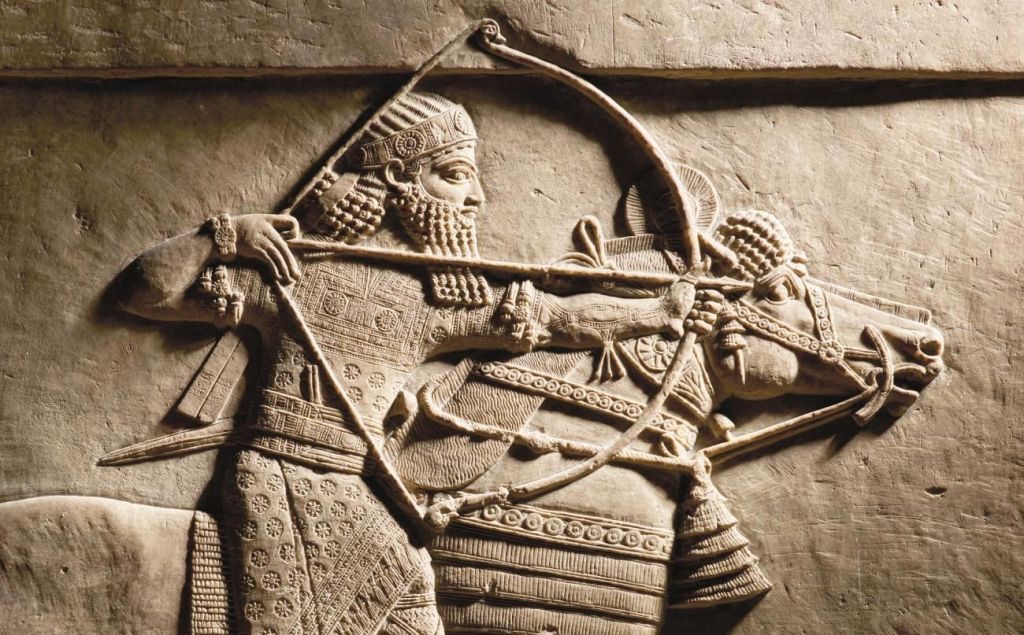
Over time, it became impossible for the king to be present at all the military campaigns of the Assyrian state, or the monarch had simply become too old to participate. In such cases, from the reign of Shalmaneser III in the 9th century onward, command was delegated to a general (turtanu). It appears that starting with Sargon II, the rank of turtanu was split in two, with each leading one of the two flanks. Additionally, we occasionally see other members of the royal family acting as substitute commanders in the Royal Annals.
Under the supreme commander, there was of course also a corps of officers, organized by the Assyrians in a strict hierarchy. Most of these powerful positions were held by scions of prominent families. There is a theory that from the mid-8th century onward, the kings began appointing eunuchs as officers in order to break the power of the aristocracy. These officers were assigned not only military tasks but also civil duties. Consequently, the state was thus entirely in the hands of the military. The Assyrian kingdom was a militaristic society: a person’s rank in the army was virtually equivalent to their position within society.
“The Assyrian kingdom was a militaristic society: a person’s rank in the army was virtually equivalent to their position within society.”
Infantry
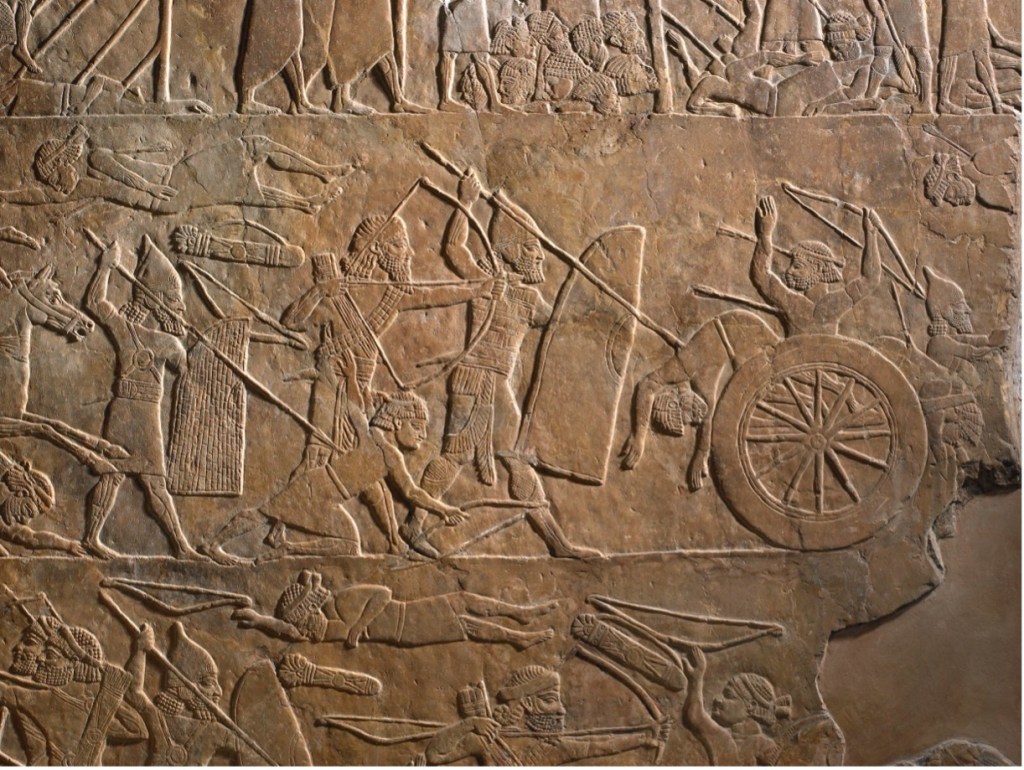
The army (kiṣir šarri) initially consisted of two components: the infantry and the chariots. Later, cavalry would be added as well. The infantry (zūk šēpē) was further subdivided into archers and spearmen. The sources refer to the spearmen as “bearers of shield and spear.” These are easy to identify in the palace wall reliefs by their typical large, dome-shaped shields. However, the largest component was that of the archers, an Assyrian specialty, who typically made up two-thirds of the infantry. Some visual sources depict them in pairs. On the one hand, there was the archer himself, and on the other, a kind of shield-bearer who protected him from enemy projectiles with a large shield.

The foot soldiers operated, according to the sources, in units of 50. It is not known with absolute certainty how these were integrated into the larger military formations. Specialist Stephanie Dalley suggests that the strength of the other units was organized decimally, with formations of 100 and 1,000 soldiers. In any case, these military divisions were organized based on origin. The soldiers likely communicated within their unit in their own dialect or language and cultivated a distinct identity. This cultural division among the soldiers somewhat worked in the Assyrian king’s favor. It reduced the chance that they would ever form a united front against the monarchy. Instead, they competed with each other for the king’s recognition.
The infantry is easy to identify in visual sources by their uniforms, which included, among other things, a cone-shaped helmet. The auxiliary troops from the vassal states, on the other hand, retained their own clothing and weaponry and are therefore easily distinguishable from the other warriors.
Chariots
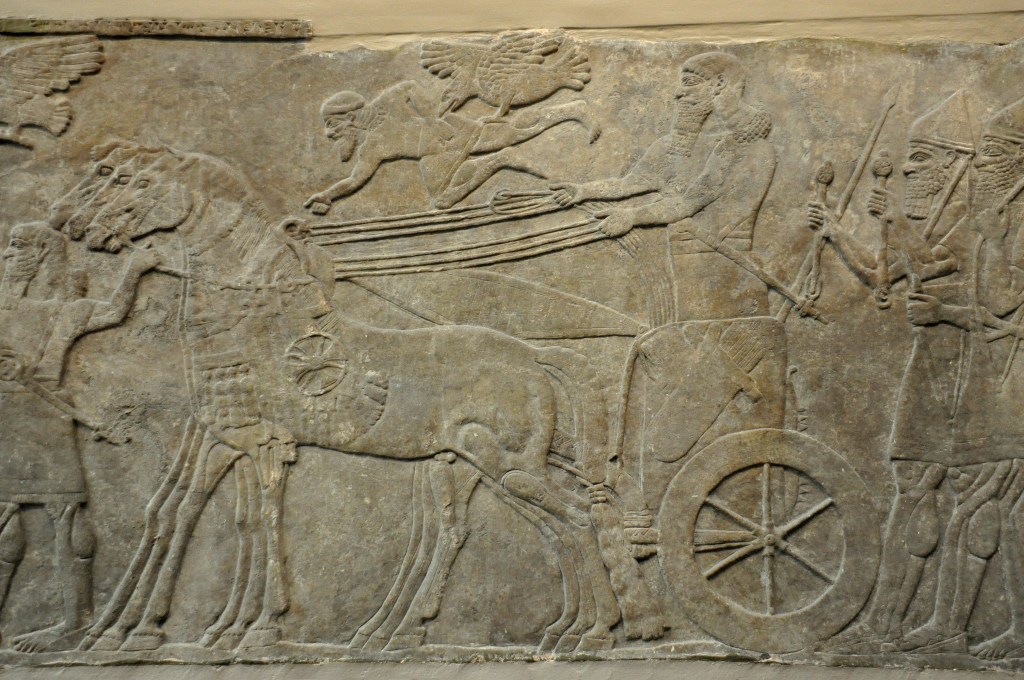
Additionally, chariots had been employed by the Assyrian army since around 1800 BCE. Until the rise of cavalry, they formed the core of the royal military force. Initially, these vehicles were relatively light, small, and fast, and were drawn by two to three horses. These earliest types carried two to three soldiers, including a driver (referred to by the Hurrian word mariamu), an archer, and possibly another person who protected the occupants with a shield. These crews could quickly target vulnerable points in the enemy army with bow and arrow.
This unit also served a psychological function. It is easy to imagine how, sometimes in formations of more than a hundred, they could strike great fear into the enemy. These units had long been semi-professional, as their crew members were required to train regularly throughout the year for this specialized form of warfare. It is unclear whether, in the earliest periods, they were a permanent part of the royal army or whether they were summoned only for specific occasions, like the rest of the troops.
“This unit also served a psychological function. It is easy to imagine how, sometimes in formations of more than a hundred, they could strike great fear into the enemy.”
Later, in the 7th century BCE, chariots became larger and more robust, carrying up to four occupants and drawn by a team of four horses. As a result, the chariot also became an effective weapon for simply crashing into enemy lines. However, the importance of chariots gradually declined—on the one hand due to the introduction of cavalry, and on the other hand due to the changing nature of the terrain on which the Assyrian soldiers fought. From the 9th century onward, the battlefield shifted from the Syrian and Mesopotamian plains toward the Taurus and Zagros Mountains. In these regions were some of Assyria’s new major rivals, such as the Medes, Urartu, and Mannea.
Cavalry
The cavalry (ša pētḫalli) became an essential component of the army from the 9th century onward. As mentioned above, the Taurus and Zagros Mountains had by then become a prominent front. Operating in such terrain proved no easy task for the chariots. Cavalry, on the other hand, was much more flexible and better able to adapt to this environment. Initially, it simply took over the role of the chariots: seeking out a vulnerable spot in the enemy’s formation and attacking it with arrows.
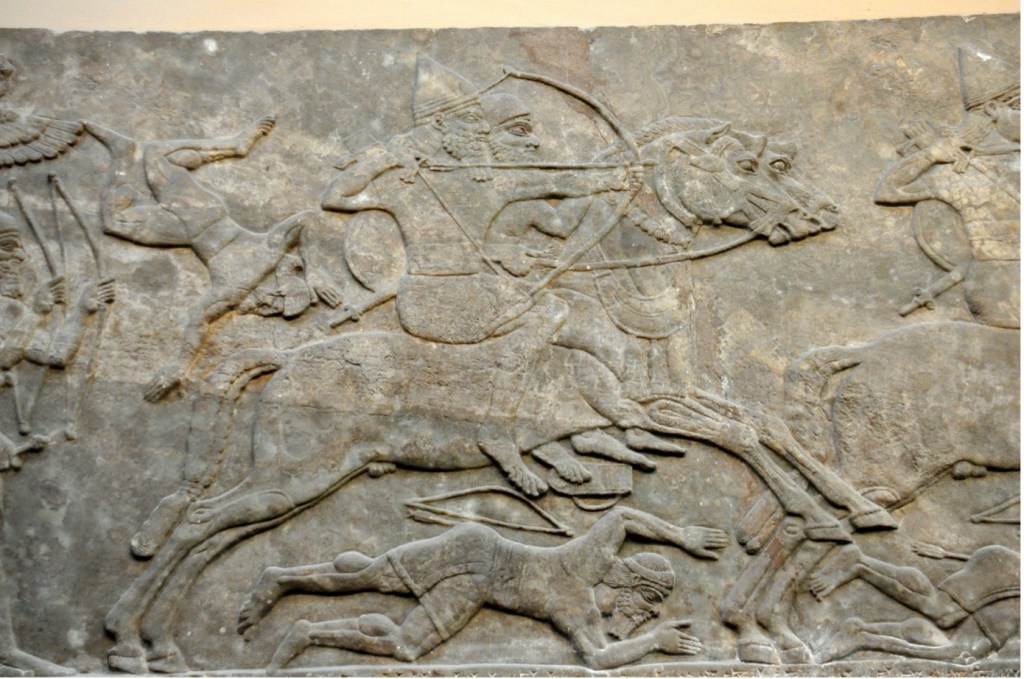
The Assyrians did not have saddles or stirrups. As a result, it was virtually impossible to shoot a bow while riding at full gallop. That is why, in visual sources, Assyrian cavalry during an attack is shown operating in pairs: one soldier fired the bow, while the other rode alongside, holding the archer’s horse by the reins and protecting him with a shield (ṣāb azmarî).
Later, from the reign of Sargon II (r. 722–705 BCE), cavalrymen began to operate individually in stead of in pairs, according to Mary Littauer and Joost Crouwel, thanks to the introduction of a new type of bridle. Although the majority of early sources depict cavalrymen primarily as archers (ṣāb qašti), there is later evidence for the existence of lancers who charged enemy lines with spears as shock troops (ṣāb kabābi).
“the cavalry became the most important part of the army and sometimes operated on the battlefield in formations of about 1,000 riders”
In any case, the cavalry became the most important part of the army and sometimes operated on the battlefield in formations of about 1,000 riders. However, the king faced one major problem: the limited availability of horses within the Assyrian kingdom. Consequently, horses became a highly sought-after import product. Kings sometimes preferred receiving horses as tribute from a vassal state over any precious metal. The sources even show the Assyrians adopting an aggressive stance toward suppliers who delayed the delivery of horses.
Tactics and Strategy
A significant portion of our information about battles and sieges is visual in nature and comes from the monumental wall reliefs in the royal palaces, the bronze gates of Balawat, and the frescoes of Til Barsip. For historians, these sources present two major drawbacks. On the one hand, they offer a one-sided, pro-Assyrian perspective; on the other hand, they depict the course of battles in a vague and schematic manner. For these reasons, it is nearly impossible to gain a balanced understanding of how battles unfolded or to clearly identify the maneuvers used.
However, it is believed that these sources provide an accurate depiction of Assyrian weaponry, uniforms, and siege equipment. Due to the detailed portrayal of Assyrian soldiers and their gear, many historians believe that the artists accompanied the army during campaigns, allowing them to study the troops up close. Be that as it may, our knowledge of Assyrian battlefield tactics remains highly limited.
We are, however, better informed about their overall strategy. In addition to battles, sieges were a frequent occurrence. Often, enemies would choose to retreat behind their city walls at the first sign of conflict. Yet the Assyrians were specialists in this form of warfare as well. Palace reliefs show Assyrian troops attacking fortified settlements using various types of war machines, such as battering rams, siege towers, and ladders, even undermining walls with tunnels at times.
Prolonged sieges, however, were costly in terms of time, lives, and resources. Therefore, a popular hypothesis suggests that Assyrian kings initially sought to compel enemy capitals to surrender without a fight by terrorizing the surrounding countryside. Vulnerable villages and unprotected rural populations became deliberate targets. Everything was burned, and the people were massacred as a warning to the besieged city. The Assyrians hoped this would pressure local authorities into surrendering in exchange for a general amnesty. If the enemy leadership refused to cooperate, they would try to convince the inhabitants to open the gates against their rulers’ will. If all else failed, there was no alternative but to storm the city in full force.
“Vulnerable villages and unprotected rural populations became deliberate targets. Everything was burned, and the people were massacred as a warning to the besieged city.”
The palace depictions testify to the horrific consequences for local populations in the event of an Assyrian victory: destruction, torture, rape and public beheadings. The Assyrians owe much of their grim reputation to such scenes. However, Dr. Carly Crouch argues that by the 7th century BCE, the Assyrians had become more restrained and selective in their acts of slaughter and destruction.
In any case, after a city’s capture, the monarch could decide either to raze the fortifications to the ground with his engineering corps or to preserve them. A captured stronghold could still serve the Assyrian kingdom as a strategic location. Often, a large part of the conquered population was deported to the other side of the empire. These population transfers primarily served to minimize the risk of rebellion by removing local populations from their homeland and leaders.

Conclusion
With its cavalry, chariots, and professional archers, the Assyrian army was considered the most efficient fighting force of the ancient Near East. During the Middle Assyrian period, soldiers were primarily farmers who could only be deployed during the summer months. However, due to their increasingly imperialist policies, the later kings were compelled to establish a professional army.
Initially, chariots were the main component of the army, but gradually, cavalry became the core of the military force. Both the horsemen and the chariots were primarily used to harass the enemy with bow and arrow, but in later periods, palace reliefs suggest they were also deployed as shock troops.
Assyrian soldiers gained a reputation for invincibility and were feared for their brutality. As a result, some enemies sometimes preferred to endure a siege with better odds rather than face a decisive open-field battle. The Assyrians, however, were also masters of this kind of warfare. Through psychological warfare and terrifying siege engines, they managed to subdue numerous fortified cities.
Nonetheless, the Assyrian Empire collapsed with astonishing speed at the end of the 7th century BCE. The Medes and Babylonians reduced the heartland of what had once been a mighty world empire to a vassal state. How this was exactly possible remains a subject of ongoing scholarly debate.
Olivier Goossens
Bibliography
- Cem, R., “The Iron Army: Assyria – Terrifying Military of the Ancient World – Part I”, War and Civilization, 2017. Geraadpleegd op 8 oktober 2022 via https://www.camrea.org/tag/sargon/.
- Crouch, C., War and Ethics in the Ancient Near East: Military Violence in Light of Cosmology and History, 2009.
- Dalley, S., “Assyrian Warfare”, A Companion to Assyria, ed. E. Frahm, 2017.
- Dalley, S., “Foreign Chariotry and Cavalry in the Armies of Tiglath-Pileser III and Sargon II”, Iraq, Vol. 47, 1985, pp. 31-48.
- Healy, M., The Ancient Assyrians, 1991.
- Littauer, M. & Crouwel J., Wheeled vehicles and ridden animals in the ancient Near East, 1979.
- Mark, J., “Assyrian Warfare”, World History Encyclopedia, 2018. Geraadpleegd op 20 oktober 2022 via https://www.worldhistory.org/Assyrian_Warfare/.
- Podany, A., The Ancient Near East: A Very Short Introduction, 2014.
- Radner, K., Ancient Assyria: A Very Short Introduction, 2015.
- Radner, K., ‘The Assyrian army’, Assyrian empire builders, University College London, 2012. Geraadpleegd op 14 november 2022 via http://www.ucl.ac.uk/sargon/essentials/soldiers/theassyrianarmy/.
- Roux, G., Ancient Iraq, 1993 (3de ed.).
- Van De Mieroop, M., A History of the Ancient Near East, ca. 3000-323 BC, 2015 (3de ed.).
 alongthesilkroad.com
Leave a comment