
Textiles occupy an important position within the history of civilization. In the context of tracing heritage and history, textiles themselves contain important information and epigraphic evidence such as dates and inscriptions as well as physical attributes such as woven structures, embellishments, fibre/materials, dyestuffs and general decorative elements. Textiles are also accompanied by marketplace lore concerning provenance and bear the circumstantial evidence of the time and place of their making, materials and form.
In tracing the history of the Silk Road, samples from Caucasian regions have revealed to us a fascinating evolution of practices and materials that have been shaped by geography, trade and a sustained cultural exchange. In particular, Armenian carpet weaving is an element of Caucasian heritage that bears an importance within the history of Eurasian textiles. Although few physical examples of Armenian carpets survive from before 1500, textual sources and comparative visual evidence allow scholars to trace the origins and evolution of their motifs with considerable clarity.
“Textiles themselves contain important information and epigraphic evidence… and bear the circumstantial evidence of the time and place of their making.”
Arab geographers and later European explorers have frequently praised Armenian carpets and related textiles for their technical refinement and visual sophistication. Ibn Hauqal, the Arab historian and geographer, had written in the 10th century regarding the quality and craftsmanship of Armenian textiles in his Book of Routes and Kingdoms. Marco Polo and other travelers recorded the production of finely woven carpets in Armenian regions, suggesting a well-established weaving tradition long before the early modern period.
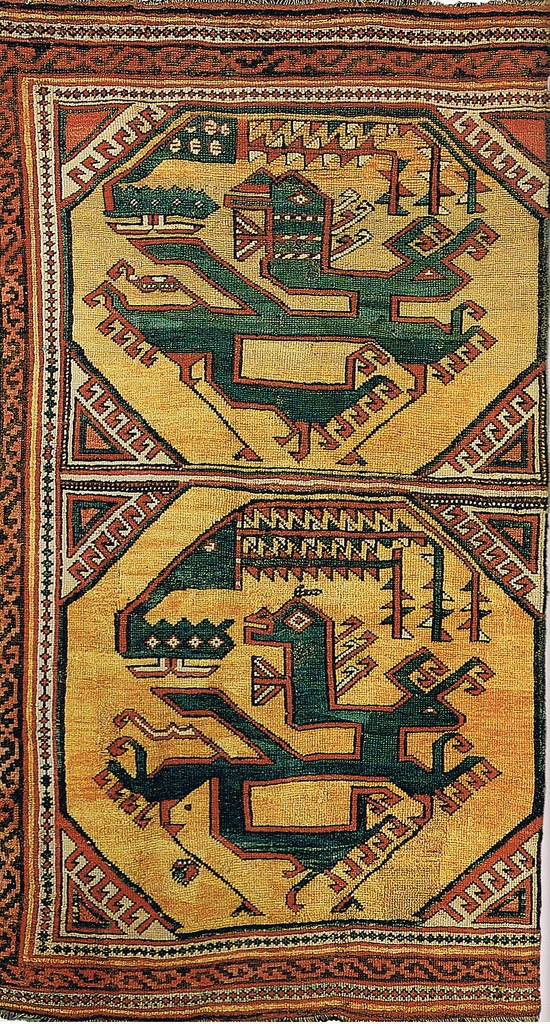
Despite historical praise, the scarcity of surviving carpet samples has placed a disproportionate emphasis on a handful of objects. Central to this debate is the Dragon and Phoenix motif carpet that has often been misinterpreted throughout Caucasian textile history. While discussing the symbolism behind the motif, it’s important to note that the origins of the Dragon and Phoenix most evidently have originated from Chinese mythology where both were associated with benevolence and celestial harmony. By the Yuan period, the Dragon symbolized imperial authority while the Phoenix embodied the empress. Their paired appearance signified balance, prosperity, and just rule; interpretations that remained intact as the motif traveled westward.
The transition of the Dragon and Phoenix motif into Armenian textile (or visual) culture occurred at various times during the thirteenth century, facilitated by diplomatic exchanges and trade under Mongol rule. Armenian nobles maintained close ties with the Mongol court, including documented embassies to Qaraqorum and Ilkhanid centers such as Sultaniya and Takht-i Suleyman. There is also historical evidence that suggests a more complex origin within the broader Caucasian sphere which was influenced by regional and imperial networks. During the reign of Abbas I of Persia, factories were reportedly established in Shirvan and Karabagh, which indicates possible connections to Safavid-era workshop production. One notable example is the Gohar Carpet which contains an Armenian maker’s inscription, providing direct evidence of Armenian participation in this weaving tradition. Such inscriptions are often the most reliable basis for attributing a carpet to a particular cultural group, though regional production and stylistic analysis may also contribute to scholarly interpretation.
“Armenian carpets thus stand as material witnesses to sustained artistic exchange, where global motifs were localized, reinterpreted, and preserved within an enduring craft tradition.”
Furthermore, the Dragon carpets of the sixteenth and seventeenth centuries are considered the oldest surviving pile carpets from the Caucasus, characterized by vivid colours, bold geometric compositions, and motifs such as lozenges, palmettes, and stylized dragon forms, sometimes depicted in combat scenes with animals. These carpets were often unusually long and narrow up to twenty feet and coarsely woven, suggesting durability and a multifunctional use for domestic interiors. Over time, the designs gradually evolved into large floral carpets, in which the earlier dragon and animal combat imagery disappeared but the decorative floral vocabulary remained. The weaving tradition of the Caucasus was primarily domestic, with carpets produced in the home by women using small vertical standing looms that could fit into interior spaces or balconies. The production of kilims, or flat-woven textiles, was similarly slow and complex and was also carried out largely by women.
Medieval Asiatic people never saw art in purely formal terms. To them, ornaments and motifs had religious, superstitious and other implications. Similarly, folk dimensions are also noticeable in the motifs and the everyday life and surroundings of the people found their way into art. These later works, though chronologically distant from the earliest surviving examples, provide critical evidence for continuity in motif usage and cultural meaning. Armenian carpets thus stand as material witnesses to sustained artistic exchange, where global motifs were localized, reinterpreted, and preserved within an enduring craft tradition.
Bakhtawar Jamil
Dragon Carpet 15th century:
Dragon Carpet 17th century:
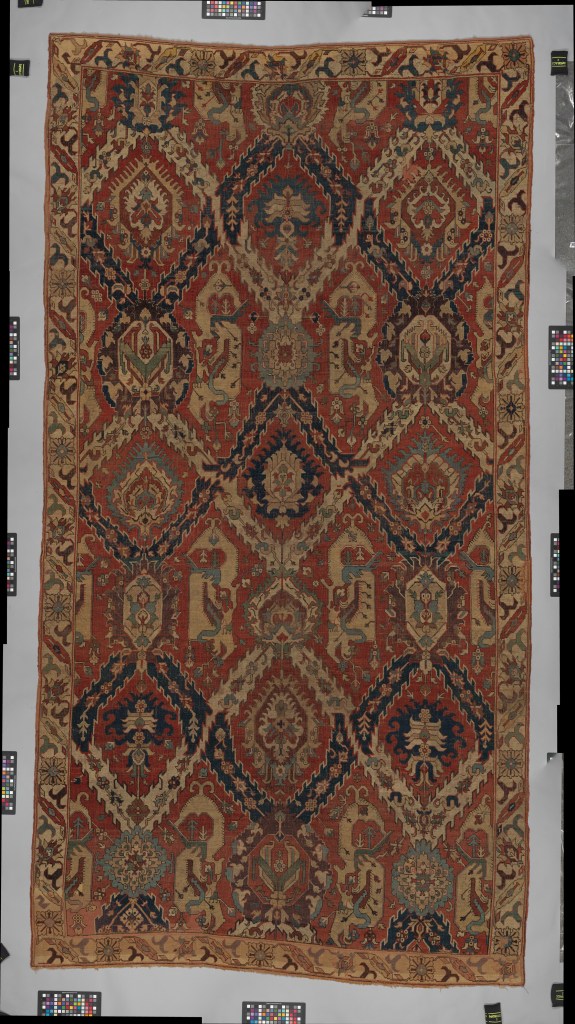
The Metropolitan Museum of Art, New York, The James F. Ballard Collection, Gift of James F. Ballard, 1922 (ID: 22.100.122).
Gohar Carpet:
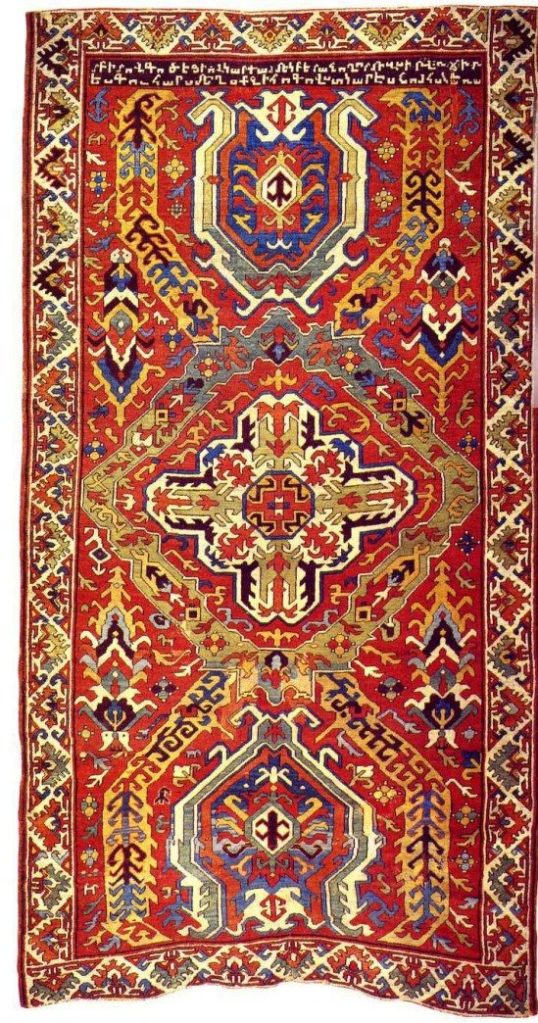
 alongthesilkroad.com
Leave a comment