
The story begins: Uyghur submission to the Mongols
In 1209, Barchuq Art Tegin (r. 1206-1230) the ruler of the Uyghur Kingdom of Qocho (ca. 840-early 14th) situated in the Tarim Basin in present-day Xinjiang, voluntarily submitted to Chinggis Khan (r. 1206-1227). From that point on, their collaboration would extend beyond trade and will be sealed in privileges, duties and a marital alliance. According to a later chronicle, Chinggis Khan declared:
“I will give him a daughter. Let him be a fifth son. Let the Ïduqut come hither, bringing gold, silver, subut-pearls, tana-pearls, nasis-brocades, and silks.”1
(Translation by Christopher P. Atwood)
“Not only did Barchuq become the “fifth son” of Chinggis Khan, but his people also benefited from this status and were granted opportunities within the Mongol Empire”
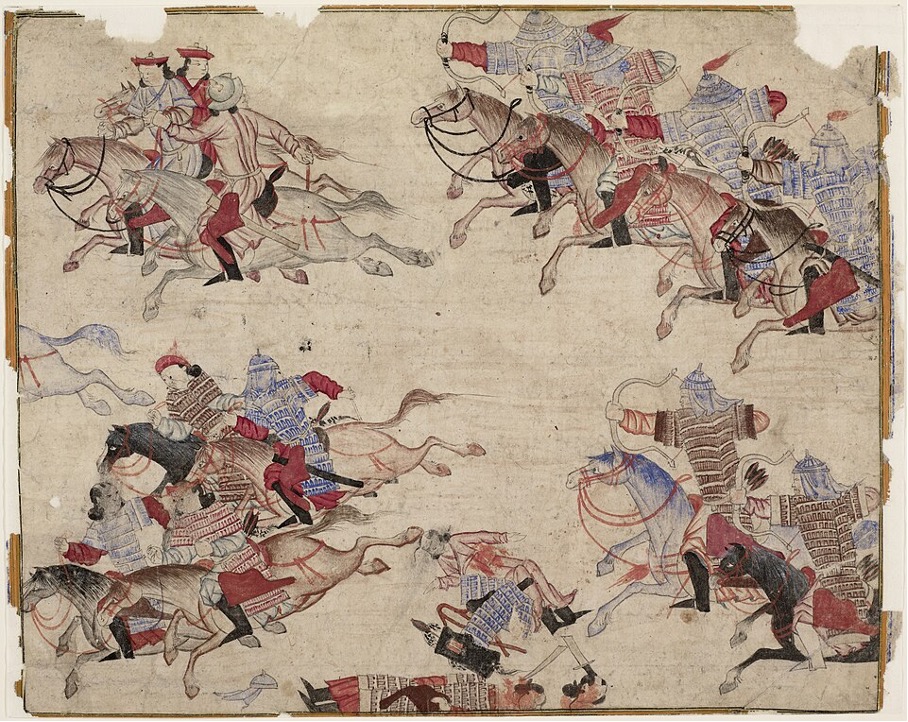
By submitting to the Mongol Khan, Barchuq accepted the status of vassal and its inherent duties. These included the possibility of the Mongols requisitioning Uyghur territory, troops, goods, as well as intellectuals. In return, the Uyghur ruler was allowed to retain the title of “iduq qut” meaning “blessed by divine favor”, his kingdom, and enjoy a privileged status within Mongol hierarchy.
Not only did Barchuq become the “fifth son” of Chinggis Khan, but his people also benefited from this status and were granted opportunities within the Mongol Empire as translators, administrators, merchants, scribes, and physicians. Their knowledge and active participation were key in the establishment and development of the Mongol Empire.
Why were Uyghurs favored?
“The Mongols had already relied on Uyghur collaboration to strengthen their economy from an early stage.”
Prior 1209, the relations between Mongols and Uyghurs were largely centred on commerce as both were involved in Silk Road trade. The location of Uyghur kingdom, situated on one of the main trade routes, positioned them in a particularly favorable situation.2 Several documents written in Old Uyghur demonstrate that the Uyghur territory was an important bottleneck in Eurasian trade through which goods and horses travelled from east to west and vice versa.3 Thus, even without a formal alliance, the Mongols had already relied on Uyghur collaboration to strengthen their economy from an early stage. In this regard, 1209 does not represent a sudden shift but rather builds upon long-standing ties and exchanges. This strategic location within the empire also made it critical to the success of the Mongol postal network known as yam.
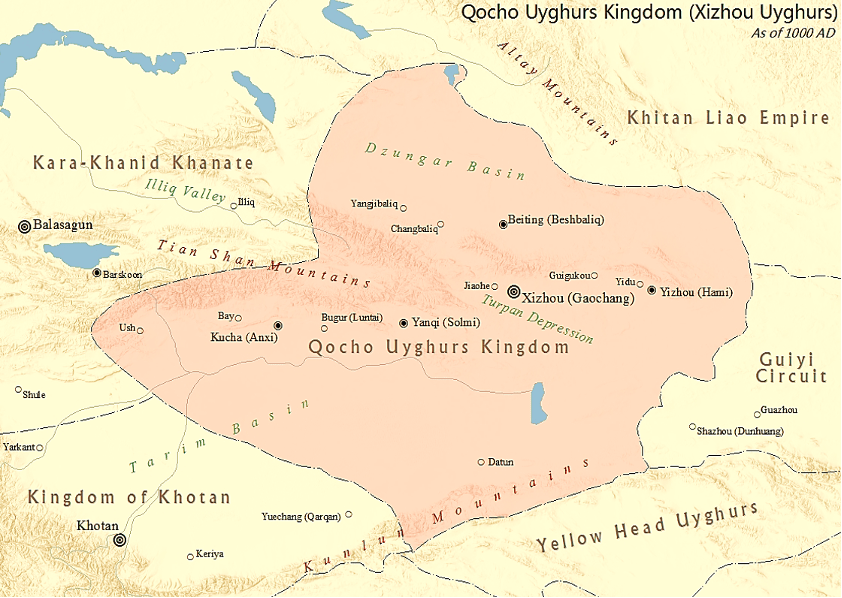
Furthermore, Uyghurs and Mongols share a common cultural background. Both originating from Mongolia, they belong to the same Turco-Mongol matrix. They share similar beliefs, practices, and ideology. The Uyghurs were nomads before they settled in the Tarim Basin around 840, and their rulers fell under the mandate of the sky deity Tengri. Their proximity to the Mongols, who also received their legitimacy to rule from Tengri and lived according to a nomadic lifestyle, was a valuable asset.
“Within the Mongol Empire, the Uyghurs could facilitate cross-cultural interactions.”
Indeed, the Uyghurs transitioned early from a nomadic to sedentary way of life. They established a local kingdom on a territory already inhabited by sedentary populations such as Tokharians, Sogdians and Han Chinese. As Márton Vér explains: “the Uyghurs were the first settled people with a high cultural and administrative level to become part of the Mongol empire making them perfect agents for the transmission of knowledge about the governance of settled subjects that was crucial for the Mongols.”4 Within the Mongol Empire, the Uyghurs could facilitate cross-cultural interactions as they ruled over a multilingual and multicultural region. In other words, the Uyghur Kingdom of Qocho appeared to be a model of government that aligned with Mongol political aims.
A wide range of roles in the Mongol Empire
“Uyghurs were more than mere soldiers, as they were also part of the Khan’s inner circle serving as advisers and tutors.”
After submitting to the Mongol Khan, Uyghurs became a “mobilized diaspora” involved in several aspects of the imperial enterprise.5
This process started with Barchuq who took part in many Mongol campaigns such as against the Khwarazmian Empire in Central Asia in 1216, and in 1225 against the Tanguts in Northern China as part of his duties.6 Uyghur military support outlived Chinggis Khan. For instance, Lian Xixian (1231–1280) a military official under Qubilai Khan (1215-1294) led Mongol troops against Ariq Böke (r. 1259-1264) and the Song dynasty (960-1279) in the 1260s.7
However, Uyghurs were more than mere soldiers, as they were also part of the Khan’s inner circle serving as advisers and tutors to the Khan’s family.8 Some Uyghurs, such as Ashiq Temür, took advantage of their linguistic skills to teach Uyghur to members of the imperial clan. Due to their proficiency in many different languages, many Uyghur officials were also involved in translating and compiling foreign technical literature and chronicles at the Great Khan’s request.9
Especially under the Yuan dynasty (1271-1368) Uyghurs occupied high positions in the administration. They belonged to the semuren category, which designated persons of high status, mostly foreigners from Central Asia. In Mongol hierarchy, the semuren were ranked just below the Mongols and above the hanren, the Han Chinese. The latter, demoted by the Mongols, even complained about the Uyghur monopoly on higher positions.10 Sources offer precious insights on the diversity of positions occupied by the Uyghurs. For example, it is known that Sevinch Toghril (fl. 1200–1230s) served in the early years of the Mongol Empire as a judge in North China. He opened the path for his descendants who were also appointed to military and civil positions.11 Moreover, Uyghurs derived other advantages from their ethnicity. Similar to the Mongols, they enjoyed tax exemptions and preferential use of the official post roads and services.12
However, even though the Uyghur kingdom managed to integrate into the Mongol Empire while primarily retaining its autonomy as a political entity, its degree of independence fluctuated throughout its existence. During the Yuan dynasty, the status of Uyghur rulers was reshaped by the Mongols. In the first half of the 14th century, the iduq qut Ne’üril Tegin (r. 1280-1318) was awarded a made-up honorific title, “Prince of Gaochang”, named after the capital of Uyghur kingdom. This title reflects the progressive loss of political power by the Uyghurs, and the emphasis on their role as administrators for the Yuan. Consequently, the descendants of Ne’üril Tegin were appointed to leadership positions including provincial governorships, the Bureau of Military Affairs, the Censorat, and other court and provincial offices.13
Surviving the fall of the empire
If Uyghur influence was evident during the Mongol era, it began even before 1209. A notorious example of it is the story of Tatar Tongga who created the Old Uyghur script14 for Mongols in 1204.15 This script became the lingua franca of the empire ensuring administrative efficiency and cohesion.16 It remained in use (written horizontally) long after the Mongols, especially in Timurid Central Asia and Iran until its replacement by the Arabic script in the 17th century.
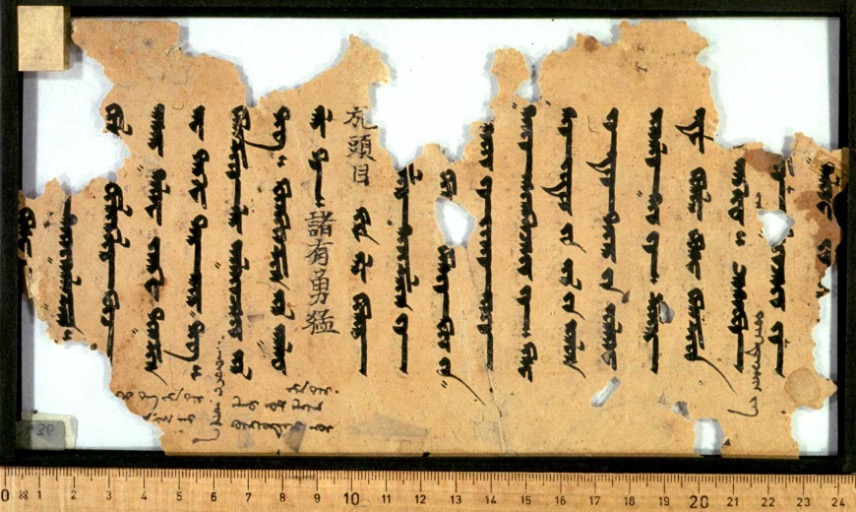
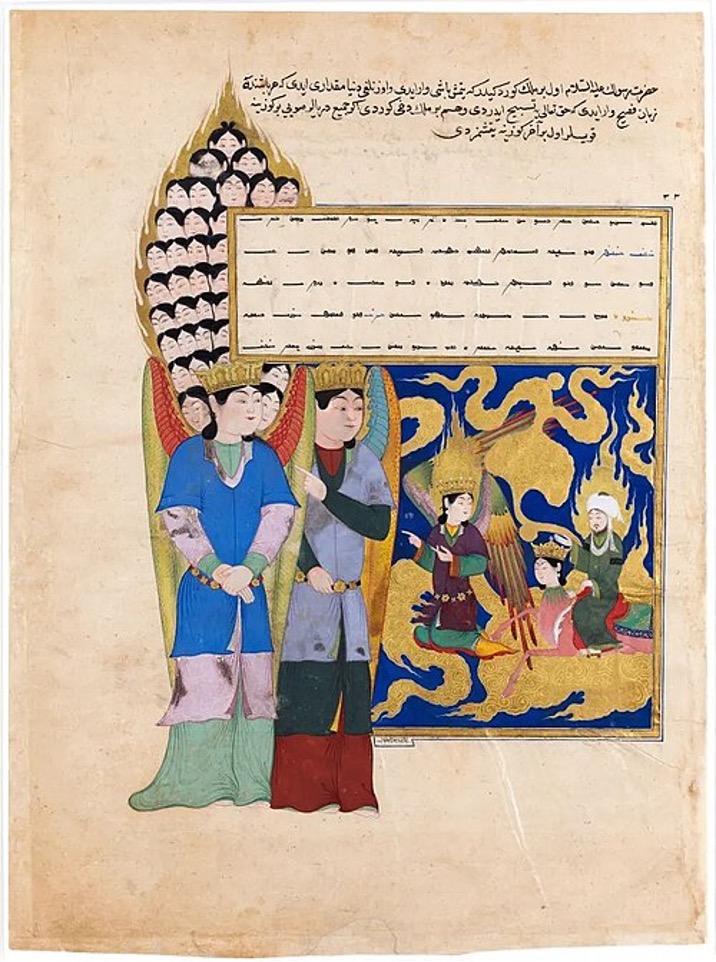
The Uyghurs legacy survived the demise of the Mongol Empire in many aspects. After the fall of the Yuan dynasty in 1368, many Uyghurs chose to remain in China. Most of them had migrated earlier from Central Asia and had been established there for generations. Under the Ming dynasty (1368-1644), Uyghurs were still present in the administration despite losing their privileged status. There is also evidence of Uyghur scribes at the Timurid court. As with the Yuan dynasty, they played a crucial role in recording the words and actions of the rulers.17
Their influence is still tangible today through the 15,000 Uyghur fragments preserved thanks to the dry climate of the desert where they were found.
The Uyghurs were particularly successful because they saw the hybrid nature of the Mongol Empire as an opportunity to thrive, making themselves indispensable in the process. From a broader perspective, the history of Uyghur-Mongol relations shows that the Silk Road and Eurasia have not been solely shaped by imperial powers, but also by local political entities, and intermediaries. This encourages us to move away from the binary narrative of the Silk Road, and to integrate a bottom-up approach of its history.
Lisa Ducher
Lisa Ducher is a recently graduated historian who completed an MA in Middle Eastern Studies at Leiden University. Her thesis focused on the evolution of Uyghur rulers’ titles under Mongol rule (ca. 840-1250). As a historian with a background in art history and Islamic art, Lisa is particularly interested in material culture and transnational interactions in Eurasia, especially during the Mongol period. In addition to her historical training, she has developed language skills in Mandarin Chinese, Turkish and Modern Standard Arabic, which she continues to strengthen. She is looking forward to pursuing another MA in Chinese Studies as a Yenching Scholar at Peking University.
- Christopher Atwood, The Secret History of the Mongols, (London: Penguin Books, 2023), 120. ↩︎
- Thomas T. Allsen, Culture and Conquest in Mongol Eurasia. of Cambridge Studies in Islamic Civilization. (Cambridge: Cambridge University Press, 2001), 12-13. ↩︎
- For more details see Márton Vér, “Insights from the Inside: An Old Uyghur Register and the Administration of the Mongol Empire,” Journal of the Economic and Social History of the Orient 64, no. 5–6 (2021): 435–448. ↩︎
- Márton Vér, “Mobility Patterns along the Eastern Silk Roads (Tenth to Fourteenth Centuries): A Global-Microhistorical Perspective.” Journal of the Royal Asiatic Society 35, no. 1 (2025): 63. ↩︎
- Ari Daniel Levine, A Review of “Subjects and Masters: Uyghurs in the Mongol Empire”, Journal of Song-Yuan Studies 39 (2009): 31–32. ↩︎
- Michael C. Brose, “The Medieval Uyghurs of the 8th through 14th Centuries,” in Oxford Research Encyclopedia of Asian History, ed. David Ludden (New York: Oxford University Press, online ed., June 28, 2017), 11. ↩︎
- Michael C. Brose, “The Mongols in the Eyes of the Uyghurs,” in The Mongol World, 1st ed., ed. Michael Hope and Timothy May (London: Routledge, 2022), 794. ↩︎
- Michael C. Brose, “Uyghur Technologists of Writing and Literacy in Mongol China,” T’oung Pao 91, nos. 4–5 (2005), 398. ↩︎
- Brose, “The Mongols in the Eyes of the Uyghurs”, 795. ↩︎
- Brose, “The Mongols in the Eyes of the Uyghurs”, 792. ↩︎
- Idem. ↩︎
- Bawden, C.R. “Kublai Khan.” Encyclopedia Britannica, February 13, 2026. ↩︎
- Brose, “The Mongols in the Eyes of the Uyghurs”, 793. ↩︎
- The Old Uyghur script itself derives from the Sogdian alphabet. ↩︎
- Elverskog, A history of Uyghur Buddhism, 120. ↩︎
- Brose, “Uyghur Technologists of Writing and Literacy in Mongol China”, 397. ↩︎
- Allsen, Culture and Conquest in Mongol Eurasia, 101. ↩︎


Leave a comment