Every civilisation possesses a location that serves as an emblem for what they represented, valued and aspired to. For ancient Greece, one could say that it was Athens, with its grand monuments and cultural advancement. For the Tang dynasty, who oversaw China’s cultural golden age, it was their capital city of Chang’an, with its monumental architecture, fine arts and orderly civic rituals. When it comes to the Achaemenid Empire, there is one clear answer. This place has gone by several names over the course of Iranian history, such as Parsa, the Hundred Columned, Jamshid’s throne and the richest city under the sun. But it is the Greeks and Macedonians who gave us the name that is most associated today: Persepolis.
This article will explore how the Great Kings imbued every facet of this architectural marvel with symbolism. From the art adorning its walls to its place within the royal calendar, we shall see how Persepolis became arguably the greatest symbol of Achaemenid ideology. Finally, we shall observe how its destruction at the hands of Alexander of Macedon has unintentionally turned the site into a symbol of historical preservation for modern historians.
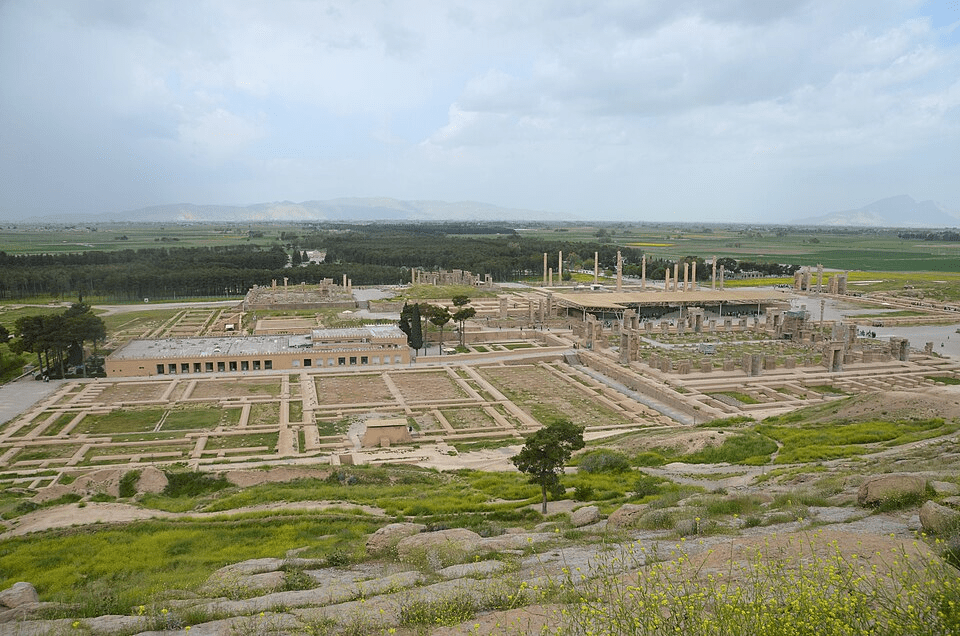
Overview of the ruins of Persepolis (Wikimedia Commons, Licensed under CC BY-SA 2.0.)
Set Into The Heartland Itself
As the Persian Empire expanded, it acquired several cities that would act as the capitals for the burgeoning state. Babylon and Susa, located both in and close to the cultural and administrative hub of Mesopotamia, would act as administrative and economic hubs while Ecbatana, the former capital of the Medean Empire, would act as the summer residence and headquarters of the Great King and his court. And yet, there wasn’t a great imperial centre within the Persian homeland itself. Cyrus’ palaces and gardens at Pasargadae may have been the first step towards such a site, but it seems that he was aware that a truly Imperial centre, one that displayed the cultural and economic might of the empire, was required, and the site of Persepolis seems to have been pre-destined for such a purpose.
In 2015, at the hill of Tol-e-Ajori, or the Hill of Bricks, archaeologists discovered the remains of a colossal gateway, surrounded by the beginnings of pavilions and gardens that were similar to Pasargadae, all dating to the time of Cyrus. Analysis showed that the bricks of the gateway would have been glazed in coloured a vivid blue, just as with the famous Ishtar gate from Babylon. It has been theorised that Cyrus had brought in craftsmen and builders from Babylon after the city’s conquest in order to take the Babylonian artistic style and merge it with others in order to create a unique Imperial aesthetic, all while displaying to the world that it was from this region that imperial power truly flowed.
Although Cyrus’ death brought an end to the project, it shows that there was already a wish to create something that both symbolised the might and extent of the Empire but also elevated the Persian homeland to a more prominent status.
When Darius The Great set his sights on Persepolis, he seems to have dismantled the monuments begun under Cyrus’ rule, intending to stamp his claim on the site. Selecting a promontory known as the Royal Hill as the site of his great work, he imagined a monument that was as much an ideological statement as it would be a residence. A representation of Persian might and the vast breadth of its world empire.
An Imperial Jewel Hewn from Stone and Wood
“Upon the Royal Hill, a colossal stone platform, covering 125,000 square meters, was built as a base for the buildings to come, making it visible for miles around and elevating the site above the ordinary world.”
Upon the Royal Hill, a colossal stone platform, covering 125,000 square meters, was built as a base for the buildings to come, making it visible for miles around and elevating the site above the ordinary world.
As visitors approached, they would first need to scale a large double staircase to reach the “floor level” of the site. These steps were far shorter than normal stairs, likely to allow groups of courtiers to climb them in a more elegant and less strenuous manner. Even the normally mundane act of walking and ascending a staircase had become a ritual and a display of elegance on a grand scale. At the summit, they would be greeted by the next display of empire: The Gate of All Nations.
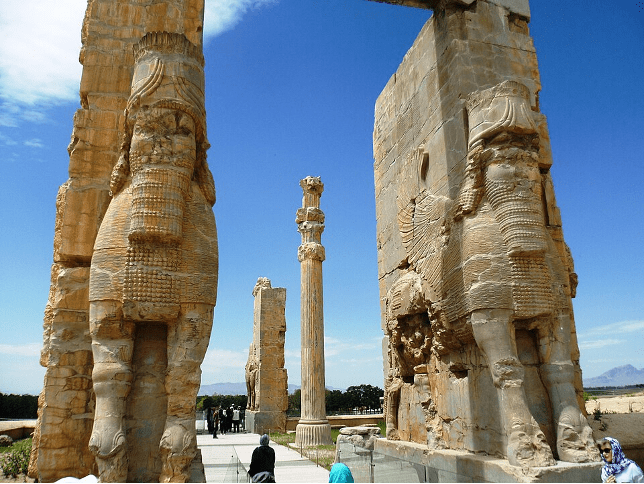
The Gate of All Nations (Wikimedia Commons, Licensed under CC BY 3.0 PL.)
As the visitors were guided through the gate and into the reception chamber, they would be met by two monumental statues, known as lamassu. These beings possessed the bodies of bulls, the wings of birds and the heads of men. Commonly believed to ward off evil, they had been adopted by the Persians from the preceding empires of Babylon and Assyria, tying the Achaemenid dynasty into the imperial tapestry of the region. While the visitors waited for access to the inner palace, they were met by an inscription commissioned by king Xerxes in the imperial languages of Old Persian, Babylonian and Elamite, declaring that Ahura Mazda, the supreme deity worshipped by the Achaemenids, not only created the world and all its wonders but that he had made Xerxes a “king of many kings”. In one monument, the Achaemenids made it clear to all who entered that they were ordained to rule, both as successors of previous earthly powers and by God himself.
Once the visitor was allowed to enter the palace complex, they would be greeted by the true imperial spectacle of Persepolis. Vast monuments rose around the visitor, supported by 70-foot columns capped with the ornate heads of bulls, griffins and lions. Together, they displayed not only the wealth of the empire, but also the artistic and architectural talent at the disposal of the Great King. Were the visitor to enter the Apadana, the colossal audience hall built by Darius the Great, they would see a chamber filled with another 72 ornate columns, large enough to accommodate thousands of people. If the visitor looked up, they would have seen that the columns supported a lavishly decorated roof made of cedarwood, a strong and highly prized wood most often sourced from the mountains of modern Lebanon, further demonstrating the wealth and reach of the King of Kings.
And yet, buildings such as the Apadana may have had a secondary symbolic meaning. The building’s components, the rectangular structure, the large inner chamber and a front portico supported by pillars, have been interpreted by some scholars as the monumental incarnation of something quite different: an Iranian nomadic tent. Just as with Achaemenid clothing, Persepolis thus projected an identity that was simultaneously imperial, cosmopolitan and distinctly Persian.
Ideology through Art
To the Persians building Persepolis, art was not simply decoration but a carefully designed mechanism with which they communicated their ideas of kingship, empire and order.
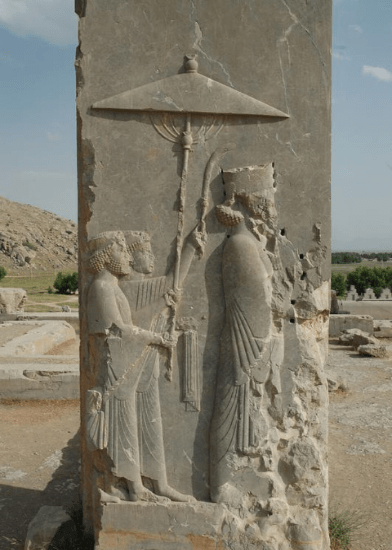
Scene of Xerxes I and his attendants, with the difference in size mirroring their respective ranks (Wikimedia Commons, Relief of Xerxes at Doorway of his Palace, Persepolis, Iran, Licensed under CC BY-SA 3.0. )
Persepolis, through its elevation, scale and the magnificence of its buildings, was meant to display the power and primacy of the Great King, a goal further pursued through art. The Great King is consistently elevated above those around him, either physically enthroned above his subjects or depicted on a larger scale. In the former case, there are some scenes where the enthroned king is shown being held aloft by his subjects. Like the temple reliefs of pharaonic Egypt, these scenes transformed political hierarchy into a sacred visual order.
“The interaction between Persians and subject peoples is shown not as one of subjugation through fear but of harmony, order and ritual submission.”
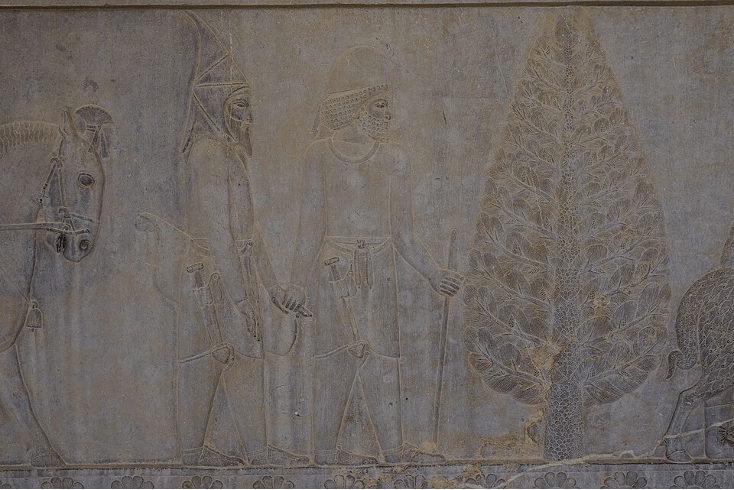
And yet, the art in Persepolis is remarkable both for what it contains and, most importantly, what it does not. When dignitaries visited the kings of Assyria in palaces such as Nineveh, they would walk past friezes showing Assyria’s military might and the gruesome consequences of defying them. In contrast, when a visitor approached the Apadana, they would be met by reliefs of a completely different tone. People from all across the empire, such as Lydians, Indians and nomadic Scythians, their distinctive dress and the various kinds of tribute they brought faithfully represented, being led by Persian dignitaries towards the king. Dignitaries are not shown doing so through force but gently, with a Persian official leading those at the front by the hand. The interaction between Persians and subject peoples is shown not as one of subjugation through fear but of harmony, order and ritual submission.
Scythian delegation being led to the king. Note the distinctive headdress and bowcase of the Scythian being led (Wikimedia Commons, Licensed under CC BY 2.0.)
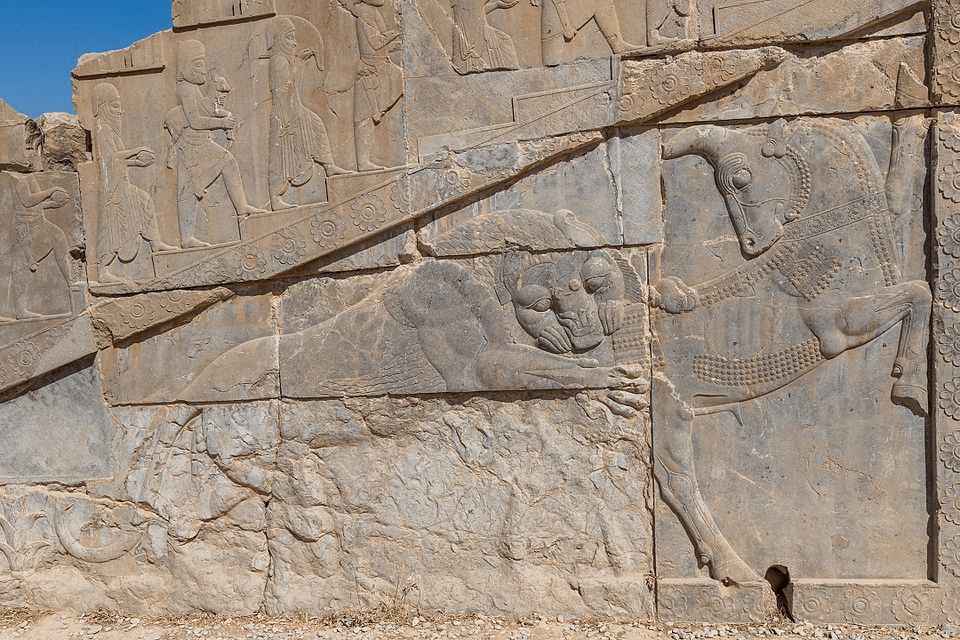
The Persians did display conflict and violence in art, such as at the Behistun inscription where Darius is shown with his foot placed onto the head of a rebel leader while others are shown bound at the neck before him. And yet, when it came to Persepolis, the Achaemenids abstained from displaying scenes of conquest or human brutality. The only two friezes that do show some form of violence show the king fighting against a winged, horned beast and a lion pouncing on a bull. The former has been interpreted as the victory of order over chaos while the latter has often been interpreted as a representation of the new year overcoming the old, an important factor for a sight that may have been the location where the king celebrated the new year, or Nowruz.
The bull and lion locked in battle, one of the very few scenes involving violence at the site (Wikimedia Commons, Licensed under CC BY-SA 4.0.)
Through its art, Persepolis presents the ideal version of the empire that the Persians strove for: hierarchical but harmonious, diverse yet orderly, many peoples united under the divinely sanctioned authority of the King of Kings.
Inferno, Preservation & Memory
“Despite the Great Kings’ vision of imperial order, chaos was bearing down on Persepolis at the head of a Macedonian army.”
Despite the Great Kings’ vision of imperial order, chaos was bearing down on Persepolis at the head of a Macedonian army. After having defeated the armies of king Darius III and overcome the defences of Aryabarza at the Persian Gates, Alexander the Great marched into Persepolis. Although the Macedonians were amazed by the majesty of the site, it would not be long before awe turned to rage. Whether sparked during a drunken revel or carried out as deliberate vengeance for the Persian sack of Athens, Alexander and his men burned Persepolis to the ground. Later Persian sources would also state that precious religious and historical texts were destroyed in the blaze, turning an act of already devastating destruction into a lasting cultural wound in the Persian cultural memory. The site would, over time, turn into a symbol of past greatness, being associated with characters from Iran’s legendary past like Jamshid, from whom Persepolis gained one of its many titles.
And yet, despite the devastation caused by the flames, they accidentally helped preserve something that has turned Persepolis into a symbol of knowledge and insight to modern historians. Although Persepolis was a place of great ceremonial importance to the Persians, it was also a repository of administrative records, all written on clay tablets that were hardened by the intense heat of Alexander’s flames, allowing over 30,000 tablets to survive to this day. The Fortification and Treasury tablets, named after the buildings within which they were discovered, provide an invaluable insight into the lives of the people who worked in the administrative machine of the empire. They provide evidence of payment given to various work forces, as well as special dispensations given to female workers who were pregnant or had recently given birth. They also describe the supply networks that sustained the empire’s messengers along the Royal Road, ensuring that food and horses were always available. They even provide stories that almost anyone today can relate to. One tablet records a manager named Parnakka furiously attempting to recover sensitive documents after a courier retired without conducting a proper handover. Fortunately, Parnakka seems to have avoided any major trouble as he is later recorded managing the transfer of wine from the king’s cellars to the queen’s as a gift.
“Without these tablets, the modern world would have lost one of its clearest windows into the lives of the ordinary people so often overshadowed by kings, nobles and monuments.”
Persepolis is rightly famed for its magnificence, from its scale to its art. And yet, such humble items made of baked clay, preserved by the agent of the site’s annihilation, have turned Persepolis into a symbol of preservation and understanding. Without these tablets, the modern world would have lost one of its clearest windows into the lives of the ordinary people so often overshadowed by kings, nobles and monuments.
A Jewel of Many Faces
Persepolis was never intended to be the administrative and governmental nerve centres of the empire like Babylon or Susa. Instead, Persepolis acted as a stage for the empire’s very soul. Through art and monument, the Great Kings displayed what they saw as the ideal version of a world empire: a divinely sanctioned power tasked with protecting the world and its many peoples from chaos. This made its destruction all the more poignant, as it is often seen as the end of the Achaemenid empire. And yet, even in death, Persepolis retained its symbolic power as a monument to the abilities of its creators but also as a rare gateway into the lives of both kings and the ordinary people who lived in the shadow of imperial grandeur.
Milo Reddaway
Further reading
Caiozzo, A., 2010. Abolala Soudavar, The Aura of Kings, Legitimacy and Divine Sanction in Iranian Kingship, Mazda Publisher, Costa Mesa, 2003, 178 p. Médiévales. Langues, Textes, Histoire, 59(59), pp.195-197.
Finn, J., 2011. Gods, kings, men: trilingual inscriptions and symbolic visualizations in the Achaemenid empire. Ars Orientalis, pp.219-275.
Kuhrt, A., 2013. The Persian Empire: a corpus of sources from the Achaemenid period. Routledge.
Llewellyn-Jones, L., 2022. Persians: The age of the great kings. Hachette UK.
Mallowan, M., 1972. Cyrus the Great (558–529 bc). Iran, 10(1), pp.1-17.
Namazi, M., 2014. Analyzing Persepolis Fortification Tablets with Focusing on Accounting and Bookkeeping Methods. بررسیهای حسابداری و ح
Neumann, K., 2021. To touch upon: A tactile exploration of the Apadana reliefs at Persepolis. In The Routledge Handbook of the Senses in the Ancient Near East (pp. 77-99). Routledge.
Razmjou, S., 2010. Persepolis: a reinterpretation of palaces and their function. The World of Achaemenid Persia: History, Art and Society in Iran and the Ancient Near East. London: IB Tauris, pp.231-245.



Leave a comment