
In present-day minds, the Uyghur people are associated with Islam. Yet, this is a relatively recent development in their history. It is only after the integration of the Uyghur kingdom of Qocho (ca.840–14th century) into the Chagatai Khanate during the 14th century that they slowly began to convert to Islam.
Long before that, in 762/763, the Uyghur kingdom adopted Manicheism as its state religion. But why would a steppe khaganate choose a religion that originated in Mesopotamia? And, why would they adopt a religion that prohibited the consumption of dairy products and meat, which represented a significant part of the steppe diet? This article aims to explore what was at stake when the Uyghur ruler Bögü Khan (r. 759–79 CE) made this decision, and what its consequences were for the region and the khaganate.
The context of Bögü Khan’s conversion to Manicheism
“Now we repent of [our] former sins. We respectfully serve the righteous teaching… Now the misconceptions have already been corrected, it is impossible to return to misconduct.”
Manichaeism is a religion derived from the teachings of the prophet Mani (216–274 CE), blending elements from Zoroastrianism, Buddhism, and Christianity. It was adopted in 762/763 by the Uyghur ruler Bögü Khan and stayed the Uyghur state religion until the middle of the 10th century. This likely happened during a Uyghur campaign in Tang China, where the ruler encountered Manichean missionaries. This episode is reported in the Chinese passage of the Karabalgasun inscription found in the Uyghur khaganate’s capital of the same name in 1889:
“The preceptors of the law [Ma]ni have secretly reached the light gate and mastered the seven sections. [Their] talents surpassed the seas and mountains. [Their] eloquence was like a falling river [from heaven]. Therefore, [they] were able to reveal the righteous teaching to the Uyghurs. [They] rejected meat food, and dairy products were introduced into the rule.”
(Translation by R. Kamalov, 2001, p.195)
The above passage details how the monks got the Uyghur ruler to convert to Manicheism, and by doing so, how they gained authority over him. The same passage mentions the honorific titles of Uyghur elites, “Tutuki, chigili, internal and external ministers, Sima,” and their declaration of conversion as follows:
“Now we repent of [our] former sins. We respectfully serve the righteous teaching. We accept the decree and declare [it]. We can obtain and retain the elusiveness and secrecy of this law! We repent three more times that we did not know [him] before, the demon was called a buddha. Now the misconceptions have already been corrected, it is impossible to return to misconduct.”
(Translation by R. Kamalov, 2001, p.195)
It can be inferred from this text that Uyghur elites’ conversion was fierce and public, but that a part of Uyghur society probably continued to follow pre-Manichean beliefs.
Indeed, before their conversion to Manicheism, the Uyghur rulers followed the traditional Turkic religious tradition, sometimes called ‘shamanism’, as it is rooted in animism and centered on the worship of the sky deity Täŋri. Consequently, Uyghur conversion to Manicheism broke with the Turkic tradition by adopting a religion founded in the 3rd century CE in Mesopotamia.
This conversion certainly differentiated Uyghur rulers from their predecessors on purpose. As Colin Mackerras explains: “The Uighur state was the only one in Eastern Asia ever to adopt this religion as its formal faith, making Bögü Kagan’s conversion of considerable historical interest and significance”.
Adopting a faith as a ‘state religion’ does not necessarily mean the forced conversion of the population. The Uyghurs ruled a cosmopolitan kingdom that included other religious communities, such as Buddhists and Eastern Christians (Nestorians). Having a state religion implies hierarchy, not exclusivity. Bögü Khan’s conversion goes beyond religion; it is a political statement that signals to external powers the kingdom’s inspirations and aspirations. The adoption of Manicheism favored the elites and created a politico-religious cast regardless of the believers’ ethnic origins.
It remains difficult to evaluate the depth of the ruler’s beliefs in Mani’s teachings. However, a conversion, even if not personal, is still a transformative act, shaping the structure of the kingdom. There is evidence of Manicheism’s influence on Uyghur political ideology and rituals. As an example, there are mentions of the Sun (Kün) and Moon (Ay) deities juxtaposed with Turkic elements such as mentions of “täŋri” in Uyghur rulers’ titles. For example, Ay täŋridä qut bulmïš alp bilgä qağan (r. 808–821) and Kün täŋridä ülüg bolmïš alp küčlüg bilgä qağan (r. 821–824).
This religious layering goes beyond titles. In the Manichean dogma, there is a constant fight between light and darkness. The sun and the moon are direct manifestations of the divine light. This cosmology presents some similarities with the Turkic ‘shamanistic’ religion, in which natural elements are also central divine elements. This probably facilitated the cosmological layering operated by the Uyghur rulers visible in their titles.
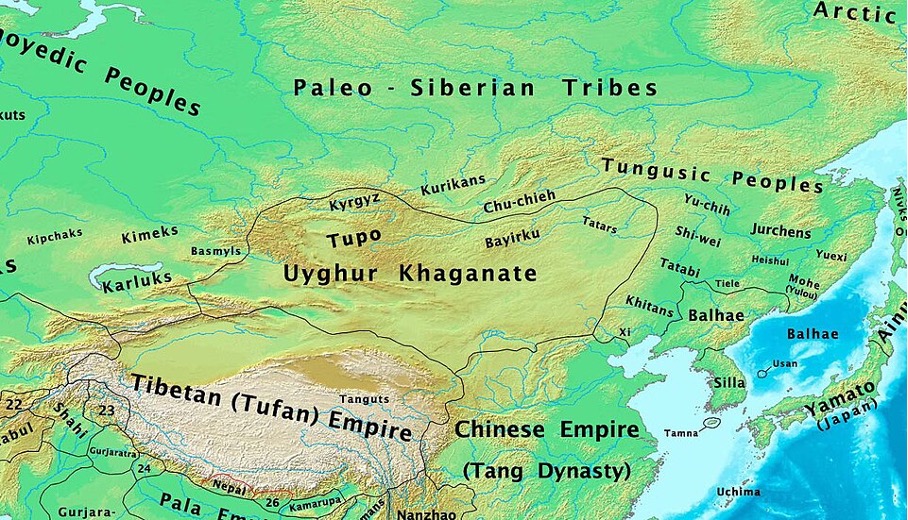
In the 8th century, the Uyghur Khaganate (744–840) was mainly established in the Orkhon Valley (in present-day Mongolia) until 840, which marks the beginning of Uyghur migration towards the South. This migration can be explained by environmental and political challenges. Uyghurs suffered from the harsh climate and were ultimately defeated by the Kyrgyz in 840. Following this defeat, they migrated in three different groups, which separately settled in the Tang territory, in the Gansu corridor, and in the Tarim Basin in the West. The latter became the West Uyghur Kingdom, due to its western location compared to the Khaganate, or Kingdom of Qocho, named after its capital.

Why adopt Manicheism?
“Adopting Manicheism can be seen as an attempt to unite and centralize.”
From a broader perspective, the act of converting has to be understood in a context of instability. It appears two decades after the Uyghurs toppled the Gökturk Empire (552–744). The Khaganate was still a young power in the region and needed to unite the inhabitants of the steppe. Adopting Manicheism can be seen as an attempt to unite and centralize. As stated in the Karabalgasun inscription, Manicheism and its clergy certainly provided significant support to the state.
However, this cause is not the only explanation. Adopting a religion that required a vegetarian diet is rather surprising considering the harsh steppe environment and the traditional diet of its inhabitants, mainly based on meat. According to many historians, including Johan Elverskog, this decision has a lot to do with the Sogdians. The historian explains: “adopting Manichaeism brought the favor of the Sogdians as well as their unrivaled economic prowess and technology to the Uyghurs”.
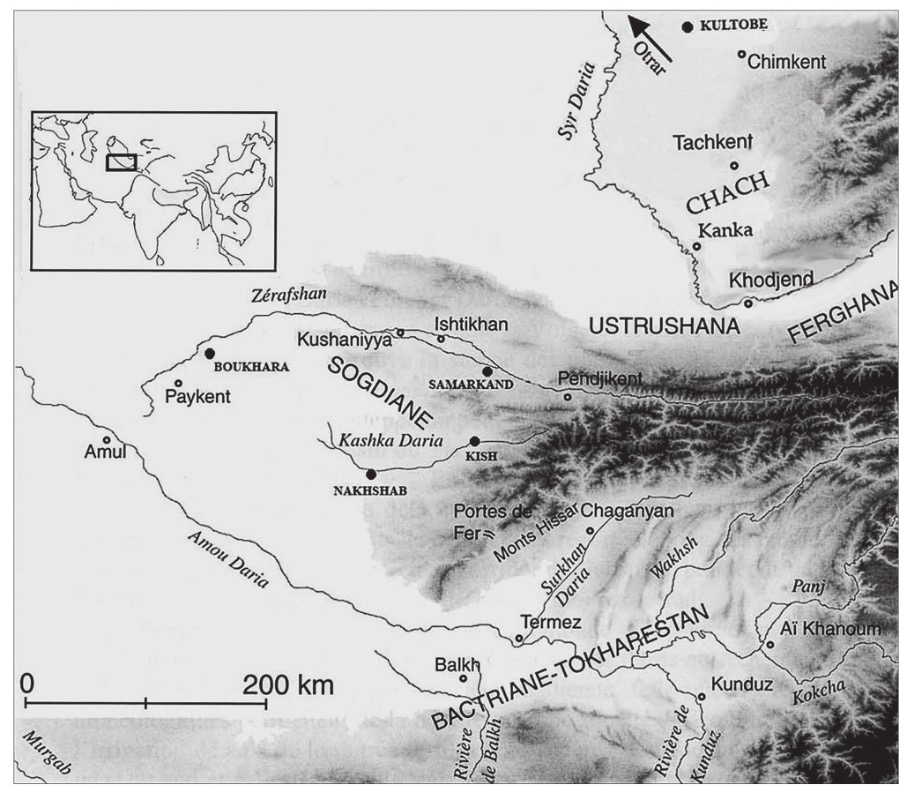
The Sogdians were an ancient Eastern Iranian people whose homeland was situated in present-day Uzbekistan and Tajikistan. They played a prominent role in the 1st millennium by developing trading networks and establishing cities governed by aristocrats where goods and merchants abounded.
Uyghurs certainly benefited from Sogdian guidance and knowledge on political and economic matters. Some historians even consider Sogdian elites as ‘a state within a state’. As described by Pin Lyu, the Sogdians were “cultural bees” moving along the Silk Road from one centre of civilization to another. Their ability to integrate various centres of power and their significant influence on the trade made them attractive allies for the Uyghurs recently settled in the region.
Tensions and opportunities: the impact of Uyghur conversion
“The Uighurs became the main patrons of the Sogdians and their religion in Inner Asia.”
After the migration of 840, Manicheism helped address issues of dynastic credibility and navigate the transition from East to West. It is likely that, because the Qocho rulers lacked genealogical legitimacy as they did not belong to the original ruling clan, auxiliaries such as religion played a greater role in their rule. Manichaeism ensured a bond between East and West Uyghurs after their migration into separate areas and enabled them to overcome genealogical disputes between the two kingdoms.
By adopting Manicheism as a state religion, Uyghurs also actively participated in the survival of Sogdian-Manichean culture. The Uyghurs became the main patrons of the Sogdians and their religion in Inner Asia. During this period, many Manichean texts were translated from Sogdian, or Middle Persian, in Old Uyghur – a Turkic language with a script derived from the Sogdian alphabet – as attested by the wide collection of documents from the Turfan expeditions.
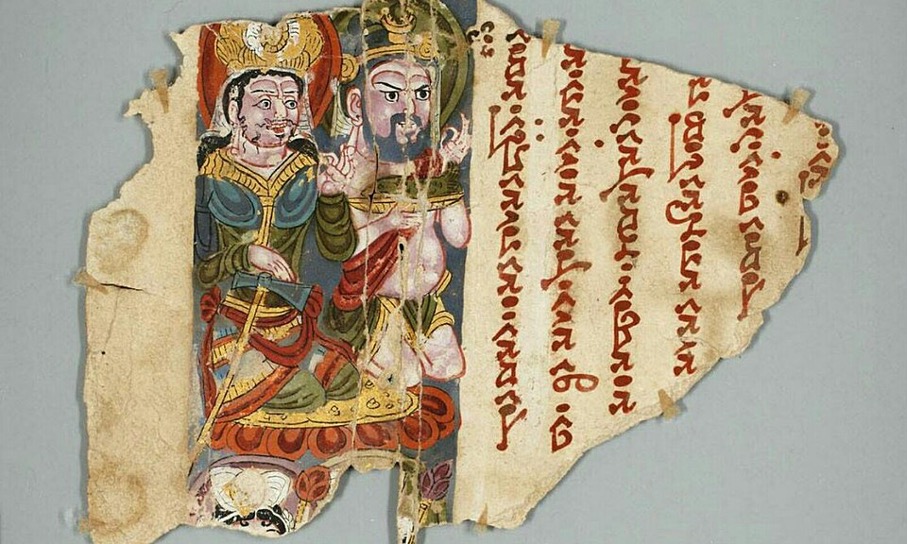
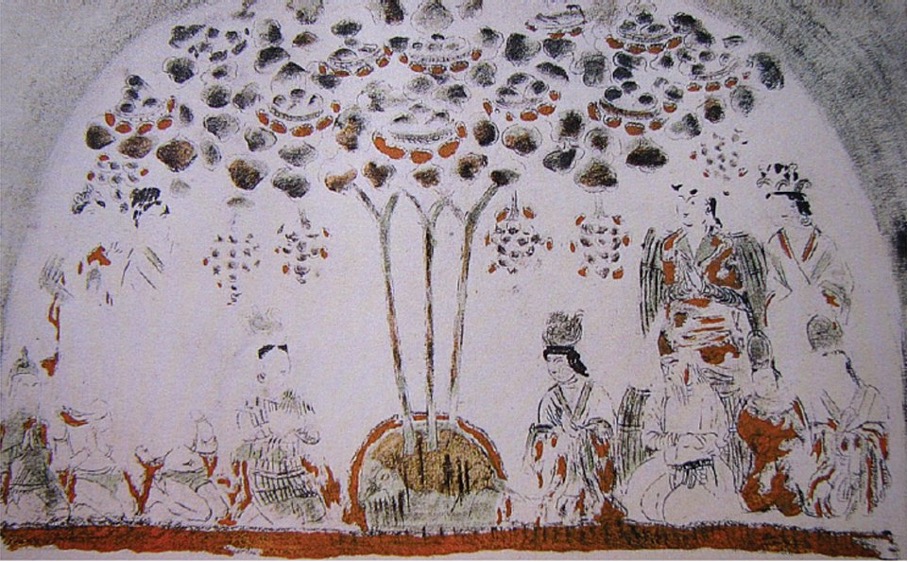
Manicheism also contributed to urban development and the deeper sedentarization of the Uyghurs around monasteries and communal spaces. Even later, when Buddhist influence grew in the kingdom in the 10th century, Manichean paintings continued to coexist with Buddhist imagery.
Nevertheless, negative consequences also stemmed from the official conversion of the Uyghur kingdom. The penetration of Manicheism in the Uyghur state was not linear and triggered reactions. There was an anti-Sogdian and anti-Manichean sentiment among Uyghur elites, which led to the persecution of Manichean believers under the reign of some Uyghur rulers. These political fluctuations not only affected the life of the Uyghur state, it also negatively impacted East-West trade relations and diplomatic exchanges.
The Uyghurs were allies of the Tang dynasty (618–907) as they helped to put down the An Lushan revolt in 755, and enjoyed mutual trade benefits. However, their relations deteriorated after Bögü Khan’s conversion to Manicheism largely because of Sogdian advisors advocating for a hostile policy against the Tang. From there, the closeness fluctuated depending on the rulers. As an example, the fourth khagan Alp Qutlug Bilge Khagan (r. 779–789) filtered out the anti-Tang elements from the state apparatus, leading to a relatively successful reconciliation.
The adoption of Manicheism as the Uyghur kaghanate’s state religion in 762 was an important milestone. This decision enabled the long-term establishment of the Manichean cult in the region and the transmission of Sogdian culture. Uyghurs’ conversion is also an example of the complex transformation that occurs when a state adopts a religion. The Uyghurs embraced new beliefs while simultaneously constructing their identity as a kingdom. In that sense, religion is part of a broader political discourse, and can easily drive alliances or conflicts, as Uyghur-Tang relations demonstrate.
Lisa Ducher
References
- Elverskog, Johan. A History of Uyghur Buddhism. New York: Columbia University Press, 2024. http://www.jstor.org/stable/10.7312/elve21524.
- Golden, Peter B. An Introduction to the History of the Turkic Peoples: Ethnogenesis and State-Formation in Medieval and Early Modern Eurasia and the Middle East. Wiesbaden: Otto Harrassowitz, 1992.
- Grenet, Franz, and Claude Rapin. “Formatsionnye periody sogdiiskoi kul’tury.” In Sogdians, Their Precursors, Contemporaries and Heirs (Transactions of the State Hermitage Museum LXII), edited by P. B. Lurje and A. I. Torgoev, 13–29. St. Petersburg: The State Hermitage Publishers, 2013.
- Kalikov, Rustam. “Manichaeism in the Uyghur Written Monuments.” Turkic Studies Journal 4, no. 4 (2022): 51–62. https://doi.org/10.32523/2664-5157-2022-4-51-62.
- Kamalov, A. K. Drevnie uigupy. VIII–IX vv. [Ancient Uighurs. 8th–9th Centuries]. Almaty: Nash Mir, 2001.
- Kasai, Yukiyo, Christoph Meinert, and Henrik H. Sørensen. “Uyghur Legitimation and the Role of Buddhism.” In Buddhism in Central Asia I: Patronage, Legitimation, Sacred Space, and Pilgrimage, edited by Christoph Meinert and Henrik H. Sørensen, 61–90. Leiden: Brill, 2020.
- Lee, J.-Y. The Turkic Peoples in World History: A Concise History. London: Routledge, 2024.
- Lyu, Pin. “The Sogdians, the ‘Cultural Bees’ of Eurasia.” 1st ed., 2024. https://doi.org/10.4324/9781003348702-13.
- Mackerras, Colin. “Relations between the Uighurs and Tang China, 744–840.” Journal of Turkic Civilization Studies(2004).
- Moriyasu, Takao. “New Developments in the History of East Uighur Manichaeism” Open Theology 1, no. 1. (2015) https://doi.org/10.1515/opth-2015-0016
- Ozbay, Betul. “Eski Uygurlarda Mani Yazısının Gelişimi.” Dil ve Edebiyat Araştırmaları, no. 21 (2020): 83–100. https://doi.org/10.30767/diledeara.623160.


Leave a comment