

Interpretations of the Eastern Roman Empire and its emperors are heavily influenced by various cultural and political agendas. From Greece’s attempted monopoly over Constantinople’s memory fueling its 20th-century imperial aspirations, to Serbia justifying their expansionist ambitions with a 14th-century East Roman court title, many states throughout history have attempted to take a slice of the metaphorical “Byzantine pie”.1 To understand this phenomenon’s roots in contemporary Byzantine studies, we must turn to one of the early giants of the field: George Ostrogorsky.
“The book was incredibly influential, with its reception contributing to the gradual transformation of Byzantine history from an obscure sub-category of Classics/medieval studies to a legitimate and autonomous academic discipline.”
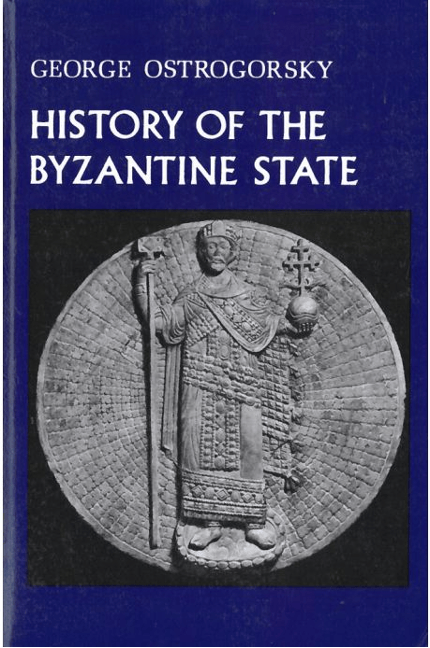
The first edition of Ostrogorsky’s the History of the Byzantine State was published in 1940, during the Second World War. The book was incredibly influential, with its reception contributing to the gradual transformation of Byzantine history from an obscure sub-category of Classics/medieval studies to a legitimate and autonomous academic discipline.2 However, the monograph is not without its problems, Ostrogorsky’s interpretation of Byzantium remained constrained by older historiographical frameworks—particularly Slavic civilizational continuity, feudalistic Western European models, and grand civilizational narratives—that distorted the complex, pluralistic character of Eastern Rome.
The late British historian Averil Cameron specifically criticizes Ostrogorsky for his “Slavist agenda”—retrofitting connections between Slavic peoples where none existed historically.3 To fully understand this critique, we will analyze an excerpt from Ostrogorsky’s work:
“From this time dates the beginning of relations between Byzantium and the Russian kingdom, which had only just come into being, and of the missionary work among this people, hitherto almost completely unknown to the Byzantines, which was to have such important consequences in the future,”4
Though this statement appears relatively innocent, certain terms hold the power to shape historical memory. Throughout the excerpt, Ostrogorsky consistently describes the religious interaction between Eastern Rome and the Kievan Rus as missionary work.5 While seeming innocent enough, this term—which many modern historians argue do not apply to East Roman diplomacy—carries significant interpretive implications. By framing these interactions through the language of missionary expansion and intimate interaction, Ostrogorsky seemingly constructs a stronger sense of civilizational continuity between Byzantium and the Rus than the evidence (see: Frankopan & Shepard) supports.6
Ostrogorsky’s imprecise application of terminology goes beyond misrepresentation of missionary work. Though the term “Kievan Rus” carries its own historiographical baggage—projecting a centralized, single-state identity onto a decentralized medieval network of East Slavic territories—Ostrogorsky puts forth the term “Russian Kingdom”.7 This encourages the reader to see Russia—in the sense of it as a continuous political subject—already existing in the ninth century. The evidence suggests that it may not have been an innocent misinterpretation; even in the 20th century, “Russia” carries obvious national significance. Whether or not this was Ostrogorsky’s intention, the terminology contains an implication that medieval Kyiv belonged straightforwardly to the history of a centralized Russian state.
Beyond terminology, Ostrogorsky’s research followed a questionable theoretical framework. In the early days of Byzantine studies (late 19th to early 20th centuries), what Dimitri Obolensky described as the “Byzantine commonwealth” was generally accepted without significant systemic pushback.8 Interestingly, this interpretation coincided with a general move amongst Russian Byzantinists (A. Vasiliev, A. Kazhdan) to incorrectly “feudalize” the empire, largely driven by a historiographical need to prove that Orthodox states had advanced through standardized “European” phases.9 Owing to this scholarly trend, Ostrogorsky asserted that Byzantium had somehow become “feudal”, manufacturing an entire class of “magnates” upon little to no historical evidence:
“Feudal magnates tried to deprive the state of its peasants and soldiers by increasing their own lands and the numbers of their dependent tenants.”10
Ostrogorsky continues by dismissing the empire’s distinctly Roman character, affirming that a complete shift to “feudal Byzantium” had been completed as early as the 7th-century:
“Byzantium, however much it clung to Roman political conceptions and Roman traditions, became a medieval Greek Empire.”11
Modern scholarship has thoroughly rejected this feudalizing model. It is now generally accepted that the Eastern Roman state developed separately from standard Western European frameworks. Averil Cameron pushes back against “feudal Byzantium” in her 2014 monograph, Byzantine Matters:
“Even now in many countries, especially in the Balkans, the standard one-volume history of Byzantium remains that of George Ostrogorsky… The book… asserts a misguided though persistent doctrine of Byzantine feudalism.”12
Ostrogorsky also postulates a dangerous framework of civilizational conflict, elevating emperor Constantine IV as the savior of European civilization against a seemingly monolithic “Islamic threat”:
“Of these three victories which saved Europe from being overwhelmed by the Muslim flood, that of Constantine IV was the first and also the most important. There is no doubt that the Arab attack which Constantinople experienced then was the fiercest which had ever been launched by the infidels against a Christian stronghold,”13
These ideas are problematic for several reasons. The sources generally do not corroborate a grand narrative of unified European resistance against Islam—Ostrogorsky’s framework gestures towards a deliberate and coordinated European Christian front, structures which never existed historically. Additionally, Ostrogorsky’s charged description of the Arab armies as “infidels” and a “Muslim flood” casts the conflict in explicitly religious and civilizational terms. It frames Islam as an irrational, monolithic, force of nature, rather than a set of political actors with their own interests, divisions, and motivations. This framework is a rejection of nuance—such as the reality of Arabic-speaking Melkite Christians in the Caliphate; Civil strife complicating the nature of Anatolian raids; and the thousands of Syrian Christians serving in the Umayyad navy.14 Ostrogorsky instead defaults to interpreting Byzantine history through a European civilizational framework, reducing the Eastern Romans to defenders of “Europe” against an external Islamic threat. A pattern emerges: on both feudalization and civilizational conflict, Ostrogorsky interprets the Eastern Roman Empire through categories external to its own, nuanced historical self-understanding.
“Ostrogorsky repeatedly imposed categories that obscured the distinctive political, social, and cultural structures of the Eastern Roman Empire.”
However, Ostrogorsky’s legacy is one more complicated than either condemnation or celebration can capture. His History of the Byzantine State helped transform Byzantine history into an autonomous academic discipline, yet the same work also demonstrates how difficult it was for the field’s scholarship to escape the intellectual frameworks of its time. By describing the Rus through the language of a “Russian kingdom,” interpreting Byzantine society through the framework of Western European feudalism, and presenting the Arab conquests through a Christian-versus-Islamic civilizational struggle, Ostrogorsky repeatedly imposed categories that obscured the distinctive political, social, and cultural structures of the Eastern Roman Empire.
However, Ostrogorsky should not be reduced to an outdated historian whose conclusions can be discarded. Both the field-defining achievements, as well as the obsolete frameworks of an earlier generation of Byzantine scholarship are embodied in the History of the Byzantine State. To study Byzantium critically is consequently not only to recover East Rome’s historical record, but also to examine the categories through which generations of historians have attempted to explain it. The history of Byzantium—just like the history of any civilization—is inseparable from the history of those who have written it.
Hughes Liu
- Kaser and Halpern, Historical Myth and the Invention of Political Folklore in Contemporary Serbia, Anthropology of East Europe Review, 1998, p. 94-95; Sotirovic, Vladislav, “Megali Idea” And Greek Irredentism In The Wars For A Greater Greece, 1912−1923, ResearchGate, 2018. Accessed July 16, 2026, p. 1-2. ↩︎
- Dunham, William Huse, Ernst Kitzinger, and Ihor Sevčenko, Memoirs of Fellows and Corresponding Fellows of the Mediaeval Academy of America, Speculum 52, no. 3, 1997, p. 774–76 ↩︎
- Cameron, Averil, Byzantine Matters, Princeton University Press, 2014, p. 2. ↩︎
- Ostrogorsky, George, (translated by Joan Hussey), History of the Byzantine State, Rutgers University Press, 1968, p. 228. ↩︎
- Ibid., p. 229. ↩︎
- Shepard and Frankopan, Revisiting the Byzantine Commonwealth: Nodes, Networks, and Spheres, Oxford Academic, 2025, p. 9. ↩︎
- Ibid., p. 229. ↩︎
- Obolensky, Dimitri, The Byzantine Commonwealth: Eastern Europe 500-1453, Weidenfield and Nicolson, 1971, p. 353. ↩︎
- Vasiliev, Alexander, History of the Byzantine Empire 324-1453, Bedrosan, 1971, p. 483. ↩︎
- Ostrogorsky, History of the Byzantine State, p. 276. ↩︎
- Ibid., p. 146. ↩︎
- Cameron, Byzantine Matters, p. 2. ↩︎
- Ostrogorsky, History of the Byzantine State, p. 125. ↩︎
- Kaldellis, Anthony, The New Roman Empire: A History of Byzantium, Oxford University Press, 2023, p. 249. ↩︎


Leave a Reply