
The Achaemenid Empire presided over remarkable achievements in art, architecture and government. Great monuments such as the palaces of Persepolis testify to the splendour of its royal court, while its administrative practices would influence several of the states that succeeded it.
Yet none of this would have been possible without the soldiers who conquered and defended the Great King’s dominions. From the armies assembled by Cyrus the Great to the enormous imperial forces commanded by Xerxes and Darius III, the Achaemenid military developed into one of the most formidable and adaptable fighting systems of the ancient world.
This series will examine the essential components of that military. Each article will explore how these forces were equipped and employed, as well as how the military traditions of the empire’s many peoples shaped the army as a whole.
We begin with the infantry. From blunting enemy attacks and holding the battle line to storming fortifications, Achaemenid foot soldiers formed the foundation of the Great King’s armies. Persian and Median troops fought alongside warriors drawn from across the empire, helping to extend Achaemenid power from the shores of the Aegean to the Indus Valley.
Assembling the Army
“What enemy could behold soldiers gathered from the Nile, the Aegean, the Iranian plateau and the lands beyond the Hindu Kush without being reminded of the enormity of the foe that faced them?”
Before we move onto the armour, weaponry and tactics that the Achaemenid foot soldier employed, we shall first cover how such forces were raised in the first place.
The Achaemenids did not rely upon a single uniform system of recruitment. Instead, they merged their military doctrines with those inherited from the Medes and the many states absorbed into their empire. For the purposes of this article, their infantry can be understood as coming from three broad and often overlapping sources: the standing forces maintained by the Great King, levies summoned from among the empire’s peoples, and soldiers supported through local systems of military service. Mercenaries would also become increasingly important, particularly during the empire’s later years.
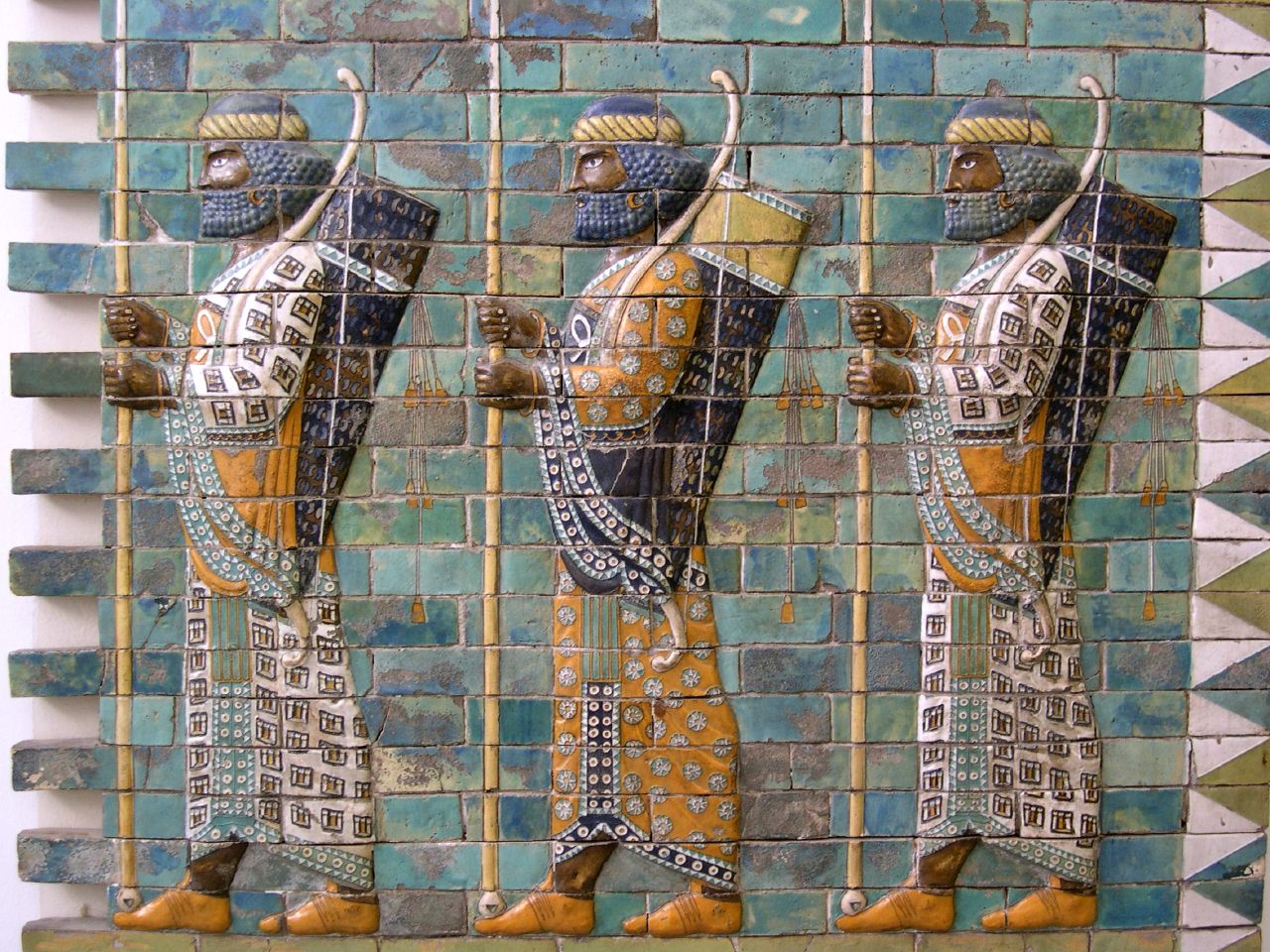
Persian and Median troops formed the military nucleus of the imperial army. The most famous of its elite infantry were the 10,000 soldiers whom Herodotus called the Immortals. We have no surviving Persian account telling us what these soldiers called themselves, but Herodotus claimed that their number was always kept at precisely 10,000. Whenever one was removed through death or illness, another warrior was selected to fill the vacancy. Whether or not the arrangement functioned quite as neatly as Herodotus suggests, his description presents them as a prestigious royal force distinguished by both their fighting ability and magnificent appearance.
Alongside these professional forces, the king could call upon the wider Persian fighting population and the manpower of the empire. The precise means by which these soldiers were recruited varied considerably. In some regions, military service was tied to the possession of land. Documents from Babylonia, for example, refer to “bow,” “horse” and “chariot” holdings whose occupants were expected either to serve with the corresponding equipment or to provide someone who could. Such evidence warns us against imagining one universal levy operating identically from Egypt to Central Asia.
Nor was the infantry composed only of Persians and Medes. A royal inscription of Darius the Great (r. 522 – 486 BCE) named approximately 30 lands and peoples under his authority, stretching from the Aegean and Egypt to Central Asia and India. When the Great King prepared for a major campaign, contingents could be raised through satraps, local rulers and subject communities, often retaining elements of their own equipment and military traditions. This diversity not only gave the Achaemenid army access to an extraordinary range of skills but also acted as a symbol. An army containing warriors from across the known world was not merely a fighting force: it was a heavily armed demonstration of the Great King’s reach. What enemy could behold soldiers gathered from the Nile, the Aegean, the Iranian plateau and the lands beyond the Hindu Kush without being reminded of the enormity of the foe that faced them?
Persian Infantry – A Combined Arms Approach
“I am skilled both in hands and in feet. (…) As a bowman, I am a good bowman, both on foot and on horseback. As a spearman, I am a good spearman, both on foot and on horseback.”
Inscription from the tomb of Darius the Great at Naqš-e Rustam
Now that the infantry was assembled, how did they fight?
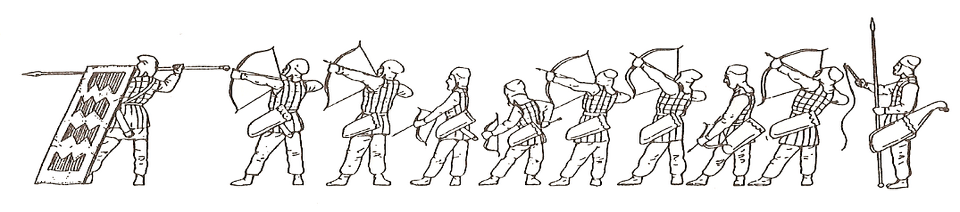
The Persian army appears to have been divided according to a decimal system, with units ranging from 10 men to 10,000. Within this system, the infantry seems to have been based off of a combination of 2 main roles: the archer and the close-quarters fighter. One influential reconstruction presents a Persian infantry formation as ten ranks deep. At its head stood a shield-bearing close-combat fighter, commonly called a sparabara, protecting nine ranks of archers behind him. The precise arrangement remains debated, but Herodotus describes the Persians at Plataea planting their shields in the ground to form a defensive barrier and loosing volleys of arrows from behind it.
“a barrage of arrows that, according to a story from Herodotus, was so vast that it could blot out the sun.”
In order to soften up the enemy, the archers, using powerful composite bows, would unleash a barrage of arrows that, according to a story from Herodotus, was so vast that it could blot out the sun. Although this claim is certainly hyperbole, whoever was facing the Persian army at this stage of the battle would have to endure hundreds of thousands of arrows falling upon them for potentially minutes on end, with many arrows bound to find a gap in whatever armour the enemy wore. Once the barrage was done, bows were set aside in favour of melee weapons as the infantry, spearheaded by the elite corps, made contact with the enemy. According to Xenophon, the Persian infantry advance was not the charge of a mindless horde but a coordinated advance that was done in complete silence, something which often greatly unnerved the foe. This combination of attack methods was often enough to send the foe into a rout, adding another victory to the Great King’s tally.
But what about equipment? Some sources state that the Persians’ equipment was markedly inferior, with Herodotus stating that the average Persian soldier fought as if they were naked when fighting against the supposedly more heavily armoured hoplite. And yet, this is far from the case. With regard to armour, Herodotus points out that the elite soldiers wore body armour covered in iron scales, something supported by finds from within the empire. The scarcity of the armour amongst descriptions of Persian troops could likely be attributed to the cost of procuring such gear, which is why it was more often seen on elite troops while lighter troops would potentially wear quilted or leather armour to provide some protection while maintaining their mobility. The infantry had access to a range of shields, ranging from the tall tower shields known as spara (hence the name given to the front rank defending the archers during ranged attack), to figure-eight style shields that could be made of either wicker or wood. The figure-eight shield would have potentially had an iron or bronze boss at the centre, granting extra protection as well as increasing blunt force damage to the opponent from shield strikes. Some Greek scenes show Persians using a crescent-shaped pelte shield as well as the Greek style aspis shield, and we can assume that such a variety of shield types either reflected circumstance, such as battlefield role, supply or differences in time period and the status of the owner.
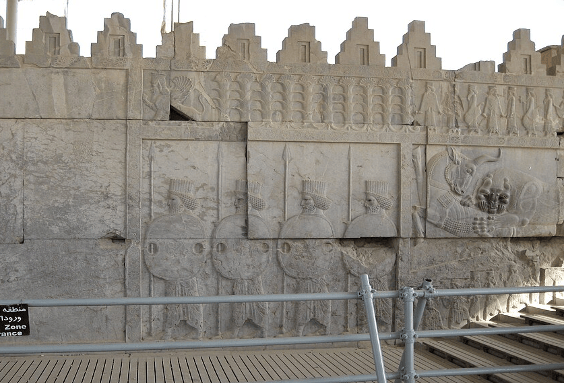
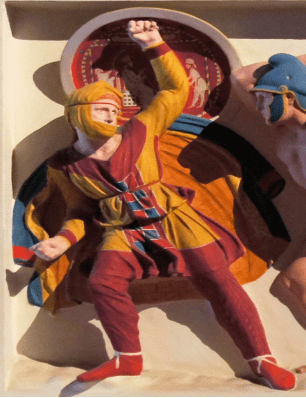
When it came to dispatching the enemy, Persian infantry had access to a veritable smorgasbord of weapons. In the inscription quoted above, Darius the Great presented his skill with both bow and spear, on foot as well as on horseback, as an essential part of his martial identity. These two weapons would likewise become important features of Achaemenid warfare, with both spears and bows being the most prominently shown items of weaponry at sites like Susa and Persepolis. Greek art also occasionally depicts Persian warriors carrying curved swords resembling the kopis, although such images should be treated cautiously. Hearkening back to the wider martial traditions of the Iranian world, Persian soldiers also wielded the akinaka and the sagaris, weapons that would become closely associated with them by their opponents.
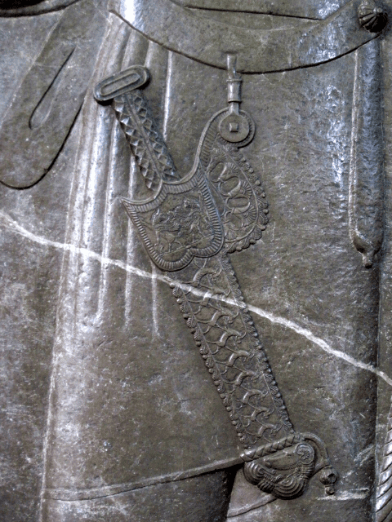
The akinaka was a short, straight sword or long dagger suspended from the warrior’s right thigh. Its sharply tapered blade made it well suited to thrusting during close-quarters combat, while its sheath would often be decorated to advertise the status of its owner. The sagaris was a battle-axe associated particularly strongly with the Iranian and Scythian worlds. Its precise form varied, but many examples combined a cutting edge on one side with a narrow pick or hammer-like projection capable of concentrating considerable force against an armoured opponent.
Far from the ill-equipped and undisciplined horde they are often described as, the Persian army was an organised and extremely effective force, without whom the Achaemenid empire would never have risen to prominence. And yet, Persian troops formed the nucleus of a much wider force. As the Persian realm expanded, different peoples would send troops to fight in the Great Kings’ armies, bringing with them a variety of skills and equipment into the Achaemenid military.
“Far from the ill-equipped and undisciplined horde they are often described as, the Persian army was an organised and extremely effective force, without whom the Achaemenid empire would never have risen to prominence.”
The Provincial Troops
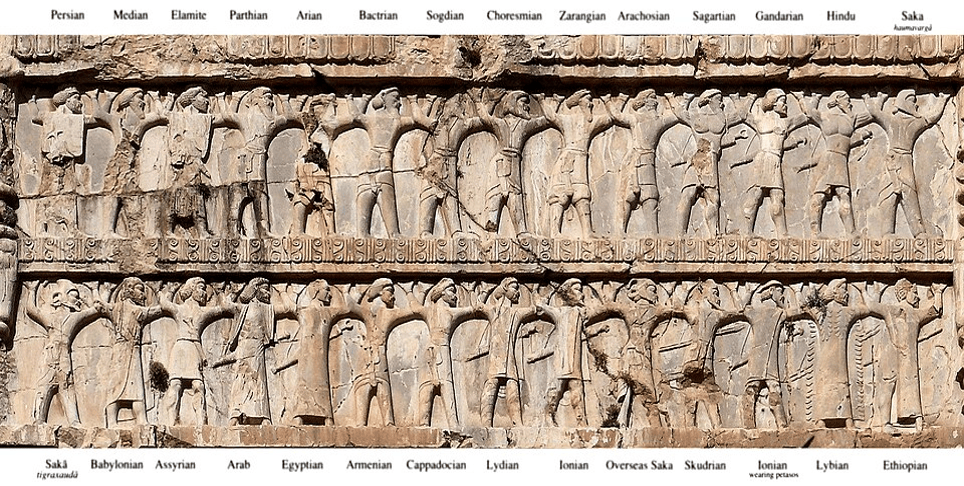
To complement the already formidable Persian missile troops, similar units were provided by many of the empire’s peoples, from Thrace to India. These included not only archers but javelin throwers and slingers as well. One of the most visually striking soldiers that were recruited by the Persians were the archers from the lands south of Egypt. Herodotus mentions how they were draped in leopard skins, had their bodies painted, and that they fought with spears tipped with antelope horn and with wooden clubs. Their most iconic weapon, however, was an enormous palm-wood bow, from which they loosed small reed arrows tipped with sharpened stone. Elsewhere, Herodotus tells a story in which an Ethiopian king challenged the Persians to invade only when they could draw his bow as easily as he could. Almost none were able to do so. Whether or not the tale is true, it reflects the formidable reputation that Greek writers attached to the bows of these warriors.
When it came to close-quarters combat, the empire also had considerable resources at its disposal. Some notable troops include Assyrian infantry, whose forebears had terrorised Western Asia less than two centuries before the conquests of Cyrus the Great. Herodotus describes them wearing linen body armour and unusual helmets made from bronze or plaited material, while carrying shields, spears, daggers and wooden clubs studded with iron, making them well equipped for the brutal realities of close combat. Greek mercenaries fighting as spear-wielding hoplites became an increasingly important presence in Achaemenid armies over time, often using their expertise against other Greek soldiers. They would also play important roles in the struggle against Alexander of Macedon in the battles of the Granicus, Issus and Gaugamela.
Not only did all these troops contribute to the Achaemenid army’s strength on a practical level, but they also acted as a psychological weapon. Having such a variety of troops, all with their own distinct arms and armour, was a demonstration of the empire’s reach. How could one hope to win against a force that has gathered warriors from across the world to face them?
One Part of a Greater Machine
The infantry would have played a pivotal role in the success of Achaemenid campaigns, from their early wars against the Medes to the conquest of the largest empire yet seen. And yet, they were not fighting in isolation. Our next article will delve into what could be considered the Achaemenid Empire’s most illustrious units. Their speed and combat prowess made them not only terrifyingly effective combatants in their own right but perfect accompaniments to the infantry in the Achaemenid combined arms approach: the cavalry.
Milo Reddaway
Further reading
- Esposito, G., 2025. Armies of the Achaemenid Persian Empire, 550-330 BC: Organization, Weapons and Tactics. Pen and Sword Military.
- Hyland, J.O., 2018. Achaemenid Soldiers, Alexander’s Conquest, and the Experience of Defeat. Brill’s Companion to Military Defeat in Ancient Mediterranean Society, 2, pp.74-95.
- Konijnendijk, R., 2021. Legitimization of war. A Companion to the Achaemenid Persian Empire, Vol. 2, pp.1139-1150.
- Konijnendijk, R., 2012. ‘Neither the Less Valorous nor the Weaker’: Persian military might and the battle of Plataia. Historia: Zeitschrift für Alte Geschichte, pp.1-17.
- MacGinnis, J., 2010. The Role of Babylonian Temples in Contributing to the Army in the Early Achaemenid Empire. The World of Achaemenid Persia: History, Art and Society in Iran and the Ancient Near East, pp.495-502.
- Manning, S., 2021. Armed Force in the Teispid-Achaemenid Empire.
- Ward, S.R., 2014. Immortal: A military history of Iran and its armed forces. Georgetown University Press.


Leave a comment