
After the previous installment ended with the Bactrian king Euthydemus I (c. 230-200 BCE) successfully resisting the eastern campaign of the Seleucid ruler Antiochus III, we now turn to what happened next. This article explores the pivotal period that followed and introduces the rulers who followed in Euthydemus’ footsteps. As we will see, some of these kings were among the most innovative monetary reformers of the ancient world, using their coinage in creative ways to communicate with their diverse subjects.
“This era — roughly the first decades of the second century BCE — was marked by major dynastic changes, probably often accompanied by violence, as well as significant cultural and religious interaction.”
We will also follow the expansion of Bactrian power across the Hindu Kush into areas of what is today northern Pakistan and northwest India. The conquering of these new territories led to the rise of the Indo-Greek kingdoms. This era — roughly the first decades of the second century BCE — was marked by major dynastic changes, probably often accompanied by violence, as well as significant cultural and religious interaction. At the same time, it remains a difficult period to study because the written sources are extremely limited: most of the kings discussed here are not mentioned in any surviving literary texts. Reign dates for the kings discussed will be given based for the most part on the authoritative work of Bopearachchi.1 It should be noted that these dates are approximate and may differ from the historical reality by as much as ten years.
What follows is an attempt to reconstruct this crucial chapter of hellenistic and Central Asian history. It should be kept in mind that the limited nature of the source material leaves room for different interpretations and that other scholars may hold different views regarding some of the following.
“The conquering of these new territories led to the rise of the Indo-Greek kingdoms.”
Bactrian Developments after Euthydemus I
In the previous instalment, we saw how Demetrius, the son of Euthydemus I, played a key role in bringing about a treaty between his father and the Seleucid king Antiochus III.2 As part of the agreement, Demetrius was supposed to marry one of Antiochus’ daughters, although it remains uncertain whether this marriage actually took place. Demetrius also appears in our literary sources: apart from his role in the treaty with Antiochus III, he is also mentioned by Strabo’s Geography, who cites Apollodorus of Artemita. He writes that the Bactrian Greeks conquered more peoples than even Alexander the Great, and he specifically names Menander (c. 165 – 130 BCE) and Demetrius as leading figures behind these campaigns.3
Another important reference to Demetrius appears in the so-called Heliodotus inscription from Kuliab in southern Tajikistan.4 This dedication to the goddess Hestia was set up by a man named Heliodotus, who asks the goddess to protect both Euthydemus I and Demetrius — a strong indication that they were still alive when the inscription was made. Notably, Demetrius is given the epithet Kallinikos (“winner of a noble victory”), a title that fits well with Strabo’s account of his successes.
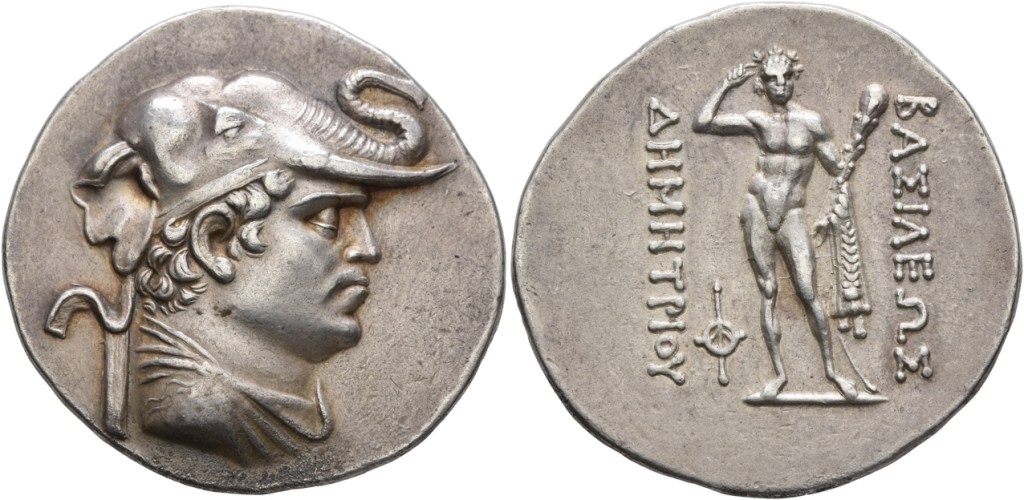
Demetrius is also consistently portrayed on his coins wearing an elephant-scalp headdress (Figure 1), a striking image that is widely interpreted as a reference to victories across the Hindu Kush.5 The reverse of his silver coinage depicts Heracles crowning himself with a wreath, which likely serves as an additional reference to a victory. His campaigns are often dated to his reign as king, but MacDowall argued convincingly that there are good reasons to question this assumption.6 Since the Heliodotos inscription dates to the lifetime of Euthydemus I and already credits Demetrius with a major victory, and since the elephant-scalp imagery appears from the very start of his coinage, it is likely that at least part of his conquests took place while his father was still ruling.
Around the time of Euthydemus I’ and later Demetrius’ reign (c. 200-190 BCE), the Mauryan Empire was in decline. The empire had risen to prominence under its founder, Chandragupta Maurya (c. 322-293 BCE), and reached its peak during the reign of its third emperor, the renowned Ashoka (c. 268-232 BCE). Following Ashoka’s death, however, the empire gradually weakened, and around 185 BCE its last ruler was overthrown and killed by Pushyamitra Shunga, who subsequently founded the Shunga Empire. It is possible that Demetrius took advantage of the Mauryan Empire’s deteriorating condition and he may even have been a contributor to its collapse, but the available evidence remains inconclusive.
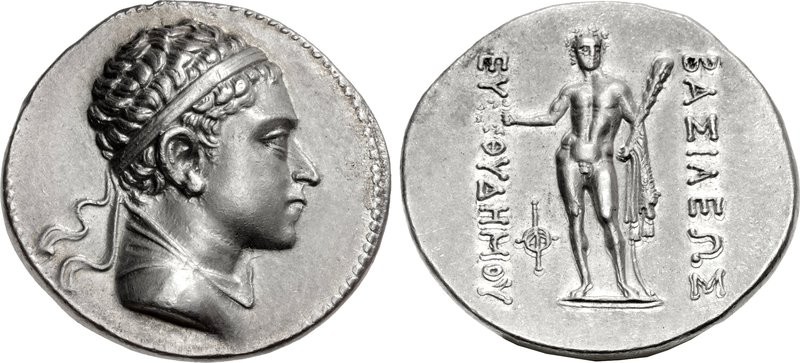
It appears that Demetrius was succeeded by Euthydemus II (c. 190-185 BCE), a ruler known to us solely through his coinage. Although no literary sources mention him, both his name and his coin imagery strongly suggest that he belonged to the Euthydemid dynasty. Like Euthydemus I and Demetrius, he chose Heracles as the principal deity on his coins, and the style of Heracles’ depiction under Demetrius and Euthydemus II is so close that a dynastic connection is very likely (Figure 2).
Euthydemus’ coinage is also remarkable as he struck some coin types in cupronickel, an alloy more familiar from modern coinage than from the ancient world. In antiquity, this material was used only by Euthydemus II and two near contemporaries, and possible rivals, Pantaleon and Agathocles. Because nickel requires very high temperatures to melt, and thus to be used for coinage, these issues represent a notable technical achievement. But they also raise unanswered questions. We still do not know why this alloy was chosen, and no later Bactrian or Indo-Greek rulers continued the practice.
While the succession of these first few kings is relatively certain, the uncertainty increases with the kings ruling after (or partly concurrent with) Euthydemus II. These include Pantaleon, Agathocles, Antimachus Theos, Apollodotus I, Antimachus Nicephorus and Eucratides. All these kings’ reigns started somewhere in the first decades of the second century BCE but their succession sequence and relation to one another is still largely unclear.
Let us begin with Agathocles (c. 185-175 BCE). Like most Bactrian rulers, he is known exclusively through his coinage; however, his issues show a lot of variety and demonstrate that he was a major monetary innovator. His coinage shows clear links with that of Pantaleon (c. 185-180 BCE), whose coinage is much rarer. Scholars have suggested that the two were either father and son or brothers.7 Like Euthydemus II, they struck coins in cupro-nickel, which makes it likely that they should be placed chronologically close to one another.
Two further important innovations in Agathocles’ coinage support this chronological placement and may even suggest that Agathocles and Pantaleon were rivals of Euthydemus II. The first is the series of so-called pedigree coins issued by Agathocles, which depict earlier Bactrian rulers as well as Alexander the Great. The second is the introduction of an epithet—an honorific title—added to the king’s name.
The pedigree series is an important tool for reconstructing chronology. Agathocles minted coins depicting Alexander the Great, Diodotus I, Diodotus II, the controversial Antiochus (to be identified with the Seleucid ruler Antiochus II or with a third Diodotid king),8 Euthydemus I, Demetrius I, and Pantaleon. This provides strong evidence that all these rulers should be placed before Agathocles in the chronology, or in some cases—probably Pantaleon—partly contemporaneous with him.
Because Pantaleon is also included in the pedigree series, it is generally assumed that although the two kings may have ruled concurrently for a time, Pantaleon died first.9 Taken together with the rarity of Pantaleon’s coins compared to the more abundant issues of Agathocles, this suggests that Agathocles ruled considerably longer.
Agathocles also appears to have been the first Bactrian ruler to introduce the systematic use of an epithet on his coinage. His silver issues can be divided into an earlier group without an epithet and a later group in which an epithet is consistently included. This again provides a valuable tool for reconstructing chronology, since rulers whose coins lack an epithet can on this basis be placed before Agathocles. This conclusion aligns with the chronological picture derived from the pedigree coins, as the rulers represented there correspond to those who did not yet employ an epithet. While Agathocles does give these earlier rulers an epithet on his pedigree series, they did not use one themselves on their own coinage.
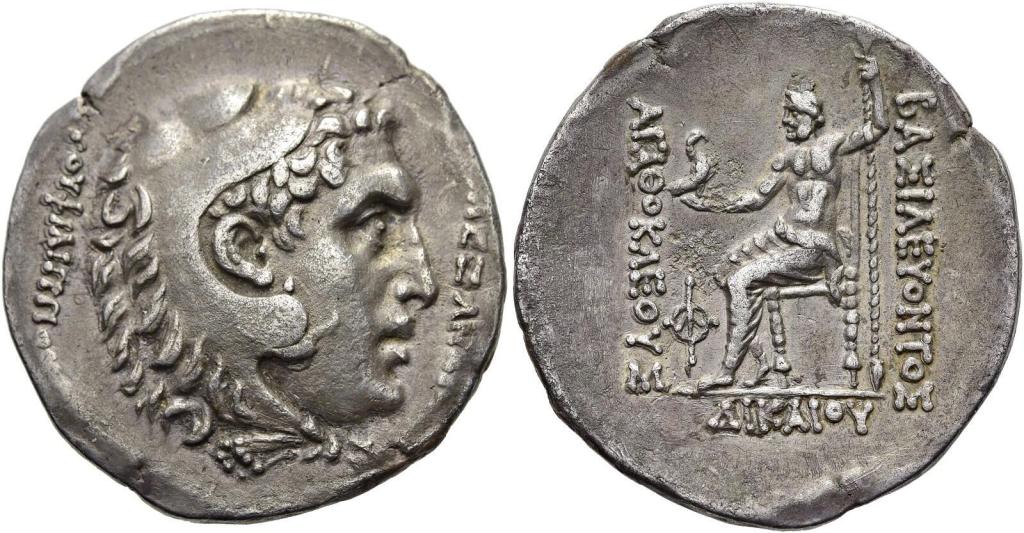
How should we interpret these innovations? When the pedigree coinages first attracted scholarly attention, one of the explanations—advanced, among others, by Johann Gustav Droysen, who coined the term Hellenistic history—held that they reflected a hierarchy of subordinate rulers governing under a main king.10 According to this interpretation, Agathocles, for example, was regarded as a vassal king ruling under Diodotus. It was, however, the German scholar Alfred von Sallet who was ultimately proven correct.11 He argued that these pedigree coins were struck by Agathocles to commemorate earlier rulers. Indeed, the subsequent discovery of a pedigree issue depicting Alexander the Great (Figure 3) demonstrated that not all of the rulers represented in the series could have reigned contemporaneously.12 This find contradicted the vassal-king hypothesis and established that the pedigree series instead commemorates earlier rulers whom Agathocles chose to honour.
However, an important point is that all pedigree issues include the use of an epithet, which places them later in Agathocles’ reign. One might instead expect such a legitimacy-building coin series to appear at the beginning of a reign, when the need for recognition was typically greatest. A possible explanation can be proposed. Although the pedigree series presents all earlier Bactrian kings, it notably excludes Euthydemus II, who was probably Agathocles’ immediate predecessor. This is an odd omission if the primary goal were legitimation. If, however, Agathocles and Pantaleon ruled partly concurrently and in opposition to Euthydemus II, another explanation is possible. Once they had eliminated their rival, that moment may have offered the ideal opportunity to reinforce legitimacy by portraying earlier kings, while deliberately excluding their recent opponent.13
“These issues are square or rectangular in shape, depict deities of Indian origin, and carry not only a Greek legend but also a corresponding legend in Brahmi or Kharosthi script.”
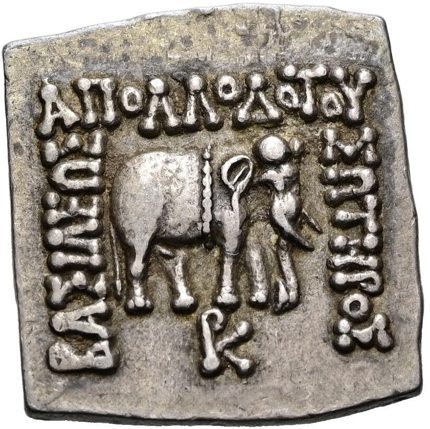
A final but certainly no less important innovation introduced during the reigns of Agathocles and Pantaleon is the appearance of new coin types clearly intended to address more diverse audiences. These issues are square or rectangular in shape, depict deities of Indian origin, and carry not only a Greek legend but also a corresponding legend in Brahmi or Kharosthi script (Figure 4). They are the earliest coins to display this combination of features, which would later become standard in Indo-Greek coinage. They make up a considerable portion of the coinage of both kings, and as a result it is often assumed that their main territory was south of the Hindu Kush.14
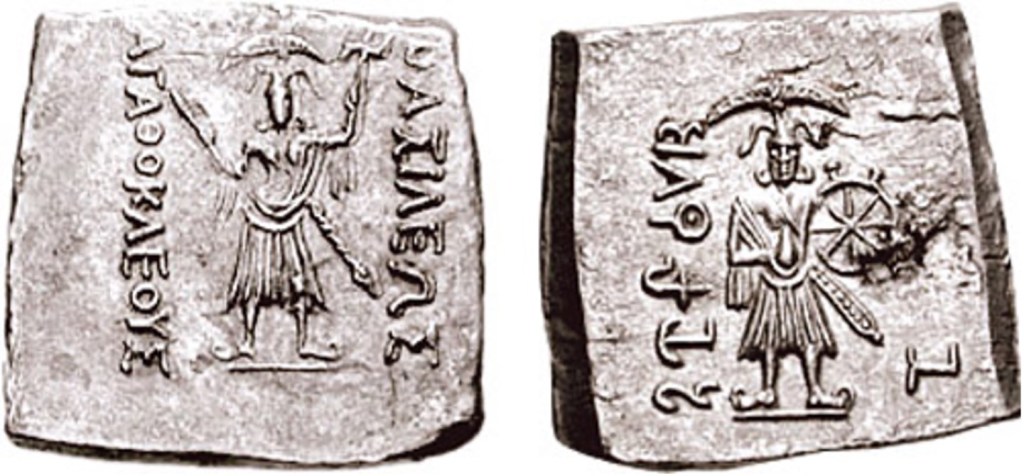
In light of these radically new cointypes, we can circle back to Demetrius I. As mentioned earlier, Demetrius is often credited with conquests across the Hindu Kush. Demetrius himself, however, did not issue coinage comparable to that of Agathocles. Perhaps his campaigns were only of a temporary nature? Whatever the case, Pantaleon and Agathocles can be seen as some of the earliest kings that also exercised control over regions south of the Hindu Kush, with the major city of Taxila often being considered as part of Agathocles’ possessions.15
Almost all the kings that closely follow Agathocles chronologically, also minted coins which clearly divert from what would commonly be identified as ‘Greek’ coinage. Antimachus Theos (c. 175-165 BCE) can be considered as an immediate successor of Agathocles. Like Agathocles, Antimachus minted his own pedigree series, but much more limited, only including Diodotus I and Euthydemus I. However, Simon Glenn was able to identify that the same coin die (which was used to strike coins by placing a piece of metal or ‘flan’ which would later become the coin, between two engraved dies and striking the images on the engraved dies into the flan, thus creating the coin) was used for both the pedigree series of Agathocles and Antimachus.16 This is a clear chronological marker, indicating that Antimachus can be seen as a direct successor of Agathocles, who shortly continued the production of pedigree issues in his own name.
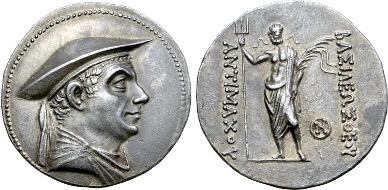
Antimachus Theos has been a puzzling figure for scholars because of his depiction of Poseidon on his coins, as there are no major bodies of water in Bactria (Figure 5). However, Frank Holt argued that the depiction of Poseidon should be linked to Poseidon’s association with horses, and given the quality of Bactrian cavalry, this seems a good assessment.17 Like Agathocles, Antimachus also minted some coins that show features not typically associated with ‘Greek’ coinage. These rectangular bronze issues depict an elephant, but unlike the types of Agathocles and Pantaleon, they do not include a bilingual legend.
An important discovery was the appearance of a tax receipt that mentions Antimachus Theos.18 The document is dated to the fourth year of his reign and also refers to two, and possibly three, other rulers. These include a certain Eumenes, who is otherwise unknown from coins or literary sources; a second Antimachus, often identified as Antimachus Nicephorus, although no epithet is given in the inscription; and possibly also Apollodotus I, though the reading of this name is uncertain because the document is damaged.19 Whatever the precise identification of the names, this document is highly important because it suggests that the Bactrian political system could involve multiple rulers governing in alliance. Since Antimachus Theos is mentioned first and is the only one given an epithet, he may have been the principal king, with the others holding subordinate status.20
This is not the only instance in which joint rule has been proposed. As discussed, it is often argued that Agathocles and Pantaleon ruled partly concurrently. In the later Indo-Greek period in particular many rulers must be placed within a tight chronological framework so arrangements of joint rule may even have been the norm.
Interestingly, a recently discovered coin type has been reported that supposedly depicts both Eucratides II and Heliocles I, which would imply a similar arrangement between them.21 However, the find is still very recent, and further analysis is required before the piece can be accepted as genuine. Unfortunately, the high prices commanded by coins have encouraged the production of many forgeries, some of such high quality that they are extremely difficult to identify as inauthentic.22
“This new system, commonly called the ‘Indian weight standard,’ became the norm for subsequent Indo-Greek rulers.”
As just discussed, the tax receipt may mention Antimachus Nicephorus and Apollodotus I, the last rulers to be treated here. These kings differ from the earlier Bactrian rulers in that they primarily issued coins intended for circulation south of the Hindu Kush, namely the territories probably first conquered by Demetrius I and later ruled by Agathocles and Pantaleon.
Apollodotus I (c. 180–170 BCE) was an innovator in his own right. His coinage clearly built upon the innovations introduced by Agathocles and Pantaleon, including the adoption of bilingual legends and square flans. Combined with the fact that many of his coins have been recovered from hoards south of the Hindu Kush, this suggests that his principal base of power was located in the Indo-Greek territories. He may have ruled contemporaneously with Antimachus Theos. His coinage clearly shows experimentation with different weight standards aimed at meeting the needs and expectations of his subjects. After several trial issues were abandoned, he adopted a drachm of about 2.4 g (Figure 6), significantly lighter than the Attic drachm of roughly 4.3 g used in Bactria itself.23 This new system, commonly called the “Indian weight standard,” became the norm for subsequent Indo-Greek rulers. Unfortunately, apart from his coins and the possible mention in the tax receipt, no further information about his reign has survived. Nevertheless, his monetary reforms make clear that he was a key figure in the early Indo-Greek kingdom.
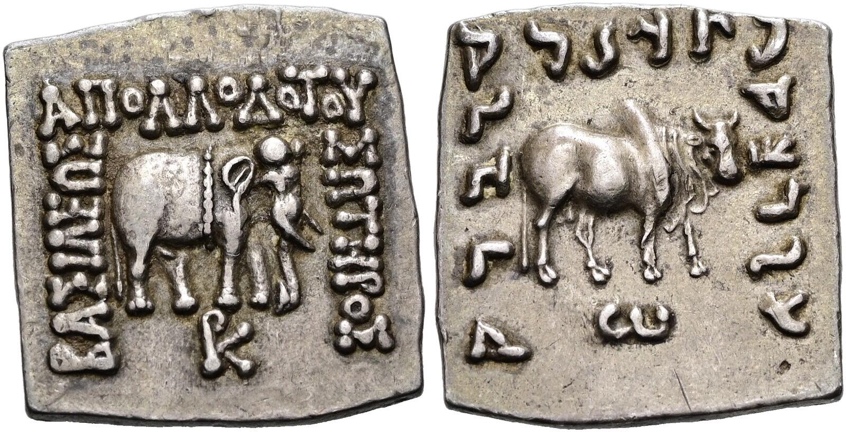
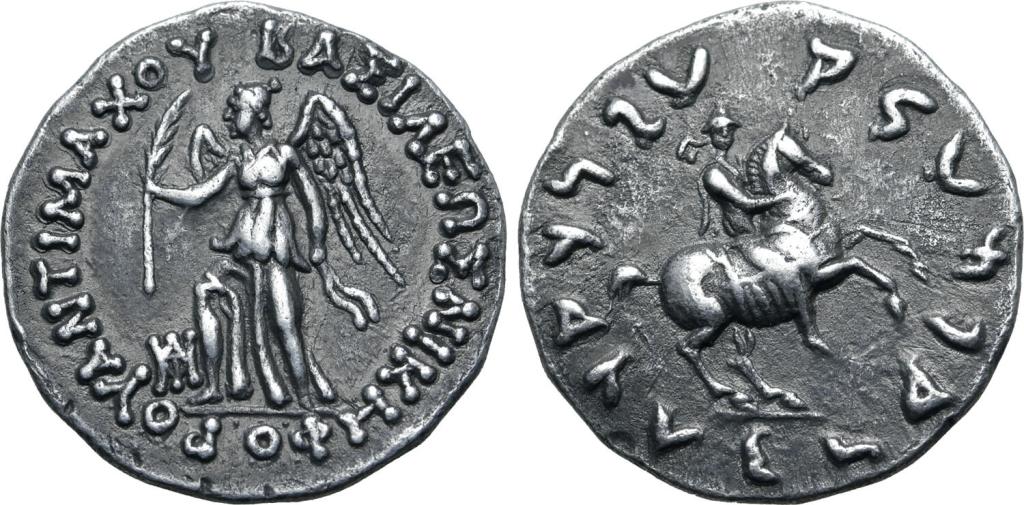
Antimachus Nicephorus (c. 175–165 BCE) is generally regarded as the successor of Apollodotus I in the Indo-Greek territories.24 From the outset of his reign, he struck coins according to the Indian weight standard, whereas the coinage of Apollodotus I reveals a series of experiments that ultimately culminated in the adoption of this standardized system. This suggests that Antimachus inherited a monetary framework that had already been largely established under his predecessor. It is also possible that the two kings were partly contemporary, with Antimachus starting to mint his coinage when that of Apollodotos had already reached its final stage. Apart from his coinage, however, we have no information on Antimachus’ reign. He is also the only king of the period for whom no portrait is known. However, given his name and possible mention in the tax receipt mentioned earlier, many scholars suggest he was a son of Antimachus Theos. Others keep open the option that Antimachus Theos and Antimachus Nicephorus may have been the same person, who used different epithets for some of his coin types.25
In this chapter of the series, we have seen how the successors of Euthydemus made further conquests across the Hindu Kush, being accompanied with new coin types that were designed to be acceptable to audiences with varying cultural and religious beliefs. Alas we have too little source material to really get a grasp of how these developments unfolded. It seems likely that the period saw some dynastic conficts, as seen with the possibility of Agathocles and Pantaleon being in conflict with Euthydemus II. Meanwhile, the tax receipt, coupled with some other hints, suggest that a form of joint rule might have been in place. This would fit with the further conquests made in this period, with the possibility that rulers divided the territories north and south of the Hindu Kush between them.
Two kings this article did not touch on are Eucratides and Menander, two of the most important Bactrian and Indo-Greek period, who should be seen as coming on the political scene closely after, or partly concurrently with some of the kings discussed here. Their rise to power and subsequent conflict with one another will be the subject of our next instalment. Luckily, for this matter we have some literary sources which help reconstruct these developments.
Join us next time to see how the two of the greatest kings of their time fought over the dominion of the Greek territories in the Hellenistic Far East!
Harald Blot
Sources
- Polybius, Histories 10.49; 11.34
- Strabo, Geography 11.11.1
Literature
- Bernard, Paul and Claude Rapin. “Un parchemin gréco-bactrien d’une collection privée.” Comptes-Rendus de l’Académie des Inscriptions et Belles-Lettres (1994): 261-94.
- Bernard, Paul, Georges-Jean Pinault, and Georges Rougemont. “Deux nouvelles inscriptions grecques de l’Asie centrale.” Journal des Savants (2004): 227-356.
- Bhandare, Shailendra. “Numismatics of ‘the other’: investigating coinage and ‘Greekness’ at Taxila.” In Buddhism and Gandara: an archaeology of museum collections, edited by H.P. Ray, 70-103. New Delhi: Routledge India, 2019.
- Bivar, Adrian David Hugh. “The sequence of Menander’s drachmae.” The Journal of the Royal Asiatic Society of Great Britain and Ireland 2 (1970): 123-36.
- Bopearachchi, Osmund. Monnaies gréco-bactriennes et indo-grecques: catalogue raisonné. Paris: Bibliothèque Nationale, 1991.
- Bopearachchi, Osmund and Wilfried Pieper. Ancient Indian coins. Turnhout: Brepols, 1998.
- Bordeaux, Olivier. Les Grecs en Inde: politiques et pratiques monétaires. Bordeaux: Ausonius Editions, 2018.
- Droysen, Johann Gustav. Geschichte des Hellenismus, vol. II, Geschichte der Bildung des hellenistischen Staatensystemes. Hamburg: Friedrich Perthes, 1843.
- Gardner, Percy. “On some coins of Syria and Bactria.” Numismatic Chronicle 20 (1880): 181-91.
- Glenn, Simon. Money and power in Hellenistic Bactria. New York: American Numismatic Society, 2020.
- Holt, Frank Lee. “The problem of Poseidon in Bactria.” In Central Asia: sources, history, culture, edited by E.A. Antonova, 721-26. Moscow: Russian Academy of Sciences, 2005.
- Holt, Frank Lee. Lost world of the golden king: in search of ancient Afghanistan. Berkeley: University of California Press, 2012.
- Jakobsson, Jens. “Antiochus Nicator, the third king of Bactria?.” Numismatic Chronicle 170 (2010): 17-33.
- Jakobsson, Jens and Simon Glenn. “New research on the Bactrian tax-receipt.” Ancient History Bulletin 32 (2018): 61-71.
- Mairs, Rachel. The Hellenistic Far East: archaeology, language, and identity in Greek Central Asia. Berkeley: University of California Press, 2016.
- Narain, Awadh Kishore, The Indo-Greeks. Oxford: Clarendon Press, 1957.
- Rea, John R., Robert C. Senior and Adrian S. Hollis. “A tax receipt from Hellenistic Bactria.” Zeitschrift für Papyrologie und Epigraphik 104 (1994): 261-80.
- Rougemont, Georges. “Nouvelles inscriptions grecques de l’Asie Centrale.” In Afghanistan: ancien carrefour entre l’Est et l’Ouest, edited by Osmund Bopearachchi and Marie-Françoise Boussac, 127-36. Turnhout: Brepols Publishers, 2005.
- Senior, Robert C. “The Indo-Greek and Indo-Scythian king sequences in the second and first centuries BC.” Journal of the Oriental Numismatic Society 179 (2004): 33-56.
- Tarn, William Woodthorpe. The Greeks in Bactria and India. Cambridge: Cambridge University Press, 1951.
- Von Sallet, Alfred. Die Nachfolger Alexanders des Grossen in Baktrien und Indien. Berlin: Weidmann, 1879.
- Wilson, L.M. “Antimachos of Bactria: coins, documents and eras.” Journal of the Oriental Numismatic Society 194 (2008): 20-2.
- Zeng, Chenyu. “A brief note on two newly discovered denominations of Eucratides I Megas: tridrachms and pentadrachms.” Journal of the Oriental Numismatic Society 249 (2022): 2-4.
- Bopearachchi 1991, Bopearachchi and Pieper 1998. ↩︎
- Polybius, Histories 10.49; 11.34 ↩︎
- Strabo, Geography 11.11.1 ↩︎
- Bernard et al. 2004, p. 333-56; Rougemont 2005, p. 133-35; Holt 2012, p. 124-25. ↩︎
- Bopearachchi 1991, p. 52. ↩︎
- MacDowall 2005, p. 197-206. ↩︎
- Bopearachchi 1991, p. 58; Narain 1957, p. 58-9; Newell 1937, p. 80; Tarn 1951, p. 156-60. ↩︎
- The hypothesis that the coins struck in the name of Antiochus were not a transitional issue of Diodotus I, but rather the coinage of a third Diodotid king who ruled after Diodotus I and II, was first advanced by Jakobsson 2010. ↩︎
- Bopearachchi 1991, p. 58. ↩︎
- Droysen 1843, p. 760-64. ↩︎
- Von Sallet 1879, p. 14-31. ↩︎
- A good overview on the historiography of the pedigree coins can be found in Holt 2012, p. 46-9. It was Percy Gardner who demonstrated the existence of a type depicting Alexander the Great, see Gardner 1880, p. 181-91. ↩︎
- Simon Glenn likewise suggested that a conflict between Agathocles and Euthydemus II may explain the latter’s omission from the pedigree series. At the same time, however, he cautions against placing too much weight on this absence, noting that several rulers represented in the pedigree series are themselves attested by only one or two specimens. It therefore remains possible that pedigree issues honoring Euthydemus II simply have not yet come to light, see Glenn 2020, pp. 140–143. ↩︎
- Bopearachchi 1991, p. 57. ↩︎
- One example can be found in Bopearachchi and Pieper 1998, p. 59. For an important critique of attributing part of the coinage of Agathocles and Pantaleon to Taxila, as well as assigning certain types to an ‘independent phase of Taxila’, see Bhandare 2018. Although Bhandare raises strong objections to these attributions, it remains likely that the coin types in question circulated south of the Hindu Kush, possibly including Taxila.
↩︎ - Glenn 2020, p. 153-58. ↩︎
- Holt 2005, p. 721-26. ↩︎
- Rea, Senior and Hollis 1994, p. 261-80; Bernard and Rapin 1994, p. 261-94. ↩︎
- Jakobsson and Glenn 2018, p. 61-71. ↩︎
- This is given as an option by Rea, Senior and Hollis 1994, p. 272. ↩︎
- This cointype was brought forward by Chenyu Zeng in a Chinese journal, and unfortunately, this is the only information on it currently available. The coin is supposed to have surfaced as part of a new hoard found in 2019 in Qunduz, on which see Zeng 2022, p. 2-4.
↩︎ - For example, a unique gold coin of Heliocles II from the collection of the Bibliothèque nationale de France was only recently identified as a forgery, thanks to chemical composition analysis, see Glenn, Olivier and Blet-Lemarquand 2024, p. 9-48. ↩︎
- Bivar 1970, p. 123-26. ↩︎
- Bivar 1970, p. 123-26. ↩︎
- Senior 2004, p. 3-4; Wilson 2008, p. 20-2; Blot forthcoming. ↩︎


Leave a comment