
The Qazvin school of painting occupies a pivotal position in the evolution of Safavid art, representing the transition between the monumental court style of Tabriz and the highly individualistic painting of seventeenth-century Isfahan. Emerging after Shah Tahmasp I transferred the Safavid capital from Tabriz to Qazvin in the mid-sixteenth century, the school developed under complex political, religious, and cultural circumstances. Although firmly rooted in the artistic traditions of Herat and Tabriz, the painters of Qazvin gradually established a distinctive visual language characterized by elongated figures, lyrical compositions, sophisticated colour harmonies, monumental wall painting, and the growing popularity of single-page paintings. The period also witnessed the production of important royal manuscripts, most notably the Shahnameh of Shah Isma’il II, while serving as the formative environment for artists whose work profoundly influenced the subsequent Isfahan school. This article examines the historical circumstances behind the emergence of the Qazvin school, its stylistic characteristics, its principal artists, and its lasting contribution to Persian painting.
Introduction
Among the artistic schools of Safavid Iran, the Qazvin school has frequently been overshadowed by the celebrated ateliers of Tabriz and Isfahan. While the former produced masterpieces such as the Shah Tahmasp Shahnameh, and the latter became synonymous with the genius of Reza Abbasi, the artistic developments that occurred in Qazvin during the second half of the sixteenth century were equally transformative. Rather than constituting merely an intermediary phase, the Qazvin school established many of the aesthetic principles that would dominate Persian painting throughout the seventeenth century. Recent scholarship has challenged the older perception of Qazvin as a period of artistic decline following Shah Tahmasp’s withdrawal from large-scale manuscript patronage. Instead, historians increasingly regard the city as a laboratory of artistic innovation where new forms of visual expression, including monumental palace decoration, muraqqaʿ (album) painting, and increasingly individualized figural representation, were cultivated. The painters active in Qazvin successfully preserved the technical refinement inherited from the royal workshops of Tabriz while simultaneously introducing stylistic innovations that fundamentally altered the direction of Persian painting.
Historical and Political Background
The emergence of the Qazvin school cannot be understood without the political circumstances of the Safavid Empire. Throughout the first half of the sixteenth century, Tabriz remained vulnerable to repeated Ottoman incursions. In response to these military pressures, Shah Tahmasp I decided to transfer the Safavid capital to Qazvin. Preparations for the relocation began around 1544, while the complete transfer of the administrative apparatus was accomplished by approximately 1555. Beyond military considerations, Qazvin possessed symbolic advantages. Located farther from the Ottoman frontier and closer to Ardabil, the spiritual centre of the Safavid order, it offered greater political security while reinforcing dynastic legitimacy. According to Persian historical sources, Shah Tahmasp purchased extensive gardens from Mirza Ashraf Jahan Qazvini and transformed the area into the royal complex known as Saʿadatabad, where palaces, gardens, ceremonial buildings, and the celebrated Chehel Sotun pavilion were constructed. Contemporary chroniclers describe these palaces as richly decorated with murals depicting royal ceremonies, literary subjects, hunting scenes, and religious narratives.
The transfer of the capital naturally brought with it the relocation of the imperial kitabkhaneh, or royal library-workshop. This institution functioned not merely as a library but as the principal artistic academy of the Safavid state, employing painters, calligraphers, illuminators, bookbinders, paper makers, and designers. Consequently, Qazvin rapidly replaced Tabriz as the foremost centre of artistic production in Iran. Yet this flourishing environment soon encountered an important transformation. During the later decades of his reign, Shah Tahmasp gradually adopted a more conservative religious outlook. As recorded by Qadi Ahmad and later historians, in 1565 the Shah formally ordered provincial governors to discourage activities considered morally questionable, including music and certain forms of artistic entertainment. Although manuscript production never ceased entirely, royal patronage became increasingly selective. The emphasis shifted toward religious manuscripts, architectural decoration, and calligraphy, while fewer lavish illustrated manuscripts were commissioned. This change profoundly affected the careers of court artists. Some remained in Qazvin under reduced patronage, while others entered the service of provincial governors. Most notably, Prince Ibrahim Mirza established an important artistic workshop in Mashhad that attracted many distinguished painters formerly associated with the royal atelier. Still others eventually migrated to Mughal India or the Ottoman Empire, contributing to the international dissemination of Safavid artistic ideals.
The Formation of the Royal Atelier in Qazvin
“the Qazvin atelier nurtured painters whose mature styles departed significantly from earlier traditions”
Despite the changing priorities of Shah Tahmasp, the Qazvin atelier remained one of the most sophisticated artistic institutions of the Islamic world. The organization inherited the collaborative workshop model perfected during the production of the Shah Tahmasp Shahnameh. Rather than assigning an entire manuscript to a single painter, projects were divided among numerous specialists responsible for design, drawing, colouring, illumination, calligraphy, and binding. The atelier was remarkable not only for its technical excellence but also for the diversity of its artistic production. Besides illustrated manuscripts, painters increasingly produced palace murals, architectural decoration, independent album paintings, portrait studies, and designs for textiles and luxury objects. This diversification reflected changing patterns of patronage and expanded the social function of painting beyond royal manuscripts. The Qazvin workshop also became a training ground for a younger generation of artists. While many senior masters had begun their careers under Sultan Muhammad, Mir Musavvir, and Aqa Mirak in Tabriz, the Qazvin atelier nurtured painters whose mature styles departed significantly from earlier traditions. The collaborative environment encouraged experimentation while preserving the extraordinary technical standards associated with the royal workshop.
Defining Characteristics of the Qazvin School”
“Perhaps the most recognizable feature is the treatment of the human figure. Artists consistently preferred elongated, elegant bodies with narrow waists, long necks, broad shoulders, and graceful gestures.”
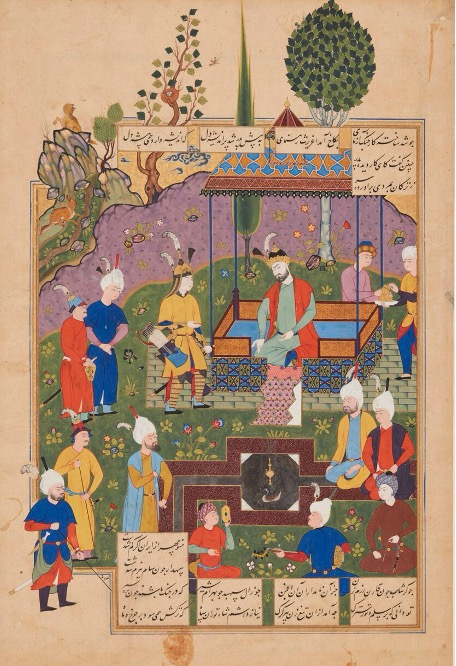
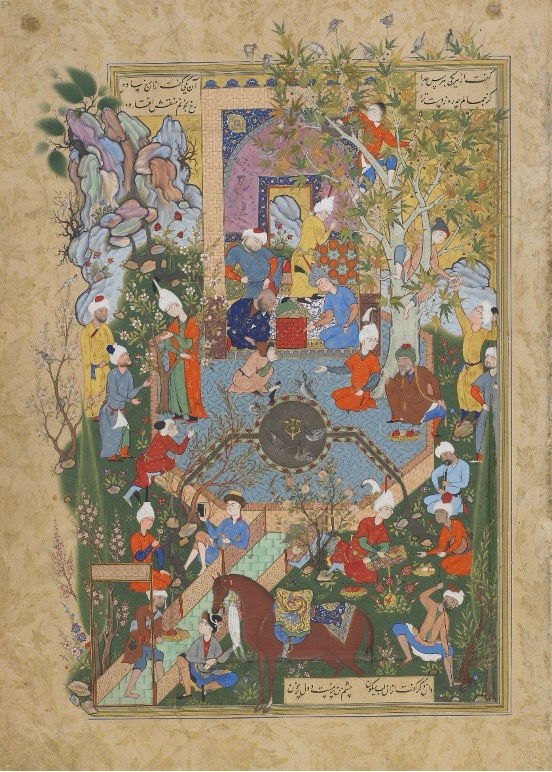
Although deeply indebted to the traditions of Herat and Tabriz, the Qazvin school gradually developed a visual identity that distinguished it from earlier Safavid painting. Persian sources summarise its principal characteristics with remarkable precision, and these observations are largely confirmed by surviving manuscripts. Perhaps the most recognizable feature is the treatment of the human figure. Artists consistently preferred elongated, elegant bodies with narrow waists, long necks, broad shoulders, and graceful gestures. Faces became increasingly idealized, characterised by oval contours, large almond-shaped eyes, elongated eyebrows, and delicately modelled features. Young courtiers and beautiful adolescents emerged as favourite subjects, anticipating the fascination with youthful beauty that would later dominate the paintings of Reza Abbasi.
Line assumed a more expressive role than before. Rather than relying exclusively upon brilliant colour, Qazvin painters achieved elegance through rhythmic contours that unified figures and landscapes. Drapery folds became fluid and animated, while gestures conveyed psychological refinement instead of dramatic movement. Landscape design underwent equally significant transformation. One of the most distinctive motifs consists of towering mauve or violet rock formations outlined with bold contours. These rocks frequently dominate the composition, creating dynamic rhythms while preserving the decorative flatness characteristic of Persian painting. Trees, flowering shrubs, and gardens are carefully balanced against architectural structures, producing harmonious rather than naturalistic environments. Colour harmonies became subtler than those of the Tabriz school. Brilliant blues, purples, emerald greens, pinks, oranges, and extensive gold illumination continued to be employed, yet the palette was organised with greater restraint and sophistication. The result is a lyrical atmosphere in which colour supports rather than overwhelms the compositional structure.
“gestures conveyed psychological refinement instead of dramatic movement”
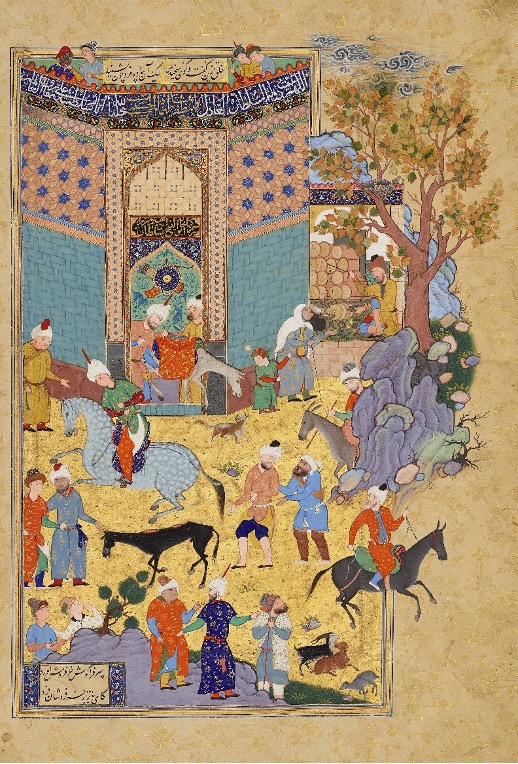
Another innovation was the increasing production of single-page paintings (muraqqaʿ leaves). Freed from the narrative demands of manuscripts, artists explored individual portraiture, idealised youths, dervishes, lovers, and court attendants placed against minimal backgrounds. This development represents one of the most significant artistic achievements of the Qazvin period and provided the immediate foundation for the flourishing album painting tradition of seventeenth-century Isfahan.
“The result is a lyrical atmosphere in which colour supports rather than overwhelms the compositional structure.”
The Shahnameh of Shah Ismaʿil II: The Masterpiece of the Mature Qazvin School
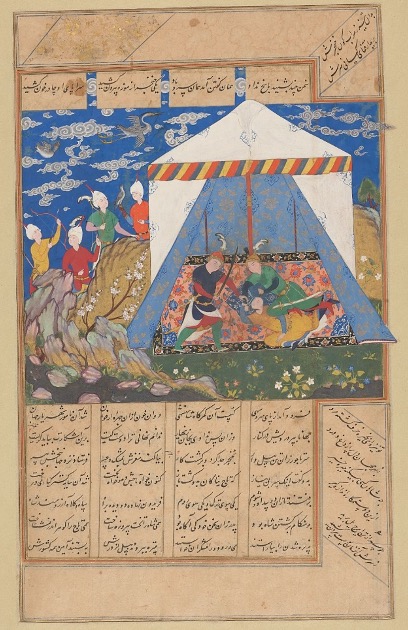
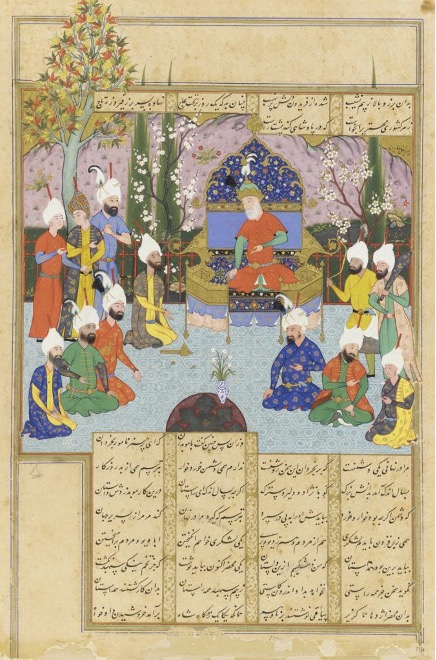
If the Shah Tahmasp Shahnameh represents the monumental culmination of the Tabriz school, the Shahnameh commissioned by Shah Ismaʿil II embodies the artistic maturity of the Qazvin school. Although never completed because of the Shah’s sudden death in 1577, the manuscript remains one of the most important visual documents for understanding late sixteenth-century Safavid painting. Unlike the earlier royal Shahnameh, whose production extended over two decades under the supervision of Sultan Muhammad and his generation, the Ismaʿil II manuscript was entrusted largely to a younger group of painters who had developed within the artistic environment of Qazvin. According to Persian sources, the manuscript originally contained approximately fifty-two illustrations, many of which are now dispersed among museums and private collections throughout Europe and North America. Despite its incomplete state, the surviving folios demonstrate remarkable artistic coherence while simultaneously revealing the individuality of several painters.
The manuscript is particularly significant because many of its paintings bear signatures or have been convincingly attributed through stylistic analysis. This allows art historians to examine the contributions of individual artists with a precision rarely possible for earlier Safavid manuscripts. At the same time, the manuscript illustrates the collaborative nature of the royal workshop, where numerous painters worked simultaneously under unified artistic supervision. Unlike the heroic monumentality characteristic of the Shah Tahmasp Shahnameh, the illustrations of Ismaʿil II increasingly favour elegance over grandeur. Figures become taller and more slender, emotional interactions are rendered with greater subtlety, and landscapes are organised through carefully balanced rhythms rather than dense ornamental complexity. These developments foreshadow the aesthetic direction that Persian painting would follow under Shah Abbas I.
“the Shahnameh commissioned by Shah Ismaʿil II embodies the artistic maturity of the Qazvin school”
Leading Masters of the Qazvin School
One of the greatest strengths of the Persian study from which this article draws is its detailed stylistic evaluation of individual painters. Rather than viewing the Qazvin school as a homogeneous artistic phenomenon, it demonstrates the diversity of artistic personalities working within the royal atelier.
Siyavush Beg Gurji
Among the leading painters of the Ismaʿil II Shahnameh, Siyavush Beg occupies a particularly distinguished position. Contemporary and modern scholars alike recognize him as one of the principal architects of the mature Qazvin style. His paintings reveal extraordinary compositional sophistication. Human figures interact naturally within complex spatial arrangements while maintaining the rhythmic balance expected of Persian painting. His rocky landscapes, with their sharply defined contours and carefully modulated mauve tones, became one of the visual hallmarks of the school. The Persian source notes that works such as Zal Consulting the Simurgh demonstrate Siyavush’s remarkable ability to integrate expressive landscape, vivid colour harmonies, and psychologically convincing figures (Ajand, 2005). Unlike many earlier painters, he endowed mythical creatures such as the Simurgh with striking vitality and movement while maintaining complete compositional harmony. Perhaps his greatest contribution lies in his remarkable synthesis of drawing and colour. Every contour appears deliberate, while colour transitions remain refined and restrained. The result is an atmosphere of poetic elegance that profoundly influenced later Safavid painting.
Sadiqi Beg Afshar
Sadiqi Beg represents another major figure associated with the Qazvin school. Celebrated today as an accomplished painter, calligrapher, poet, and art theorist, Sadiqi Beg exemplifies the intellectual breadth associated with Safavid court artists. Sadiqi’s paintings possess exceptional refinement and technical precision (Ajand, 2005; Azizpour, 2024). His compositions are carefully constructed, his colour harmonies are subtle rather than flamboyant, and his treatment of natural elements demonstrates close observation combined with decorative stylisation. His later independent drawings reveal another important innovation of the Qazvin period: the growing importance of album painting. These works, often depicting solitary youths or elegantly dressed courtiers, represent an important transition toward the independent figure studies perfected later by Reza Abbasi.
Murad Daylami
Although less well documented historically, Murad Daylami emerges from stylistic analysis as one of the finest painters of dynamic narrative scenes. His compositions exhibit remarkable movement without sacrificing compositional clarity. Persian scholars have noted the emotional immediacy of his battle scenes and the harmonious relationship between architecture, landscape, and human action. His figures remain animated yet carefully integrated into balanced compositions, demonstrating the technical sophistication characteristic of the Qazvin atelier.
The Legacy of the Qazvin School
“Qazvin artists simplified compositions, refined line, and introduced greater psychological sensitivity into figural representation.”
The historical significance of the Qazvin school extends far beyond the relatively brief period during which Qazvin served as the Safavid capital. Its true importance lies in transforming the language of Persian painting at a decisive historical moment. First, the school successfully preserved the extraordinary technical achievements of the Tabriz atelier while adapting them to changing political and cultural circumstances. Instead of merely repeating established formulas, Qazvin artists simplified compositions, refined line, and introduced greater psychological sensitivity into figural representation. Second, the period witnessed the remarkable expansion of artistic production beyond royal manuscripts. Palace murals, architectural decoration, and especially independent album paintings became increasingly important. The emergence of the single-page painting fundamentally altered Persian artistic practice by encouraging painters to concentrate upon individual figures rather than literary narratives. Third, the school produced a generation of artists whose influence extended throughout the Persianate world. Painters associated with Qazvin carried Safavid artistic principles to Mashhad, Mughal India, and, ultimately, Isfahan. Finally, the aesthetic ideals developed in Qazvin provided the essential foundation for the revolutionary achievements of the Isfahan school. The elegant youths, expressive contour lines, simplified compositions, and poetic sensibility perfected by Qazvin painters reached their fullest expression in the works of Reza Abbasi, whose artistic language would become synonymous with seventeenth-century Persian painting. Rather than representing a transitional interruption between two more celebrated artistic centres, the Qazvin school should therefore be recognised as one of the decisive turning points in the history of Iranian art. It was in Qazvin that Safavid painting moved beyond the monumental narrative traditions of Tabriz toward the refined lyricism and individual expression that would define the final flowering of classical Persian painting.
References
- Azizpour, Shadabeh. (2024). Safevî tasvir sanatı ekolleri (Doctoral dissertation). Department of Art History, Faculty of Letters, Erciyes University, Kayseri, Türkiye. National Thesis Center (YÖK National Thesis Center). Thesis No. 844698.
- Azizpour, Shadabeh. 2026. “From Herat to Isfahan: Aesthetic Continuity and Transformation in Turco-Persian Miniature Painting (Kamāl al-Dīn Behzād and Rezā ʿAbbāsī)”. İSTEM, sy 47: 1-34. https://doi.org/10.31591/istem.1898496.
- Ajand, Yaʿqub. Naqqāshī dar Maktab-hā-ye Tabrīz, Qazvīn va Mashhad [Painting in the Schools of Tabriz, Qazvin, and Mashhad]. Tehran, 2005.
- Canby, Sheila R. The Golden Age of Persian Art 1501–1722. London: British Museum Press, 1999.
- Canby, Sheila R. “The World of the Early Safavids: Shah Tahmāsp at Qazvin, 1550–1576.” In Shah ʿAbbas: The Remaking of Iran. London: British Museum Press, 2009.
- Gray, Basil. Persian Painting. Geneva: Skira, 1961.
- Qadi Ahmad. Golestān-i Hunar (The Garden of Art). Translated by V. Minorsky. Washington, DC: Smithsonian Institution, 1959.
- Robinson, B. W. Persian Miniature Painting. London: British Museum Press, 1967.
- Robinson, B. W. Persian Paintings in the India Office Library. London: Sotheby Parke Bernet, 1976.
- Titley, Norah M. Persian Miniature Painting and Its Influence on the Art of Turkey and India. London: British Library, 1983.
- Welch, Stuart Cary. A King’s Book of Kings: The Shahnameh of Shah Tahmasp. New York: Metropolitan Museum of Art, 1972.
 alongthesilkroad.com
Leave a comment