
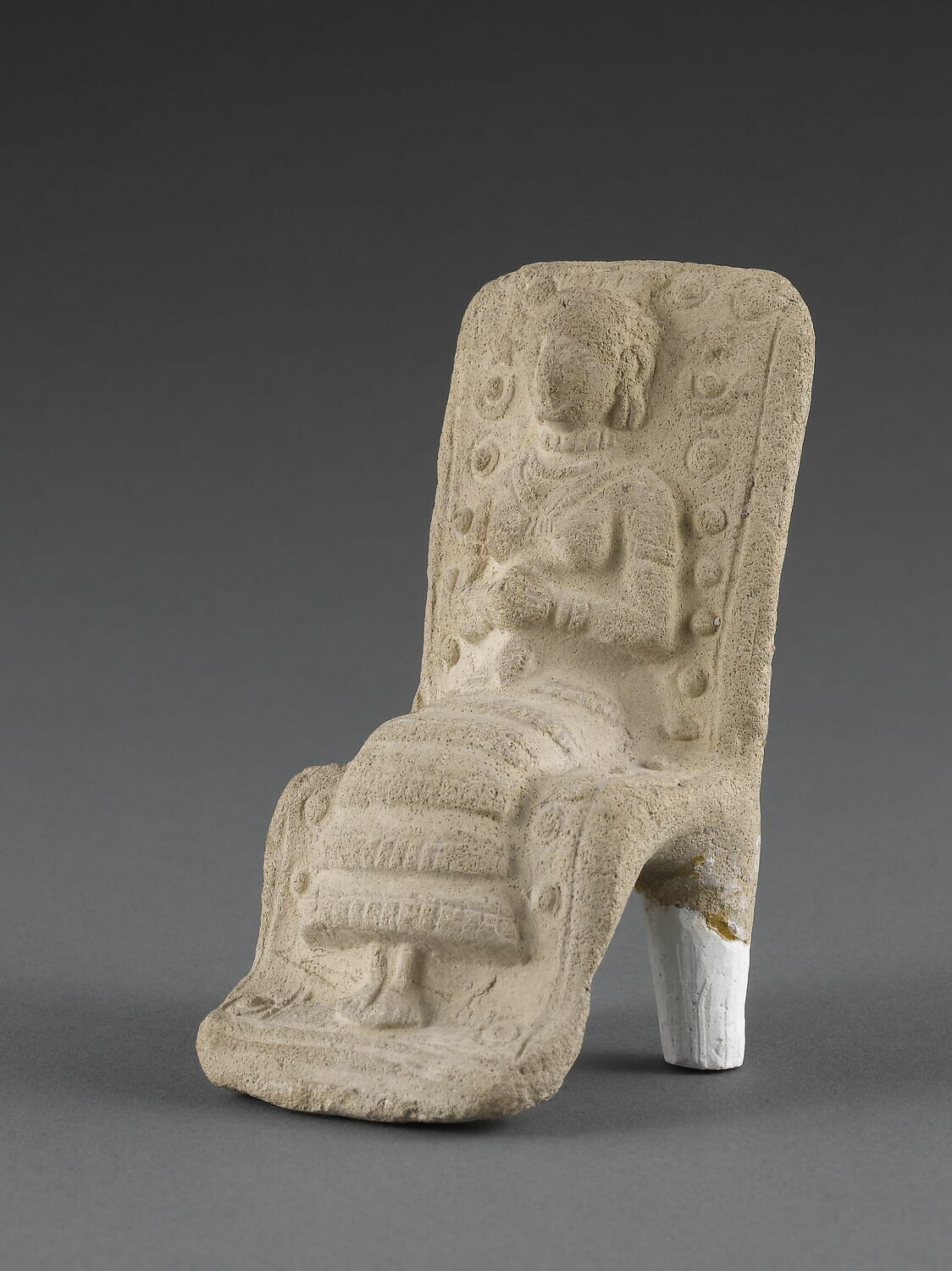
Imagine you’re a traveller in the 18th century BCE and have just arrived at the gates of Sippar after a two-day journey from Babylon. After passing through the gates, you are taken aback as the city is bursting with activity. Caravans from far away in Iran have just arrived, and throughout the streets, numerous merchants and shopkeepers can be heard shouting, selling their merchandise and negotiating its prices. While proceeding toward the Ebabbar temple complex to pay homage to the city’s famed patron, the sun god Shamash, you suddenly arrive at an enclosed neighbourhood which seems as busy as any other. You can’t help but notice one difference: the overwhelming majority of the people around you are women walking about without any male guardian. You have, in fact, entered the quarter of the nadîtums, a select group of women who have been dedicated to the sun god. They formed an interesting anomaly in an otherwise unforgiving patriarchal society. These respected women weren’t married, managed their own property and could even expand their estate. Although they are sometimes regarded as one of the most remarkable examples of women who escaped the clutches of Babylonian patriarchy, their independence knew its limits. This article will briefly discuss these interesting women and assess their standing within Babylonian society and their perceived autonomy.
“You can’t help but notice one difference: the overwhelming majority of the people around you are women walking about without any male guardian.”
The Discovery of the Nadîtums
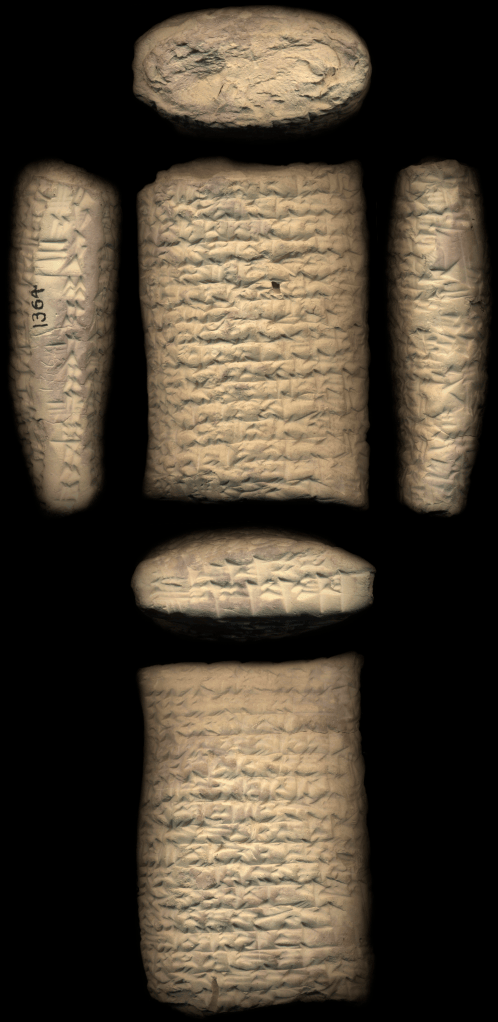
Shamash’s nadîtums were first identified after the excavations conducted for the British Museum during the 1880s by the Mosul-born archaeologist Hormuzd Rassam. Thousands of tablets from the Old Babylonian period were unearthed, which puzzled archaeologists. About a third of them, in fact, attested to the economic activities of women, a group which Assyriologists usually situated at the margins of Mesopotamian society and economy. At Sippar, however, they appear to have constituted a central pillar of the local economy, with some researchers even claiming that they played a role in the city’s long-distance trade with Susa in Iran. They owned slaves, bought and leased houses, agricultural fields and orchards, and even managed numerous taverns in the city. Despite the impressive yields of Hormuzd Rassam’s expeditions, archaeology was back then unfortunately still in its infancy at the time, often leaving us in the dark as to the circumstances in which these documents were found. This has seriously complicated the study of the nadîtums. Luckily, the University of Baghdad, which continued researching the site in 1978, has remedied some of these issues, carefully documenting the context in which the new clay tablets were found.
The City of Sippar
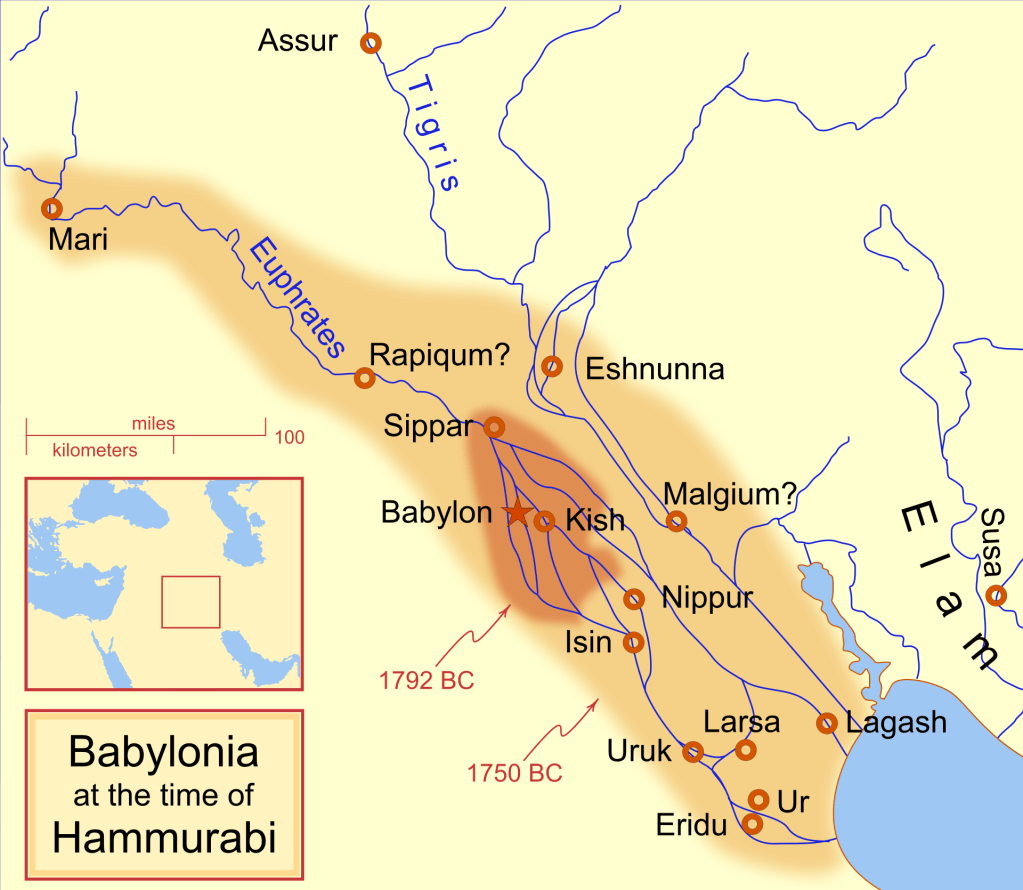
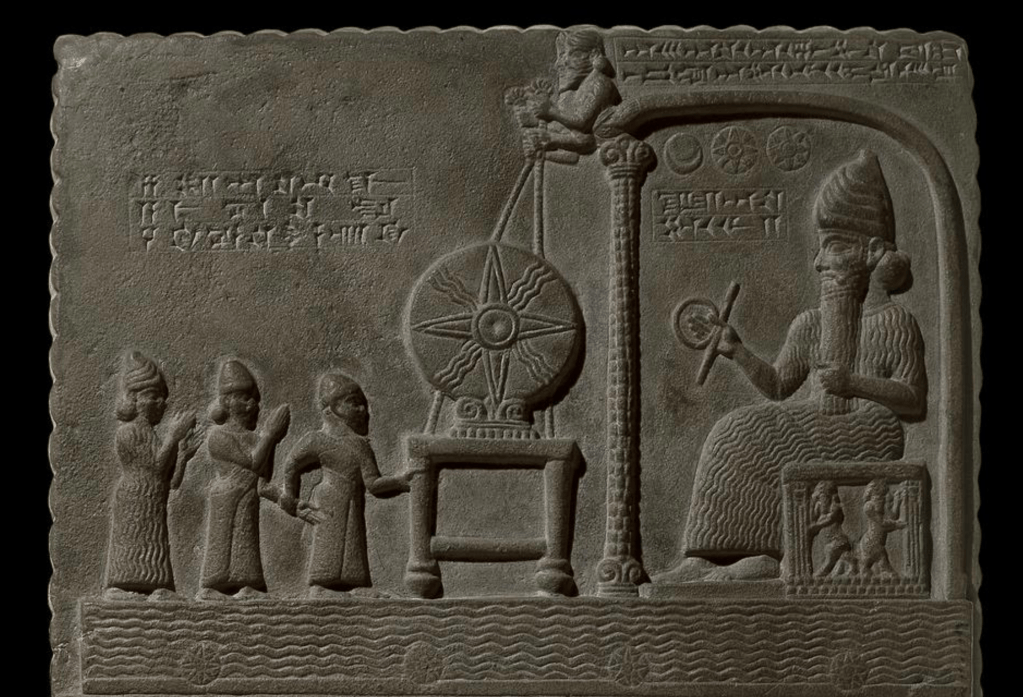
The phenomenon of the nadîtums was not confined to Sippar alone, with such women also being attested at Babylon and Nippur. Lack of time and space compels the author of this article to focus only on the best-attested branch of this religious group, those at Sippar. Sippar was one of Mesopotamia’s most ancient cities, inhabited since the Uruk period, i.e. the 4th millennium BCE. The site was situated about two days’ journey north of Babylon. It maintained its status as a vibrant centre of trade and production all the way up until the late 1st millennium BCE. Its most defining feature, however, was the so-called Ebabbar, which is Sumerian for “the bright/white house”. This was the main sanctuary of Shamash, the god of the sun and justice, who was one of the central deities of the Mesopotamian pantheon. The association between light and law came from the idea that the sun laid bare all the injustices of the land. This explains why King Hammurabi (r. c. 1792–c. 1750 BCE) dedicated his famed laws to the sun god, probably at Sippar. It was likewise in honour of Shamash that a religious order of women, the nadîtums, was founded.
Who were the Nadîtums?
Sippar’s nadîtums were girls who were dedicated by their father or another male guardian to the sun god, usually at a young age. They were subsequently relocated to the city’s special neighbourhood for the nadîtums, the gagûm, which was close to the Ebabbar. The gagûm was a formal institution with its own bureaucracy and overseers, but more about this later. The oldest reference to this community at Sippar dates to the reign of King Sumu-la-El, c. 1880 BCE, and the institution survived all the way up until the end of the Old Babylonian period under King Samsu-ditana (1625–1595 BCE). A nadîtum can be readily identified in a text through the logogram LUKUR (𒊩𒈨). Other Akkadian terms for nadîtum were qadištu and mašītu.
Their subsequent subordination to the god is reflected in the title “slave girl of Shamash and Aya (Shamash’s wife),” which can be found on several cylinder seals. It is unclear what their initiation ritual (nišîtu) looked like, but the presence of several diviners among the witnesses in the texts referring to this occasion might indicate that some sort of extispicy took place. Upon entry into the order, the girls severed all legal ties with their previous families and received new names, reflecting their new identity. These names typically referred to their new status as nadîtums and celebrated their life in service to the sun god and his divine consort, with famous examples being “Gift of Aya,” “Wish of Shamash,” “His Favourite,” or “Our Guardian Deity.” The initiation was accompanied by the donation of a “dowry” (nudunnû) by the male guardian to the nadîtum, as if she were being married off to the god. The size of these dowries usually corresponded to the dowries of girls who were actually married off. It is important to note that these possessions were considered the inalienable private property of the nadîtums themselves and not of the cult of Shamash at the Ebabbar. In any case, the idea of a sacred marriage might explain their forced celibacy, barring them from marriage and having children for the rest of their lives. The sexual purity of these women became an important point in the discussion of the nadîtums, leading some researchers to equate them with nuns in Christianity. This ban on marriage with a mortal didn’t apply everywhere, however, with the nadîtums of Marduk at Babylon being attested as spouses, although the prohibition on having children seems to have been universal.
Praying to the Gods: The Nadîtums and their Families
Despite their formal separation from their families and their move into the quarter of the nadîtums, the gagûm, these women maintained strong contact with their relatives. Numerous letters attest to how these girls still communicated regularly with their kin, and a large number of contracts even show that the nadîtums and their families continued to support each other in various economic and judicial matters.
Furthermore, continued contact with their relatives was stimulated by the expectation that these initiated maidens would pray for their families’ health and good fortune, based on the belief that these girls interceded directly with the gods. This is perfectly reflected in the following letter by a devotee: “I always pray to my Lord and my Mistress for your life at the morning and the evening sacrifices. I have heard of your illness and I am worried. May my Lord and my Mistress not cease to protect you on the left hand and on the right (AbB 11 106: 1-3).” They were therefore sometimes called kāribtum, which is Akkadian for “she who prays”. Thus, the nadîtums were, in some sense, performing a service for their relatives. In exchange, these girls expected continued financial support from them. Besides the previously mentioned dowry and subsequent regular payments, this assistance included the bestowal of gifts during several religious festivals in which they took an active part. One such festival was “the seven days of sebūt šatti”, an autumnal feast in the seventh month (Tišritum) of the Babylonian calendar, which can be seen as a Mesopotamian counterpart to the Jewish autumn festivals, including the Day of Atonement (Yom Kippur). Another important event was the “day of the destiny of the nadîtums” in the fifth month (Abu), during which offerings were brought to the deceased. This might be linked to the Christian All Souls’ Day on 2 November, on which worshippers commemorate and celebrate their past relatives. Finally, there was “the day of Ṭebētum of the nadîtums” in the tenth month (Ṭebētum), which might have been a special festival for the women of Sippar
“Sending a girl to the gagûm was thus a useful way to keep the wealth within the family.”
The nadîtums’ intercession with the gods was an important motive for relatives to put these girls into the cloister. As Amanda Podany points out, we should never underestimate the Mesopotamians’ belief in the gods and their wish to acquire their benefactions. However, another reason has been put forward by researchers for why so many Sippareans dedicated their sisters and daughters to the sun god. As mentioned earlier, these girls were not allowed to marry or have children. What then happened to their possessions? These reverted to their closest male relatives when they passed away. Sending a girl to the gagûm was thus a useful way to keep the wealth within the family. The alternative would be to marry the girls off, which would result in the relocation of assets to another household through the dowry.
The Social Status of the Nadîtums
This prerequisite of gift-giving and continued support by their families might explain why the institution never comprised more than 200–300 members at any one time. To maintain a nadîtum was, in fact, quite a burdensome affair which not everyone could afford. The nadîtums therefore mostly came from wealthy backgrounds, with some of the girls even hailing from royal families. Their elevated social status is reflected in their sometimes sumptuous dowries. For example, a certain Shat-Aya’s entry into the cloister was accompanied by the lavish gift of five fields, one large house, a tavern, several shops, an orchard and 20 slaves.
The girls of Shamash were highly respected throughout Mesopotamia. The institution’s fame extended far beyond the walls of Sippar. At a certain point, Zimri-Lim (r. 1775–1761 BCE), the king of Mari in modern-day Syria, was advised in a prophecy to give one of his daughters to the cloister, despite Sippar not being under his control. Having a nadîtum in the family was considered a source of pride. It seems that many of these girls also revelled in their status, with a certain Amat-Shamash stating in a letter, when talking about the king of Karanâ, Aqba-Ḫammu: “I esteemed him highly, as was fitting for my status as nadîtum (OBTR 134).” Not all nadîtums shared this sense of pride, however, with Princess Erišti-Aya, the daughter of the queen of Mari, writing to her mother with a sense of disdain: “You and your husband … put me in a convent (ARM 10 43).” One can indeed imagine that a life of forced celibacy was not attractive to all women.
The Economic Activities of the Nadîtums
One of the most defining features of Sippar’s nadîtums was their remarkable activity in the local economy. Many weren’t satisfied with the dowry and support they received from their families and therefore sought ways to expand their wealth. As mentioned above, about a third of the business in the city was conducted by these women, thus making the gagûm a cornerstone of Sippar’s prosperity. They appear as contracting parties, witnesses and sometimes even scribes, which also shows that some of these women could read and write. One of their specialities was agricultural real estate, where we often see them purchasing or leasing fields. Here, they interacted with men and women from outside the gagûm as well as with fellow nadîtums. Ichiro Nakata has noticed that these girls’ activities appear to have been mostly confined to certain irrigation districts around Sippar, although it remains to be seen why exactly this was the case. The nadîtums’ fields could range from rather modest plots of land to relatively large fields, with sizes varying between 0.36 ha and 9 ha, the latter being the equivalent of roughly 13 football fields.
“Not having to deal with pregnancy and the subsequent upbringing of children opened up a lot of time for these ambitious women, and they clearly did not take this time for granted, putting it to good use.”
The nadîtums were also very much active within the city itself. Besides owning many homes and shops, a lot of these women seem to have had a large stake in the tavern business. Again, many made deals with men and women who did not belong to the gagûm. All of this economic activity shows that not only were the nadîtums not isolated from their previous families, but they also intensely intermingled with the people of Sippar. Some have even suggested that these nadîtums might have been involved in the famed long-distance trade with Susa, Elam (Persia). One explanation for this remarkable activity on the market could be their ban on having children. Not having to deal with pregnancy and the subsequent upbringing of children opened up a lot of time for these ambitious women, and they clearly did not take this time for granted, putting it to good use.
Despite all this business activity, many nadîtums still seem to have lived in dire circumstances, or at least claimed to do so. We encounter many girls complaining about their relatives’ lack of support: “But you never think of me. You never have a jar of good oil sent to me and you never say to me, ‘offer it to your mistress and pray for me (OBTR 134).’” Some even assert that they suffer from hunger and have to give up their possessions in exchange for allowances. Due to a lack of support from their relatives, some nadîtums adopted someone to take care of them once they reached old age. The most obvious candidates appear to have been actual female family members, such as nieces, although interesting alternatives existed, with one woman freeing her slave girl before adopting her. This obviously clashed with the interests of the nadîtum’s closest male relatives, who expected to receive the woman’s estate upon her death. Instead, her adopted child became her heir, often leading to disputes with their disenfranchised brothers and fathers.
Organisation of the Gagûm and its Relationship with the King of Babylon
Most of the nadîtums lived together in a separate quarter at Sippar, the so-called gagûm, while others were not connected with the gagûm neighbourhood or the institution. The neighbourhood became more demarcated under the famed King Hammurabi (r. c. 1792–c. 1750 BCE), who surrounded it with a wall. The nadîtumsdwelled here in tiny houses which were mostly smaller than 36 square metres, with some dwellings consisting of a mere two rooms in total. These were just big enough to accommodate a single person, reflecting the nadîtum’s isolation from family life. Another architectural feature which underscores their formal alienation from their previous families is the absence of cellar burials in these houses. In the Old Babylonian period, families were normally entombed together in the basement of the paternal home, while the nadîtums were laid to rest in a separate cemetery. These modest dwellings in the gagûm seem quite at odds with the extremely wealthy status of some of these nadîtums. Amanda Podany, however, has suggested that some women, although officially living in the gagûm, rather spent their days in a larger, second house outside the cloistered area.
Besides living quarters, the gagûm also contained buildings which housed the quite extensive administrative apparatus of this religious association. These officials were almost exclusively men, and their titles neatly described their function, reflecting the well-structured organisation of the cloister. There was, for example, the messenger of the nadîtums, an official scribe, a judge, and a “keeper of the gate”. All the way at the top of the hierarchy stood the overseers. Women were initially eligible for this function, but from Hammurabi’s reign onwards, men came to monopolise the overall organisation of the nadîtums. The fact that there could be two or three overseers simultaneously might suggest that the gagûm was subdivided into several groups. Besides guaranteeing the smooth running of the institution, these overseers were also expected to protect the interests of the nadîtums. For example, at one point, one overseer complained to the chief of a canal district that a slave belonging to one of his girls had been wrongfully taken: “Why do you detain Liwwira-ana-ilim, the slave of a nadîtum of Shamash? … He is the slave of a nadîtum of Shamash! Let him go free, so that the nadîtum of Shamash does not address herself to the king … is the convent there to be plundered (AbB 1 129).”
The institution enjoyed great authority and seemed to have operated with significant autonomy. Nevertheless, it has been suggested that the convent of Shamash came under greater royal authority under the aforementioned King Hammurabi. In fact, since his reign, overseers came to be called the “servants of the king” rather than the previous “servants of Shamash”. Indeed, the kings of Babylon seem to have taken an active interest in the convent. Hammurabi, for example, besides having a wall built around the gagûm, included several laws pertaining to nadîtums in his renowned code. One such law, the famous Law 110, states: “If a nadîtu or an ugbabtu who does not reside within the cloister should open (the door to?) a tavern, or enter a tavern for some beer, they shall burn that woman (trans. M. Roth).” Traditionally, this law has been interpreted as enforcing the nadîtums’ expected sexual purity, since taverns were considered places of debauchery with strong associations with prostitution. A more recent and more convincing interpretation, put forward by Martha Roth, reads Law 110 rather as a measure by the king to safeguard the gagûm’s monopoly on taverns within Sippar. In other words, Hammurabi sought to economically protect the cloistered women connected to the gagûm against nadîtums who weren’t officially part of this religious organisation.
“Without royal support, the nadîtums’ days were numbered.”
Later on, the king of Babylon again took active measures to defend the interests of the gagûm. By the later part of the Old Babylonian period, it appears that the families of the nadîtums were increasingly unable or unwilling to support the girls they had sent into the cloister. The king therefore intervened and held the brothers and fathers of these women accountable for failing to fulfil their expected duties toward the gagûm. Those who failed to do so were barred from sending their daughters and sisters into the cloister. Finally, the strong royal connection can also be deduced from the fact that the organisation disappeared soon after the royal house collapsed around 1595 BCE, when the Hittites took Babylon. Without royal support, the nadîtums’ days were numbered.
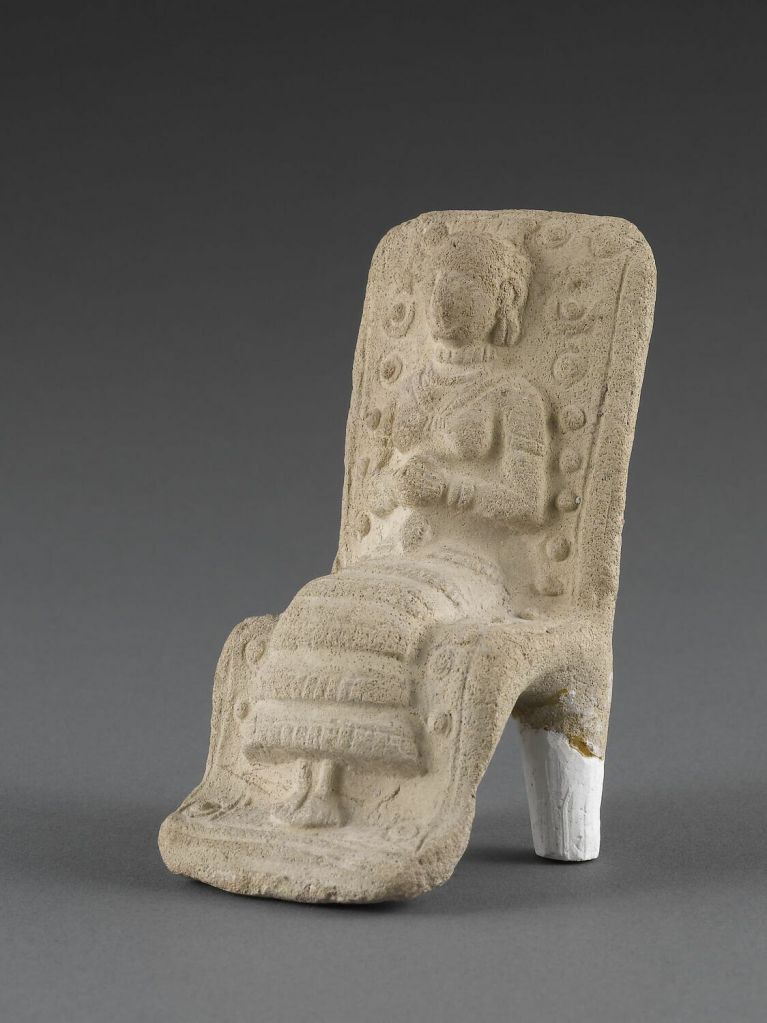
The Fall of the Gagûm into Oblivion
After the fall of the Old Babylonian kingdom, the gagûm and its nadîtums became an echo of the distant past. With time, the Mesopotamians themselves forgot what these girls were all about. In later Babylonian literature, strange and inaccurate associations with promiscuity and prostitution emerged. Biblical and later Greek stereotypes, which depicted the Mesopotamians as morally corrupt and prone to strange practices, further distorted the image. Ideas such as Herodotus’ sacred prostitution in Babylon clouded our judgement for centuries, even misleading the first researchers of the nadîtums in the modern era. Luckily, our understanding has grown tremendously over the past decades, laying bare an extraordinary group of women who navigated Mesopotamian society with significant autonomy, at times amassing great wealth. Their independence knew its limits, however. After their initiation, many remained very dependent on their male relatives for support. Some even struggled to make ends meet due to a lack of assistance. Furthermore, the overseers and administrative apparatus in control of the cloister were almost all men, further putting their perceived autonomy within the patriarchy into perspective. Nevertheless, these women continue to fascinate, presenting a rare example in Babylonian history of women getting a chance to carve out a living for themselves and make their own decisions.
Olivier Goossens
Bibliography
- Diakonoff, I., “Women in Old Babylonia not under Patriarchal Authority”, JESHO, Vol. 29, 1986, pp. 225-238.
- Harris, R., Ancient Sippar: A Demographic Study of an Old-Babylonian City: 1894-1595 BC, 1975, Istanbul.
- Launderville, D., Celibacy in the Ancient Near Eastern Law Collections Prior to the First Millennium BC, Piscataway, 2010.
- Nakata, I., “Economic Activities of nadītum-Women of Šamaš”, The Role of Women in Work and Society in the Ancient Near East, eds. B. Lion & C. Michel, 2016, Boston-Berlin, pp. 255-269.
- Podany, A., Weavers, Scribes and Kings: A New History of the Ancient Near East, 2022, New York.
- Roth, M., Law Collections from Mesopotamia and Asia Minor, 1997 (1995), Atlanta.
- Roth, M., “The Priestess, the Prostitute and the Tavern: LH §110”, Munuscula Mesopotamica: Festschrift für Johannes Renger, eds. B. Böck, E. Cančik-Kirschbaum & T. Richter, Münster, 1999, pp. 445-464.
- Stol, M., “Women in Mesopotamia”, JESHO, Vol. 38, 1995, pp. 123-144.
- Stol, M., Women in the Ancient Near East, 2016, Berlin-Boston.
- Stone, E., “The Social Role of the Nadītu Women in Old Babylonian Nippur”, JESHO, Vol. 25, 1982, pp. 50-70.
- Van Wyk, S., “Prostitute, Nun or ‘Man-Woman’: Revisiting the Position of the Old Babylonian NadiātuPriestesses”, Journal of Northwest Semitic Languages, Vol. 41, 2015, pp. 95-122.


Leave a Reply